Commercial Building Management Systems in Texas: The 2026 Engineering Guide

A building management system is not a hardware purchase; it's an engineered ecosystem where physical automation and digital intelligence converge. In the demanding climate of the Lone Star State, high-performance commercial building management systems Texas leaders invest in must do more than just toggle switches. You've likely felt the friction of fragmented platforms that refuse to communicate, or watched energy costs climb as you struggle to meet the 2021 IECC standards and the latest low-GWP refrigerant mandates. This lack of synergy doesn't just waste power; it creates an unnecessary burden for those seeking a single point of accountability.
We believe that true harmony in a building comes from meticulous planning and technical precision. This guide provides the engineering blueprint to unify HVAC, lighting, and security into a single, responsive environment that slashes operational overhead while improving occupant retention. We'll examine the technical architecture required to future-proof your infrastructure and transform your facility from a collection of disparate parts into a cohesive, intelligent asset.
Key Takeaways
- Understand how modern commercial building management systems Texas owners utilize serve as a central nervous system, moving beyond basic HVAC control to unified IoT intelligence.
- Identify the essential engineering requirements for enterprise-grade networking that supports a resilient and high-performance automation roadmap.
- Learn why open protocols like BACnet and Modbus are critical for eliminating system friction and maximizing the long-term return on your infrastructure investment.
- Master the methodical implementation lifecycle, from the initial discovery phase to final commissioning, ensuring every technical detail aligns with your business objectives.
- Establish criteria for selecting a strategic integrator in the Texas Triangle who understands the specific nuances of local energy markets and building codes.
The Evolution of Commercial Building Management Systems in Texas
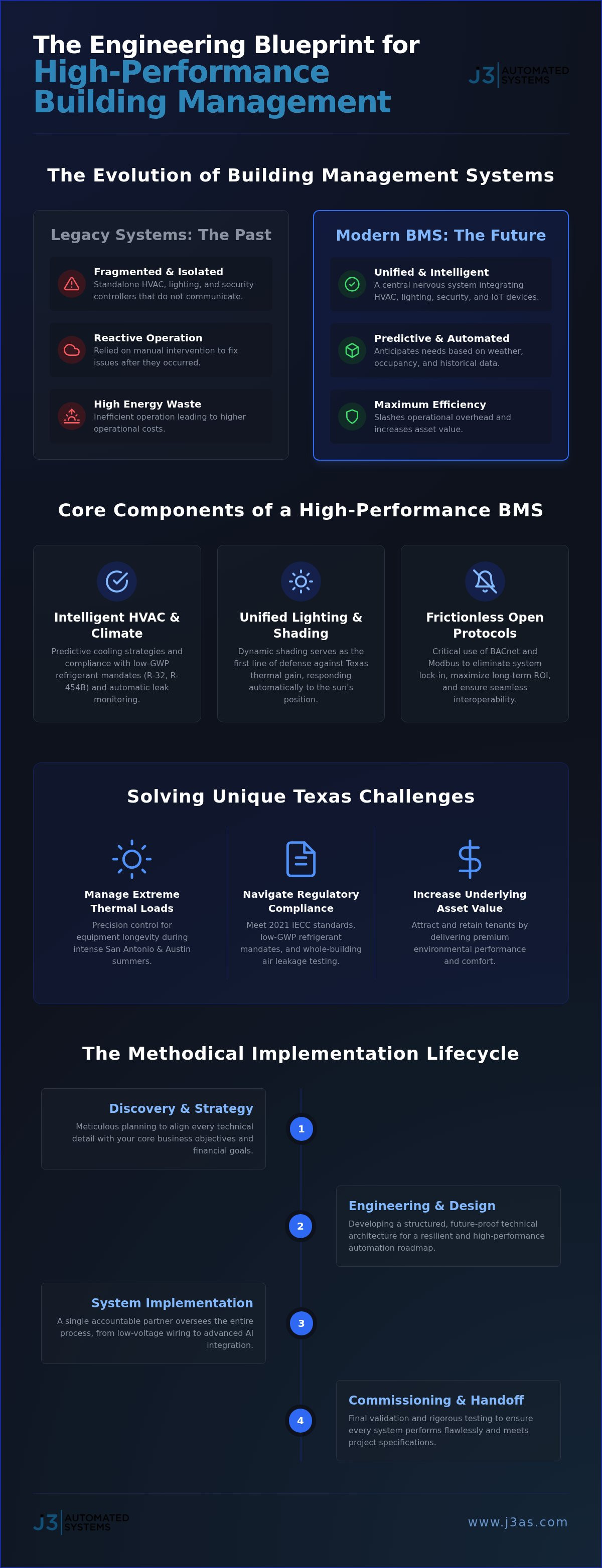
Modern commercial building management systems Texas developers now deploy represent a radical departure from the static hardware of previous decades. In the past, facility managers wrestled with standalone HVAC controllers and isolated lighting panels that rarely shared data. These legacy systems were reactive, relying on manual intervention to solve friction in the building's operation. Today, the industry has transitioned toward Building automation systems (BAS) that function as a central nervous system, unifying disparate components into a singular, intelligent ecosystem.
This evolution isn't just about convenience; it's a response to growing complexity. Intelligent automation replaces the fragmented approach of old building controls with a holistic architecture. By integrating HVAC, lighting, and security, engineers can now create a fluid environment where systems anticipate needs rather than just responding to failures. This shift from simple hardware to digital intelligence defines the modern standard for high-performance Texas facilities.
Why Texas Commercial Properties Require Intelligent Automation
The extreme thermal loads of San Antonio and Austin summers create a unique engineering challenge that standard equipment cannot solve alone. It's common for cooling systems to work at peak capacity for months, making precision control vital for equipment longevity. Beyond comfort, the regulatory landscape has tightened. As of 2026, the adoption of the 2021 International Energy Conservation Code (IECC) and new low-Global Warming Potential (GWP) refrigerant mandates for systems like R-32 have raised the bar for compliance. In cities like Austin, where whole-building air leakage testing is mandatory, automation ensures the building envelope and mechanical systems work in perfect synchronization. These intelligent systems don't just reduce energy waste; they increase the underlying asset value in a competitive market where tenants expect premium environmental performance.
The Intersection of Physical Spaces and Digital Workflows
Engineering excellence in 2026 focuses on how software integration enhances physical environments. We've moved beyond the era of simple hardware retail. The new priority is creating a seamless bridge between mechanical hardware and digital business tools. This requires a single accountable engineering partner who can oversee the entire implementation lifecycle, from low-voltage wiring to custom AI integration. When engineered correctly, a unified BMS is a strategic operational asset that bridges the gap between mechanical performance and financial predictability. By removing the friction of manual administration, these systems allow owners to focus on growth rather than maintenance, ensuring the facility remains resilient for years to come.
Engineering Efficiency: Core Components of a High-Performance BMS
Engineering a high-performance commercial building management systems Texas environment requires a departure from the "set it and forget it" mentality. It's a structured roadmap where every component is intentionally selected to remove friction. By treating the facility as a unified organism, owners achieve a level of efficiency that standalone controllers simply can't match. This approach relies on modern digital technologies in building automation to bridge the gap between mechanical hardware and digital oversight.
Intelligent HVAC and Climate Optimization
Precision airflow management is the foundation of a healthy indoor environment. In 2026, Texas facilities must adapt to new HVAC refrigerant regulations, including the mandatory transition to low-Global Warming Potential (GWP) refrigerants like R-32 and R-454B. High-performance systems now include automatic leak monitoring for larger equipment, ensuring compliance with reduced allowable leak thresholds. Beyond compliance, intelligent systems use predictive cooling strategies. By analyzing local weather patterns and occupancy data, the system pre-cools the building before the San Antonio or Austin sun reaches its peak, significantly reducing the strain on the electrical grid.
Unified Lighting and Automated Shading
Automated shading serves as the first line of defense against Texas thermal gain. When window treatments are integrated into the BMS, they respond dynamically to the sun's position, blocking heat before it enters the space. We often integrate Lutron and Ketra systems to create high-end architectural environments that prioritize both aesthetics and energy savings. Natural light harvesting sensors detect when sunlight is sufficient to illuminate a room, automatically dimming electric lights to reduce the load. This synergy between physical shades and digital dimming creates a polished, effortless atmosphere for occupants.
Secure Networking: The Invisible Backbone
A resilient automation system is only as strong as the network supporting it. The same high performance residential networking principles used in elite estates apply to commercial facilities. You need a robust, hardwired infrastructure capable of supporting hundreds of IoT devices without latency. Security is equally critical; IoT-enabled building management requires sophisticated cybersecurity protocols to protect sensitive operational data. When you're ready to move beyond fragmented hardware, focus on engineering a resilient automation strategy that secures your long term investment.
Intelligent Surveillance and Access Control
Modern security isn't just about cameras; it's about intelligent data integration. Access control systems now communicate with the HVAC and lighting pillars to identify which zones are occupied. If a tenant badges into an office suite, the BMS immediately adjusts the climate and lighting for that specific area. This level of coordination ensures that security protocols and energy efficiency goals work in tandem rather than in isolation.
Interoperability and the ROI of Integrated Automation Ecosystems
Longevity in building engineering isn't accidental; it's a byproduct of open standards. For a facility to remain resilient, its internal components must communicate across a unified language. This is why open protocols like BACnet and Modbus are essential for any sophisticated infrastructure. They prevent the technical debt associated with proprietary "walled gardens," ensuring that your investment remains flexible as new technologies emerge. By prioritizing interoperability, you eliminate the friction of siloed data and create a foundation for true intelligence.
The real return on investment often hides in the removal of manual administrative burdens. When systems talk to each other, they generate a wealth of telemetry that can be harnessed through ai business process automation. Instead of facility managers manually checking logs, AI identifies subtle anomalies in energy consumption or mechanical vibration. This synergy between physical telemetry and digital intelligence transforms a building from a cost center into a high-performance operational asset.
Eliminating Operational Friction with Custom Software
Visualizing complex facility data requires more than a generic dashboard. We utilize custom web app development San Antonio to build bespoke internal tools that map directly to your specific business goals. These applications serve as a digital backbone, allowing your team to monitor real-time sensor triggers and automate maintenance ticketing. By removing the need for manual data entry, you reduce human error and ensure that your staff focuses on high-value tasks rather than administrative troubleshooting.
The Financial Impact of Predictive Maintenance
Predictive maintenance is the ultimate hedge against unforecasted capital expenditures. By employing intelligent load balancing across your HVAC and lighting arrays, you extend the operational life of expensive hardware. The system identifies component failures before they occur, allowing for scheduled repairs rather than emergency replacements during a Texas heatwave. This methodical approach to commercial building management systems Texas owners trust provides a clear path to financial predictability. You aren't just saving on energy; you're protecting the long-term integrity of the building’s core mechanical systems.
Navigating the Implementation Lifecycle: From Discovery to Commissioning
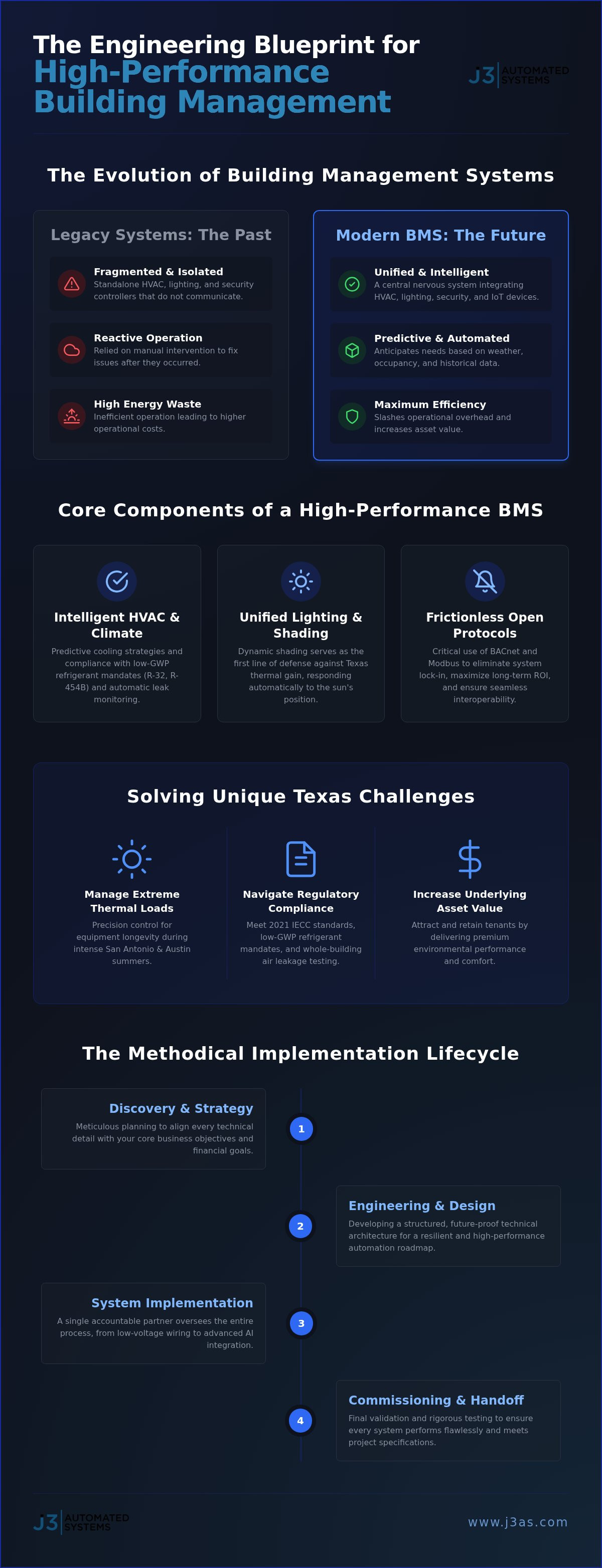
Successful implementation of commercial building management systems Texas owners invest in is not merely a matter of installation; it is a process of orchestration. Many providers treat automation as a series of disconnected hardware purchases, leaving the owner to manage the friction between different vendors. We advocate for a single accountable team model where engineering, software integration, and physical installation are managed under one philosophy. This methodical progression ensures that the initial vision for the facility is exactly what is delivered at the final commissioning stage.
Phase 1: Discovery and Strategic Mapping
The lifecycle begins with an exhaustive discovery phase designed to map business goals to technical requirements. We identify the specific operational pressures of your Texas facility, such as the high occupancy cooling demands in San Antonio or the strict energy mandates in Austin. By auditing existing infrastructure for integration potential, we establish a long-term technology roadmap. This strategic planning prevents the common pitfall of technical obsolescence, ensuring your building remains an intelligent asset for the next decade.
Phase 2: Engineering and Hardware Integration
Moving from strategy to execution requires technical precision. We design the low-voltage wiring and network topology to support a resilient ecosystem of sensors and controllers. This phase involves tight coordination with architects and mechanical contractors to ensure a clean, unobtrusive installation. It is during this stage that we ensure your commercial security system design Texas requirements are fully integrated into the building's flow. By unifying security with HVAC and lighting at the hardware level, we remove the silos that often plague modern facilities.
Phase 3: Tuning and White-Glove Support
The final step is commissioning, which is where the system is tuned for peak performance. We customize user interfaces to make complex building telemetry simple and intuitive for your team to manage. This white-glove approach includes comprehensive staff training and ongoing system optimization to ensure the building operates as engineered. Our commitment doesn't end at installation; we transition into a long-term partnership to maintain the system's integrity. To begin engineering your facility's transformation, contact our expert integration team today.
By following this structured lifecycle, you replace the burden of managing fragmented systems with the calm reliability of an engineered environment. This process transforms a collection of equipment into a high-performance ecosystem that responds effortlessly to your operational needs.
Selecting a Strategic Automation Partner in the Texas Triangle
Choosing a strategic partner for the commercial building management systems Texas leaders rely on involves more than a simple price comparison. It requires a deep evaluation of technical rigor and long-term operational accountability. Many firms operate as volume-driven equipment resellers, yet a true integrator serves as a high-level consultant who sees the hidden connections between disparate systems. In the Texas Triangle, where building codes and energy markets vary significantly between San Antonio and Austin, you need a partner who understands the nuances of the 2021 IECC and local utility mandates. J3 Automated Systems serves as a visionary steward of your facility, simplifying the intersection of physical infrastructure and digital oversight for serious commercial clients.
The Importance of Local Service and Accountability
Local expertise is a fundamental requirement for system resilience. When critical climate or security systems encounter friction, rapid response times from a local team prevent minor issues from becoming major liabilities. We focus on the specific operational needs of Boerne, New Braunfels, and San Marcos, ensuring our engineering team remains accessible for high-touch service. Understanding the Central Texas power grid and regional environmental stressors allows us to tune systems for maximum reliability during peak summer loads. A single accountable team eliminates the administrative burden of managing multiple vendors, providing a unified point of contact for every technical detail from low-voltage wiring to custom AI integration.
Future-Proofing Your Commercial Investment
A sophisticated automation roadmap must account for future scalability. We design systems that grow with your business, ensuring that your initial investment remains relevant as technology evolves. This forward-thinking approach often involves applying the precision of luxury home audio solutions to executive suites and high-end conference environments, creating a polished atmosphere that reflects your brand's prestige. By integrating AV, networking, and building controls into a singular, intelligent ecosystem, you create a seamless experience for both staff and stakeholders.
Engineering a high-performance building is a journey from fragmentation to harmony. It requires a partner who values precision, understands the local landscape, and takes full responsibility for the final result. To transform your facility into an intelligent, high-performance asset, contact J3 Automated Systems for a comprehensive consultation on your custom automation roadmap.
Engineering Your Facility’s Future
Transitioning from fragmented hardware to a unified ecosystem is no longer a luxury; it's a requirement for operational resilience. By integrating HVAC, lighting, and security under a single protocol, you remove the friction that drives up costs and degrades occupant comfort. Modern commercial building management systems Texas owners deploy must be designed with the technical rigor of an engineered roadmap rather than a simple collection of standalone products.
J3 Automated Systems provides a single accountable team for engineering and installation, bringing Central Texas local expertise to San Antonio, Austin, and Boerne. We specialize in the high-end integration of physical and digital systems, ensuring your infrastructure remains as intelligent as it is reliable. Our methodical approach simplifies the most complex technical challenges, allowing you to focus on your core business while we steward your facility's performance. Partner with J3 Automated Systems for Your Commercial Roadmap and transform your building into a masterpiece of technical harmony. The path to a more efficient, future-proof environment starts with a single, sophisticated vision.
Frequently Asked Questions
What is the primary difference between a BMS and building automation?
A Building Management System (BMS) serves as the centralized software interface that monitors and manages building equipment, while building automation refers to the hardware and programmed logic that executes tasks without manual intervention. Think of the BMS as the brain's executive function and automation as the nervous system's reflexes. Together, they create a cohesive environment that reduces operational friction and ensures your facility responds dynamically to environmental changes.
How much can a building management system save on energy costs in Texas?
Implementing the commercial building management systems Texas facilities require can lead to substantial reductions in energy consumption by optimizing HVAC and lighting loads. While exact savings vary based on building age and usage patterns, aligning with 2021 IECC standards and utilizing automated shading significantly lowers demand during peak summers. These systems eliminate the waste of cooling unoccupied spaces and provide the precision control necessary to meet tightening state energy regulations.
Can a BMS be retrofitted into an existing commercial building in San Antonio?
Retrofitting a sophisticated automation system into an existing San Antonio facility is entirely possible through a combination of wireless protocols and software overlays. We audit your current infrastructure to identify which legacy controllers can be integrated and which require replacement to meet modern efficiency standards. This architectural approach allows you to modernize your building's intelligence without the need for invasive structural changes, preserving the integrity of historic or established properties.
What are the benefits of integrating security and HVAC into one system?
Integrating security and HVAC into a single ecosystem allows for occupancy-based climate control that responds in real-time to badge-in events. When a tenant enters a specific zone, the system automatically adjusts the temperature and lighting to pre-set comfort levels. This synergy removes the burden of manual scheduling and ensures that energy is only consumed where people are actually present, enhancing both security oversight and operational efficiency through a unified data stream.
Do modern building management systems require a dedicated IT network?
High-performance building management systems perform best on a resilient, dedicated IT network that isolates automation traffic from general business data. This separation is critical for maintaining cybersecurity and ensuring that mission-critical controls, such as fire safety and HVAC, aren't affected by office bandwidth spikes. A dedicated infrastructure provides the invisible backbone necessary for hundreds of IoT sensors to communicate with zero latency, supporting a stable and reliable operational environment.
How long does a typical commercial BMS installation take in Texas?
The timeline for a commercial installation depends on the project's complexity and the building's scale, though we prioritize a methodical lifecycle from discovery to commissioning. New construction projects typically align with the general building schedule, while retrofits are planned to minimize disruption to daily business operations. By utilizing a single accountable team for both engineering and implementation, we streamline the process and eliminate the delays often caused by coordinating multiple independent vendors.
What is predictive maintenance in the context of building automation?
Predictive maintenance uses real-time telemetry and AI business process integration to identify mechanical anomalies before they lead to system failure. Instead of relying on a calendar-based service schedule, the system monitors vibration, pressure, and energy draw to forecast when a component needs attention. This proactive approach extends equipment life and prevents the emergency downtime that can be devastating during extreme heat events in the San Antonio and Austin regions.
Why should I choose a local Texas integrator over a national firm?
Choosing a local Texas integrator ensures your partner possesses deep expertise in the specific energy markets and building codes of the Texas Triangle. National firms often lack the granular knowledge of local utility rebate trends or the unique thermal load challenges of the Central Texas climate. A local team provides the rapid response times and white-glove accountability necessary for maintaining sophisticated systems in Boerne, New Braunfels, and the surrounding areas.