Commercial Security System Design in Texas: Engineering Intelligent Protection for Modern Facilities
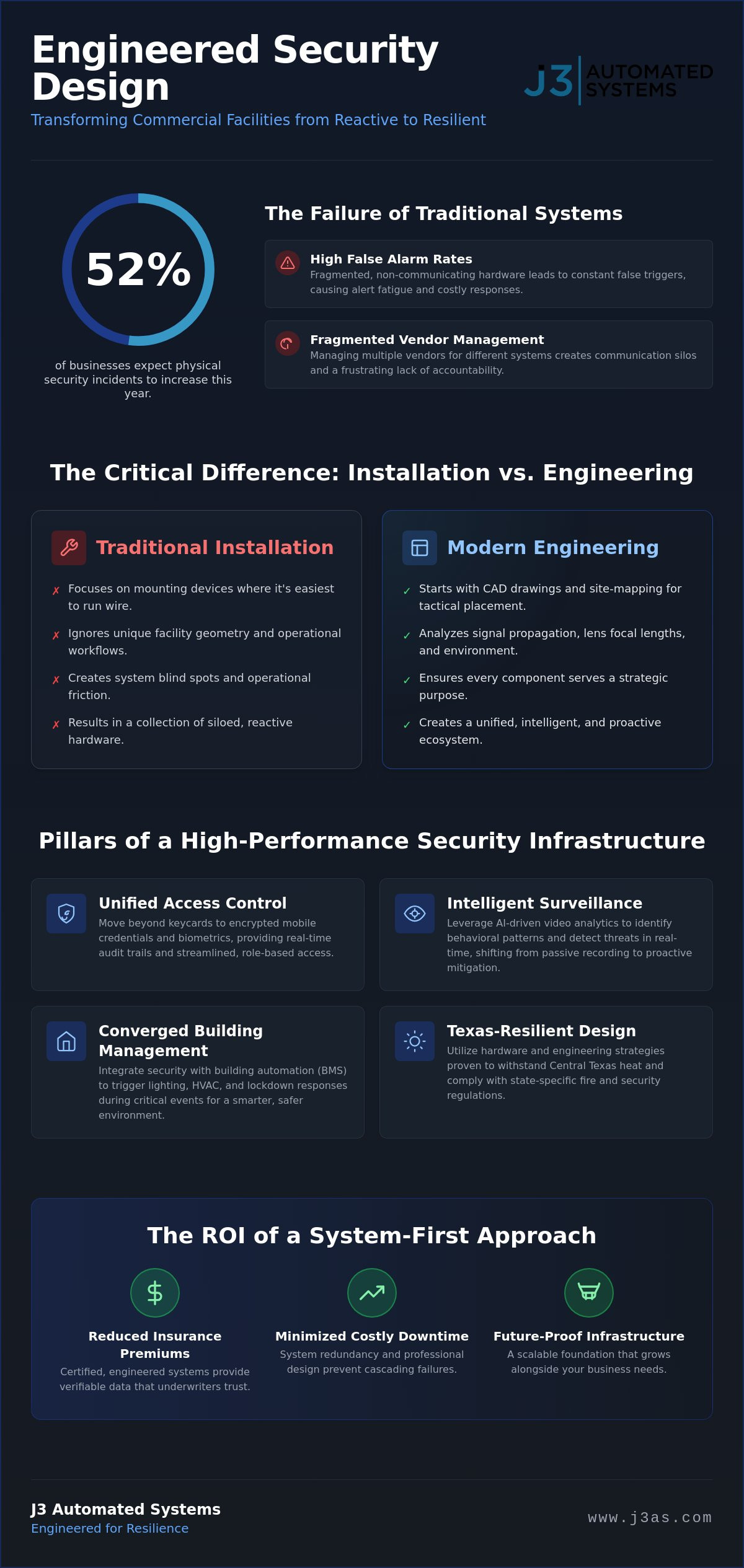
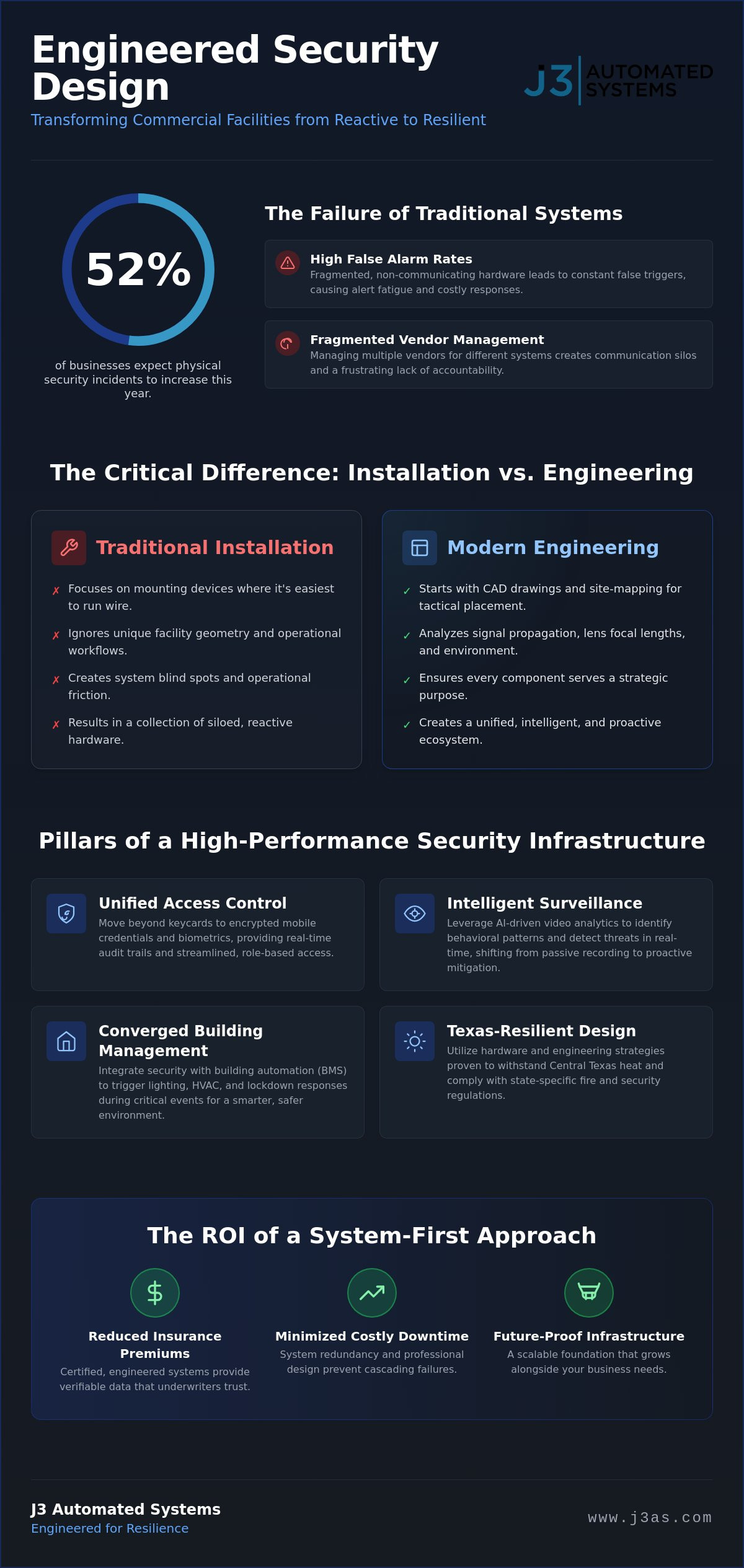
In a climate where 52% of businesses expect physical security incidents to increase this year, the traditional approach of mounting cameras and hoping for the best is no longer a viable strategy. True resilience requires a sophisticated approach to commercial security system design Texas facility managers can rely on to do more than just record events. It demands a transition from fragmented hardware to a unified, intelligent architecture that anticipates risks before they manifest.
You've likely felt the friction of managing multiple vendors and disparate systems that refuse to communicate. This lack of integration often leads to high false alarm rates and a frustrating absence of clear accountability when things go wrong. This article demonstrates how engineered security design transforms your facility from a simple monitored space into an intelligent, resilient environment. We'll examine the shift toward converged building management, the role of AI in proactive threat detection, and how a single point of contact creates a future-proof infrastructure that improves operational efficiency alongside safety.
Key Takeaways
- Learn why a custom engineering approach outclasses off-the-shelf security bundles by addressing specific facility floorplans and unique operational requirements.
- Explore the transition from simple keycards to unified biometric access and AI-driven video analytics that identify behavioral patterns in real time.
- Understand how professional commercial security system design Texas integrates surveillance with building automation to trigger lighting and HVAC responses during critical events.
- Discover the essential Texas-specific fire codes and environmental engineering required to keep high-end security hardware resilient against Central Texas heat.
- Gain insight into the J3 Roadmap, a process that provides a single accountable team for the entire lifecycle of complex automation and security projects.
Beyond Basic Surveillance: The Strategic Value of Engineered Security Design
Security is not a commodity you buy in a box; it's a foundational architectural requirement. For high-stakes environments, the traditional model of mounting cameras and connecting sensors is insufficient. True protection requires a shift from reactive monitoring to proactive, intelligent threat mitigation. This evolution begins with commercial security system design Texas facilities deserve, which treats every sensor, lock, and lens as a node within a unified, intelligent ecosystem. When security is engineered rather than simply installed, it moves beyond a cost center and becomes a driver of operational continuity.
Off-the-shelf commercial bundles frequently fail because they ignore the unique geometry and operational flow of a specific facility. A warehouse in San Antonio has different thermal and line-of-sight requirements than a high-rise in Austin. Generic systems create blind spots, trigger high rates of false alarms, and introduce friction into daily workflows. Professional design replaces this guesswork with a holistic strategy that reduces long-term maintenance costs and eliminates the burden of managing fragmented, siloed hardware; for instance, specialized equestrian properties often require dedicated systems like BovEquine to ensure foaling and horse health are monitored with the same architectural precision as the rest of the facility.
The Difference Between Installation and Engineering
A "truck-and-ladder" installer focuses on mounting devices where it's easiest to run wire. A system designer, however, starts with CAD drawings and site-mapping to ensure every component serves a tactical purpose. This meticulous planning involves calculating lens focal lengths, analyzing wireless signal propagation, and ensuring hardware longevity through precise environmental placement. By using sophisticated Physical Security Information Management (PSIM) principles, engineers create a single interface where disparate technologies speak a common language. This level of precision ensures that your infrastructure remains resilient against both physical intrusions and digital vulnerabilities.
The ROI of a System-First Approach
Investing in professional commercial security system design Texas helps owners realize significant financial returns through risk reduction. Certified, engineered systems often qualify for reduced insurance premiums because they provide verifiable, high-fidelity data that underwriters trust. Beyond insurance, this approach minimizes costly downtime by eliminating the "cascading failures" common in fragmented systems. When one component fails in a professionally designed network, the system's inherent redundancy keeps the facility protected. Security engineering is the intersection of physical safety and digital intelligence. By prioritizing this intersection, businesses move away from the frustration of outdated hardware and toward a future-proof environment that scales alongside their growth.
The Pillars of High-Performance Security Infrastructure
High-performance security infrastructure rests on a foundation of interconnected technologies. While many vendors sell individual components as standalone fixes, commercial security system design Texas leaders prioritize the synergy between these pillars. It starts with a resilient, enterprise-grade network backbone. Without this digital foundation, even the most advanced AI cameras or biometric readers become liabilities prone to latency and failure. True engineering ensures that the data flowing from your perimeter to your command center is both instantaneous and secure; for many Texas businesses, this includes integrating managed IT support from SpaceCenter Systems to maintain the integrity of that network.
Access Control and Identity Management
Modern identity management has moved far beyond the physical keycard. We now engineer unified access control systems that utilize encrypted mobile credentials and biometric verification to eliminate the risk of lost or cloned fobs. These systems integrate directly with visitor management and employee logs, providing a real-time audit trail that satisfies rigorous Texas Private Security regulations. For multi-site businesses, cloud-based credentials allow administrators to manage permissions across several Austin or San Antonio locations from a single, secure dashboard. This role-based approach doesn't just improve safety; it streamlines operational efficiency by ensuring people have access only to the areas they need, exactly when they need them.
Surveillance as a Business Intelligence Tool
Surveillance is no longer a passive record of what already happened. Intelligent video systems now utilize AI for object recognition and behavioral analytics to flag anomalies before an incident occurs. These high-fidelity imaging tools provide forensic-grade evidence essential for liability claims, but their value extends into business intelligence. By analyzing heat mapping and occupancy data, facility managers can optimize floor plans and staffing levels based on actual traffic patterns. This convergence of security and data science is a hallmark of sophisticated commercial security system design Texas projects. In high-end residential estates, we often apply the same precision found in cinema-grade home theater design to ensure surveillance interfaces are as intuitive as they are powerful.
Intrusion detection completes the ecosystem with multi-layered perimeter protection. We tailor these sensors to specific Texas facility types, ensuring that vibrations, glass breaks, or unauthorized movements are detected with surgical accuracy. This layered defense creates a ring of protection that keeps threats at the edge of the property rather than inside your lobby. For those seeking to unify these disparate pillars into a single, accountable infrastructure, a consultation with an expert systems integrator is the first step toward true resilience.
Converged Systems: Integrating Security with Building Management (BMS)
Security should never exist as an isolated silo. In a truly modern facility, your protection layer functions as an integral part of the building’s nervous system. Sophisticated commercial security system design Texas projects now bridge the gap between physical safety and operational intelligence by unifying security hardware with commercial building management systems Texas owners use to run their day-to-day operations. This convergence allows for a level of automation that transforms a passive building into a responsive environment. When your access control system knows the building is empty, it shouldn't just lock the doors; it should communicate with the HVAC and lighting systems to enter an energy-saving state.
This integration relies on adherence to rigorous Security Industry Association (SIA) standards for interoperability. By following these frameworks, we ensure that different hardware languages translate into a single, cohesive dialogue. Linking occupancy sensors to climate control does more than just lower utility bills. It provides a granular view of facility usage that helps stakeholders identify underutilized spaces. Custom software dashboards then visualize this data in real time, giving you a comprehensive map of your facility’s health and security status on one screen.
Automated Response Protocols
The true power of convergence lies in "If-This-Then-That" logic. We design automated response protocols that remove the need for human intervention during high-stress events. For example, a fire alarm trigger can be engineered to automatically release specific access control locks for safe egress while simultaneously turning on all interior lighting and raising automated shades to provide first responders with clear lines of sight. During off-hours, these same systems can simulate occupancy by varying lighting patterns, creating a psychological deterrent that goes beyond what a simple camera can offer. This level of commercial security system design Texas ensures that your facility is working for you even when no one is on-site.
The Single-Pane-of-Glass Experience
Managing a complex facility shouldn't lead to "app fatigue." We eliminate the friction of toggling between disparate platforms by creating a single-pane-of-glass experience. Through custom web app development, we centralize security reporting, environmental controls, and maintenance alerts into a unified interface. To ensure the hardware running these critical systems stays in peak condition, you can check out We Fix PC Laptop for expert computer repair services. AI plays a critical role here, filtering out the "noise" of thousands of daily data points to present only actionable insights. This architectural approach ensures that your team isn't buried in notifications but is instead empowered by a clear, prioritized view of what requires their attention.
Navigating the Texas Commercial Security Landscape
Operating in Texas presents a distinct set of challenges that national, one-size-fits-all security providers often overlook. From the specific regulatory requirements of the Department of Public Safety to the brutal thermal demands of the Central Texas climate, commercial security system design Texas requires a localized engineering perspective. Success in this landscape isn't just about selecting the right hardware; it's about ensuring that hardware remains compliant, resilient, and scalable as the Texas economy continues its rapid expansion.
A sophisticated design must account for the state's multi-layered regulatory environment. While state-level licensing sets the baseline, local jurisdictions in the San Antonio and Austin corridor often adopt specific versions of the International Building Code (IBC) and International Fire Code (IFC). As of 2026, many Texas municipalities have transitioned to the 2024 IBC and IFC standards. Adhering to these local Texas codes is a non-negotiable prerequisite for obtaining commercial permits and ensuring long-term liability protection. Furthermore, any project with a construction cost of $50,000 or more must strictly comply with the Texas Accessibility Standards (TAS), which impacts the placement and operation of automated entry systems.
Compliance and Regulatory Standards
Meeting Texas Department of Public Safety (DPS) licensing requirements is the first step in establishing an accountable security posture. Every engineer and installer on your property must be vetted through the Private Security Bureau to ensure they meet the state's rigorous background and training benchmarks. Beyond simple licensing, we focus on the intersection of security and the Americans with Disabilities Act (ADA). We engineer automated exit and entry points, including custom driveway gates and automatic gate installation, that provide seamless access for all individuals while maintaining a hardened perimeter. This attention to detail ensures your facility remains both welcoming and impenetrable.
Geographic Considerations for Central Texas
The environmental reality of Central Texas is a primary factor in hardware longevity. In high-heat environments like San Antonio and New Braunfels, standard outdoor enclosures can become ovens that degrade internal circuitry. We engineer thermal management strategies into our commercial security system design Texas projects, utilizing specialized cooling and UV-resistant materials to protect your investment. For rural Texas estates or satellite facilities where traditional cabling is impractical, we deploy resilient networking solutions that bridge the gap between remote locations and your central command center. This geographic expertise ensures that your protection remains consistent, regardless of your facility's location or the summer's peak temperatures; similarly, maintaining the physical exterior of your property through services from jbmcustomcontracting.com helps ensure long-term structural resilience against the local climate.
Secure your facility with an engineering team that deeply understands the local regulatory and environmental landscape by partnering with J3 Automated Systems for your next project.
Partnering with J3 Automated Systems for Bespoke Security Engineering
Complex infrastructure requires more than a vendor; it requires a steward. J3 Automated Systems approaches commercial security system design Texas through the lens of high-level consultancy, acting as a visionary integrator for projects that demand absolute precision. We replace the fragmented chaos of managing multiple contractors with a single, accountable team responsible for the entire lifecycle of your system. This white-glove approach ensures that every component, from AI-driven analytics to automated building controls, functions in perfect harmony under one unified philosophy.
Our methodology is rooted in intellectual rigor and technical authority. We don't just sell hardware; we engineer an environment where complexity is simplified for the end-user. By managing the hidden connections between your digital processes and physical security, we remove the burden of system management from your shoulders. This allows you to focus on your operations while we maintain the integrity of your facility’s protection in San Antonio, Austin, and the surrounding regions.
The Discovery and Mapping Process
Every project begins with an exhaustive discovery phase where we identify hidden vulnerabilities within your current facility flow. We look beyond obvious entry points, analyzing how data moves through your network and how personnel navigate your space. This results in a tailored technology roadmap that aligns with your long-term business goals rather than just meeting immediate needs. The process concludes with meticulous tuning and commissioning, a critical stage where we stress-test every trigger and sensor. This ensures a zero-friction handoff, where the system is fully optimized and intuitive from the moment you take control.
Long-Term Support and Evolution
A truly intelligent system is never static. As AI and automation technologies advance, your security infrastructure must evolve to stay ahead of emerging threats. We provide ongoing system optimization and software updates that keep your hardware at the peak of its capability. This continuous innovation cycle ensures your investment remains future-proof, adapting as your business grows or as new regulatory standards emerge in the commercial security system design Texas landscape. We act as your dedicated partner in this evolution, providing the technical expertise needed to navigate a rapidly changing technological world.
To begin engineering a more resilient and intelligent environment for your facility, schedule a consultation with J3 Automated Systems today.
Elevating Your Facility’s Intelligence and Resilience
Modern facility management requires a fundamental shift from viewing security as a collection of hardware to seeing it as a unified, intelligent ecosystem. By prioritizing an engineering-first philosophy, you eliminate the friction of fragmented systems and gain a resilient infrastructure that anticipates threats rather than just recording them. We've explored how integrating surveillance with building automation creates a responsive environment that scales with your growth while meeting the specific regulatory and environmental demands of the San Antonio and Austin corridor.
True protection is achieved through meticulous planning and a deep understanding of the hidden connections between physical safety and digital intelligence. This level of sophisticated commercial security system design Texas facility owners require is best realized through a partnership that values long-term functionality over quick fixes. Our single accountable team provides the intellectual rigor and Texas-based expertise needed to transform your high-end property into a masterwork of complexity and ease.
Take the first step toward a harmonious and secure future for your facility. Partner with J3 for your next Texas security engineering project and experience the clarity of bespoke engineering. Your path to a more intelligent, effortless operation begins with a single conversation.
Frequently Asked Questions
What is the difference between an alarm company and a security system design firm?
A security system design firm provides architectural engineering and holistic integration, whereas a traditional alarm company typically focuses on hardware installation and monthly monitoring. Design firms act as high-level consultants who map out how security interacts with your building's automation and networking. This approach ensures your infrastructure is bespoke and scalable, rather than a generic solution that fails to address specific facility vulnerabilities.
Can my existing commercial security cameras be integrated into a new BMS?
Existing cameras can often be integrated into a new Building Management System (BMS) provided they support industry-standard protocols like ONVIF. We analyze your current hardware to determine if it meets the fidelity and communication requirements for high-level automation. If compatible, we bridge these legacy devices with modern software dashboards to centralize your facility oversight without requiring a complete hardware overhaul.
What are the specific licensing requirements for commercial security in Texas?
All companies providing security services must be licensed by the Texas Department of Public Safety (DPS) Private Security Bureau. This includes specific business licenses and individual registrations for every designer and installer on your property. Ensuring your partner meets these state benchmarks is critical for commercial security system design Texas projects, as it guarantees adherence to the Texas Occupations Code and local building safety regulations.
How does AI improve commercial security system performance?
AI transforms security from a passive recording tool into a proactive threat detection system through behavioral analytics and object recognition. Instead of simply capturing footage, AI-enabled systems identify anomalies such as unauthorized loitering or perimeter breaches in real time. This filtered data allows security teams to respond to actual incidents while significantly reducing the burden of false alarms caused by environmental noise.
Is cloud-based access control more secure than on-premise systems?
Cloud-based access control offers superior scalability and remote management capabilities compared to traditional on-premise servers. It eliminates the single point of failure inherent in local hardware and provides automated security patches to defend against digital vulnerabilities. For multi-site businesses in Texas, the cloud allows for instantaneous credential updates across all locations, ensuring your identity management remains fluid and resilient.
How much does a custom commercial security design cost in San Antonio?
The cost of a bespoke security design in San Antonio depends on the facility's scale, the complexity of integration with existing systems, and specific hardware requirements. Factors such as the number of access points, the depth of AI analytics required, and the level of building automation integration all influence the final investment. We provide project-based engineering that prioritizes long-term ROI and operational efficiency over low-cost, short-term fixes.
How long does the engineering and installation process typically take?
The timeline for engineering and installation varies based on project scope, typically moving from an initial discovery phase to final commissioning over several weeks or months. Large-scale commercial projects require a methodical roadmap that includes site mapping, CAD design, and rigorous system tuning. Our single accountable team manages every milestone to ensure the project stays on schedule while maintaining the highest standards of precision.
Can J3 integrate security with my existing lighting and HVAC systems?
J3 specializes in integrating security triggers with your existing lighting and HVAC systems to create a responsive building environment. We engineer protocols where security events, such as an after-hours breach, automatically trigger high-intensity lighting or specific climate responses. This convergence improves both safety and energy efficiency, transforming your facility into an intelligent ecosystem where all components work in harmony.