AI Business Process Automation: Engineering Intelligence into Modern Workflows

Does your technology stack feel like a collection of isolated islands or a single, high-performance engine? Most organizations view automation as a tool to be installed, yet the most successful enterprises treat it as an environment to be engineered. You've likely experienced the exhaustion of fragmented data and the rising operational costs that come from repetitive, manual labor. It's a common burden, often compounded by the fear that adopting ai business process automation means handing over control to an ungoverned "black box" that lacks transparency.
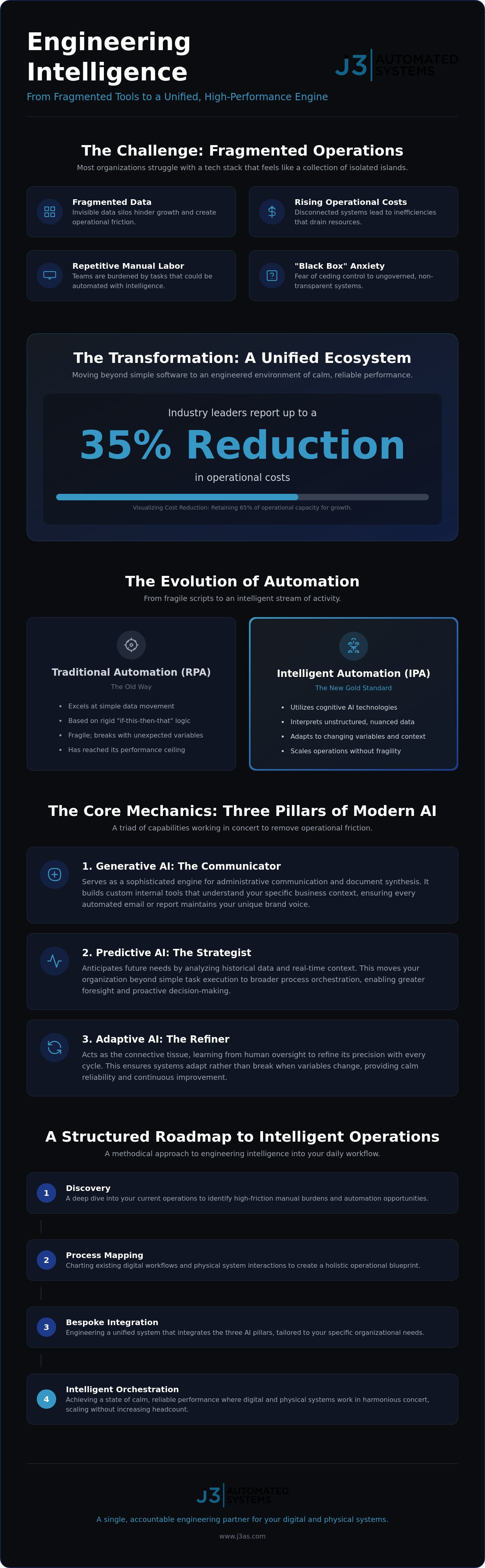
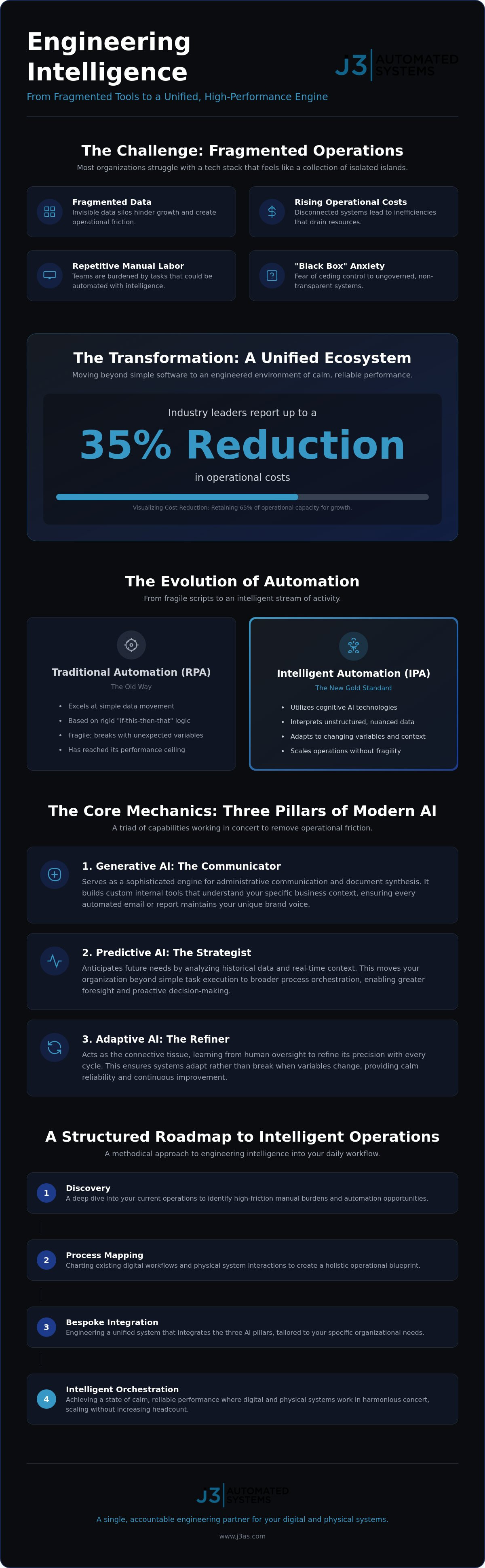
True intelligence doesn't just replace a task; it integrates your entire workflow. This article demonstrates how sophisticated automation transcends basic software to create a frictionless, unified environment for your organization. We'll explore how to achieve the 35% reduction in operational costs reported by industry leaders while bridging the gap between your physical building systems and digital tools. You'll discover a methodical approach to engineering intelligence into your daily operations, transforming complexity into a state of calm, reliable performance that scales without increasing headcount.
Key Takeaways
- Understand the evolution from simple software scripts to an engineered ecosystem where cognitive technology drives operational fluidity.
- Master the three pillars of modern intelligence, including generative, predictive, and adaptive models, to handle complex administrative communication and anticipate organizational needs.
- Transition from rigid, linear workflows to dynamic ai business process automation that orchestrates tasks and adapts when variables change.
- Follow a structured roadmap from discovery to process mapping to identify and eliminate high-friction manual burdens within your current operations.
- Learn the value of a unified approach that integrates physical building management with digital tools through a single, accountable engineering partner.
Defining AI Business Process Automation in 2026
Modern operational excellence is no longer about simply buying more software. It's about the convergence of cognitive technology and operational engineering. By 2026, ai business process automation has evolved into a standard that prioritizes frictionless workflows over simple task repetition. We've moved beyond the era of rigid logic into a period where systems learn and adapt to your specific organizational needs. This evolution requires a holistic perspective that treats digital workflows and physical environments as a single, unified ecosystem.
The shift from static "if-this-then-that" logic to adaptive systems marks a turning point for the modern enterprise. Traditional tools often break when faced with unexpected variables, requiring manual intervention that drains your team's energy. Modern automation thrives on these variables. It uses historical data and real-time context to make informed decisions, ensuring that your operations remain fluid regardless of external pressures. This architectural approach ensures that intelligence is woven into the very fabric of your workflow rather than being bolted on as an afterthought.
The Evolution from RPA to Intelligent Automation
For many growing organizations across the San Antonio and Austin corridors, traditional Robotic Process Automation (RPA) has reached its ceiling. RPA excels at moving data between spreadsheets, but it falters when faced with the nuance of human communication or variable decision-making. Intelligent Process Automation (IPA) represents the new gold standard for high-end operations. It utilizes cognitive technologies to interpret unstructured data, such as handwritten invoices or complex email inquiries, with surgical precision. This evolution allows your operations to scale without the fragility inherent in older, static scripts. It transforms a series of disconnected tasks into a purposeful, intelligent stream of activity.
The Business Value of a Unified Intelligence
Leadership teams often carry a heavy burden of complexity, managing a patchwork of disconnected software tools. This fragmentation creates high operational costs and invisible data silos that hinder growth. By integrating Business Process Automation (BPA) with advanced AI, you remove these barriers. The result is a streamlined environment where information flows effortlessly between departments. AI business process automation is an architectural approach to operational harmony that treats every digital and physical interaction as a coordinated component of a larger whole. This methodology ensures that as your business variables change, your systems adapt rather than break. It provides a level of calm reliability that standard off-the-shelf software simply cannot replicate, allowing you to focus on high-level strategy instead of administrative maintenance.
The Mechanics of Intelligent Systems: From Generative to Predictive Models
Engineering intelligence into a workflow requires a nuanced understanding of how different AI models interact. It isn't a monolithic block of code but a triad of capabilities: Generative, Predictive, and Adaptive AI. These three pillars form the foundation of modern ai business process automation, each serving a distinct role in removing operational friction. While Generative AI synthesizes information and handles communication, Predictive AI anticipates future needs. Adaptive systems act as the connective tissue, learning from human oversight to refine their precision with every completed cycle.
The transition from manual effort to intelligent orchestration relies on these models working in concert. According to Gartner's Market Guide for BPA, the most effective implementations are those that move beyond simple task execution to broader process orchestration. This ensures that your organization isn't just doing things faster, but doing them with greater foresight. When these systems are properly engineered, they eliminate the "black box" anxiety by providing clear, data-driven logic for every automated decision.
Generative AI in Administrative Workflows
Generative AI has moved far beyond simple chat interfaces. In a professional setting, it serves as a sophisticated engine for administrative communication and document synthesis. We use these models to build custom internal tools that understand your specific business context, ensuring that every automated email or internal report maintains your unique brand voice. Through meticulously engineered prompts, these systems handle the heavy lifting of drafting and summarizing, allowing your leadership team to focus on high-level approval rather than initial creation. This approach transforms administrative labor into a streamlined, governed process that scales effortlessly.
Predictive Analytics for Commercial Efficiency
The most significant breakthroughs occur when digital intelligence meets the physical environment. By connecting predictive models to commercial building management systems, organizations can anticipate resource needs before they become critical issues. These systems analyze patterns in energy usage, HVAC performance, and occupancy to proactively tune your facility for maximum efficiency. It's a shift from reactive maintenance to proactive optimization. For example, your automation might adjust climate controls based on predicted meeting schedules or optimize lighting based on real-time security data. If you're ready to bridge the gap between your physical and digital operations, exploring a bespoke automation strategy can reveal hidden efficiencies in your current infrastructure. This intersection of data and physical space ensures your facility operates with the same intelligence as your software.
Traditional Automation vs. AI-Driven Orchestration
Speed is often mistaken for efficiency. In the context of organizational growth, moving faster only helps if you aren't accelerating toward a bottleneck. Traditional automation typically relies on linear, rigid paths that perform admirably under perfect conditions but crumble when faced with real-world variability. AI business process automation represents a shift from these fragile scripts toward a dynamic, orchestrated ecosystem. It's the difference between a music box that plays a single preset tune and a conductor who adjusts the tempo and volume of an entire orchestra in real time.
Choosing to implement an engineered solution rather than simply buying a standalone tool is a commitment to long-term resilience. While foundational Business process automation focuses on the digitization of manual tasks, true orchestration manages the intelligence governing those tasks. This architectural approach ensures that your systems don't just execute work; they understand the context of that work, creating a unified narrative across your entire operation.
Static Workflows: The Limitation of Rigid Rules
Most organizations are familiar with "if-then" logic. It's the backbone of basic software triggers. However, this rigidity creates significant friction when exceptions occur. When a vendor changes an invoice format or a client sends an atypical request, these rigid systems often fail; this forces your team back into manual recovery mode. There is a hidden, compounding cost to maintaining thousands of these fragile automations. They require constant supervision and frequent repairs. Forward-thinking businesses in the San Antonio and Austin regions are moving away from these brittle frameworks in favor of resilient, engineered systems that can interpret nuance and handle exceptions without human intervention.
AI Orchestration: The Master of Complexity
Intelligent orchestration functions as a "digital twin" for your business processes, visualizing the flow of data and decisions with surgical precision. As a visionary integrator, AI connects fragmented software tools into a single, cohesive narrative. It sees the hidden connections between your procurement data, client communications, and physical building management. This level of ai business process automation allows you to build "white-glove" experiences for your clients. While the frontend remains simple and elegant, the backend operates with invisible, automated precision. It removes the administrative burden from your staff, allowing them to focus on high-value strategy while the system manages the complexity of daily operations. This isn't a quick fix for a single problem; it's a sophisticated investment in the future harmony of your organization.
Strategic Implementation: Mapping Your Automation Roadmap
Success in ai business process automation is not a matter of chance; it is the result of meticulous planning and architectural rigor. We begin every project with a Discovery Phase. This isn't a search for software, but a deep dive into the high-friction manual tasks that currently drain your organization's energy. By identifying where data stalls or where repetitive labor occurs, we can define the specific requirements for a more fluid operational environment. This stage is critical for ensuring that the final solution addresses the root causes of inefficiency rather than merely masking the symptoms.
Process Mapping follows this discovery, allowing us to visualize the flow of data and decisions across your entire organization. We treat your business as a single, integrated system. This perspective enables us to engineer bespoke web apps and internal tools that are tailored to your logic, ensuring that your technology serves your people. The final stage is commissioning and tuning. This is our "white-glove" approach to implementation, where we refine every interaction to ensure your systems work in perfect harmony. We don't just install tools; we engineer an ecosystem that grows with you.
Identifying the Right Processes for Automation
We evaluate potential automation targets based on three primary criteria: frequency, complexity, and the impact on the client experience. Starting with "low-hanging fruit," such as administrative data entry or document synthesis, allows your team to build momentum and see immediate relief from the burden of manual labor. This methodical approach scales beautifully, whether you're managing a commercial enterprise or overseeing integrated cinema-grade environments for luxury residential management. By automating the high-frequency, low-variance tasks first, you free up your most valuable assets to focus on the nuance and craftsmanship that define your brand.
The Role of Custom Software in Automation
Off-the-shelf SaaS products often fail to capture the unique nuances that give your business its competitive edge. They force you to adapt your workflows to their limitations, which creates new forms of friction. We believe in designing custom internal tools that act as a "single source of truth" for your team. These bespoke applications are built on a foundation of resilient networking, ensuring they have the high-performance infrastructure required for sophisticated AI processing. This tailored approach ensures that your ai business process automation remains a proprietary asset that supports your specific goals. If you're ready to move beyond generic tools, our team can help you engineer a custom automation roadmap that delivers long-term operational harmony.
Bespoke Integration: The J3 Approach to Intelligent Operations
J3 Automated Systems serves as the single accountable partner for your entire automation roadmap. While many providers focus exclusively on software, we recognize that true intelligence requires a bridge between your digital workflows and your physical environment. This holistic perspective ensures that your ai business process automation isn't an isolated tool but a central nervous system for your organization. We deliver professional engineering and installation for premier residential and commercial clients across Texas, moving beyond the industry hype to provide systems that prioritize long-term functionality and reliable performance. Our team manages the entire lifecycle of a project, from the initial architectural mapping to the final commissioning of your bespoke tools.
Engineering Harmony Across Physical and Digital Spaces
We bridge the gap between disparate systems, including professional AV, intelligent lighting, physical security, and custom AI business tools. Our "broad-to-narrow" philosophy allows us to see the overarching narrative of your business before executing the fine details of a specific integration. This ensures that every component serves a unified purpose. For instance, we've seen local small and medium-sized businesses achieve significant productivity gains by using customized AI tools to synthesize data from their physical building management systems into actionable administrative reports. This level of integration removes the friction that typically exists between how a building operates and how a business functions. It transforms your facility from a passive shell into an active participant in your company's success.
Serving the Texas Innovation Corridor
Organizations throughout the San Antonio and Austin corridors trust J3 because we offer a level of precision and intellectual rigor that faceless SaaS providers cannot match. In an era of generic, off-the-shelf products, the value of a local partner who understands the hidden connections between your systems is immeasurable. We act as dedicated stewards of your operational experience, combining technical expertise with a high-touch, service-first attitude. Our commitment doesn't end at implementation; we provide "white-glove" support to ensure your ecosystem remains fluid as your needs evolve. You don't have to manage the complexity of modern technology alone. Discover how J3 can engineer a frictionless operational future for your business and transform your daily workflows into a state of intelligent, effortless harmony.
Architecting a Future of Operational Harmony
The transition from fragmented manual tasks to an integrated, intelligent ecosystem is the hallmark of a resilient organization. You've seen how ai business process automation transcends simple software installation to become a foundational element of your operational architecture. By moving away from rigid, linear rules and embracing adaptive orchestration, you remove the administrative burden that hinders growth. This shift allows your team to focus on high-value strategy while your systems manage the complexity of daily data and physical building variables with surgical precision.
True operational fluidity requires a partner who understands the hidden connections between your digital tools and physical environments. J3 Automated Systems provides end-to-end engineering across the San Antonio and Austin corridors, ensuring your infrastructure is as intelligent as your workflows. Our single accountable team develops bespoke internal tools designed for your specific logic, bridging the gap between hardware and software. We invite you to partner with J3 to engineer your intelligent business roadmap and discover the calm reliability of a truly frictionless environment. Your journey toward effortless operation begins with a single, well-engineered step.
Frequently Asked Questions
What is the difference between AI and traditional business process automation?
Traditional automation relies on rigid, linear "if-then" logic that often fails when real-world variables change. In contrast, ai business process automation utilizes cognitive models to interpret unstructured data and adapt to new scenarios. It moves beyond simple task repetition to intelligent orchestration, allowing the system to handle nuance and exceptions that would typically require manual human intervention.
Can AI business process automation integrate with my existing software tools?
Intelligent automation is engineered specifically to serve as the connective tissue between your isolated software tools. We design custom internal tools and web apps that bridge the gap between fragmented systems, creating a single source of truth for your data. This architectural approach ensures that information flows seamlessly between your current platforms without requiring you to replace your entire technology stack.
How much does it cost to implement custom AI business automation in Texas?
Implementation costs are project-based and vary depending on the complexity of your organizational workflows and the scale of physical integration required. Factors such as the number of manual processes being engineered and the depth of building management system connectivity influence the final scope. We focus on delivering a high-return investment in resilience and operational harmony rather than a generic, recurring software subscription.
Is AI business process automation secure for sensitive client data?
Security is a foundational priority in our engineering process. We utilize private, governed models and resilient networking to ensure that sensitive client information remains protected and within your control. This methodology avoids the "black box" risks of public AI tools, providing a transparent and secure environment that complies with modern data governance standards.
What industries benefit most from AI-driven process orchestration?
Any industry burdened by high-friction administrative tasks or complex facility requirements will see significant benefits. This includes professional services, luxury residential property management, and commercial enterprises within the San Antonio and Austin innovation corridors. Organizations that need to scale their operations without proportionally increasing their administrative headcount find the most value in these engineered systems.
How long does a typical AI automation project take from discovery to commissioning?
The timeline for a project follows a methodical progression through discovery, process mapping, engineering, and final tuning. While the duration depends on the specific complexity of your operations, most organizations begin experiencing a state of intelligent, effortless operation within a few months. We ensure every system is meticulously commissioned to guarantee long-term functionality before the project is considered complete.
Do I need a technical team to manage AI-automated processes once they are installed?
You don't need a dedicated in-house technical team to oversee your automated workflows. We engineer our solutions to be autonomous and intuitive, removing the burden of technical maintenance from your leadership team. J3 serves as your single accountable partner, providing the "white-glove" support and professional stewardship required to keep your systems running at peak performance.
How does AI automation reduce commercial operating costs over the long term?
AI automation reduces costs by allowing your organization to increase its operational capacity without the need for additional headcount. It eliminates the compounding expenses associated with manual data entry errors and optimizes resource allocation within your physical facility. By removing repetitive administrative labor, you free your most valuable assets to focus on high-level strategy and revenue-generating activities.