Commercial Building Management Systems in Texas: The 2026 Engineering Guide

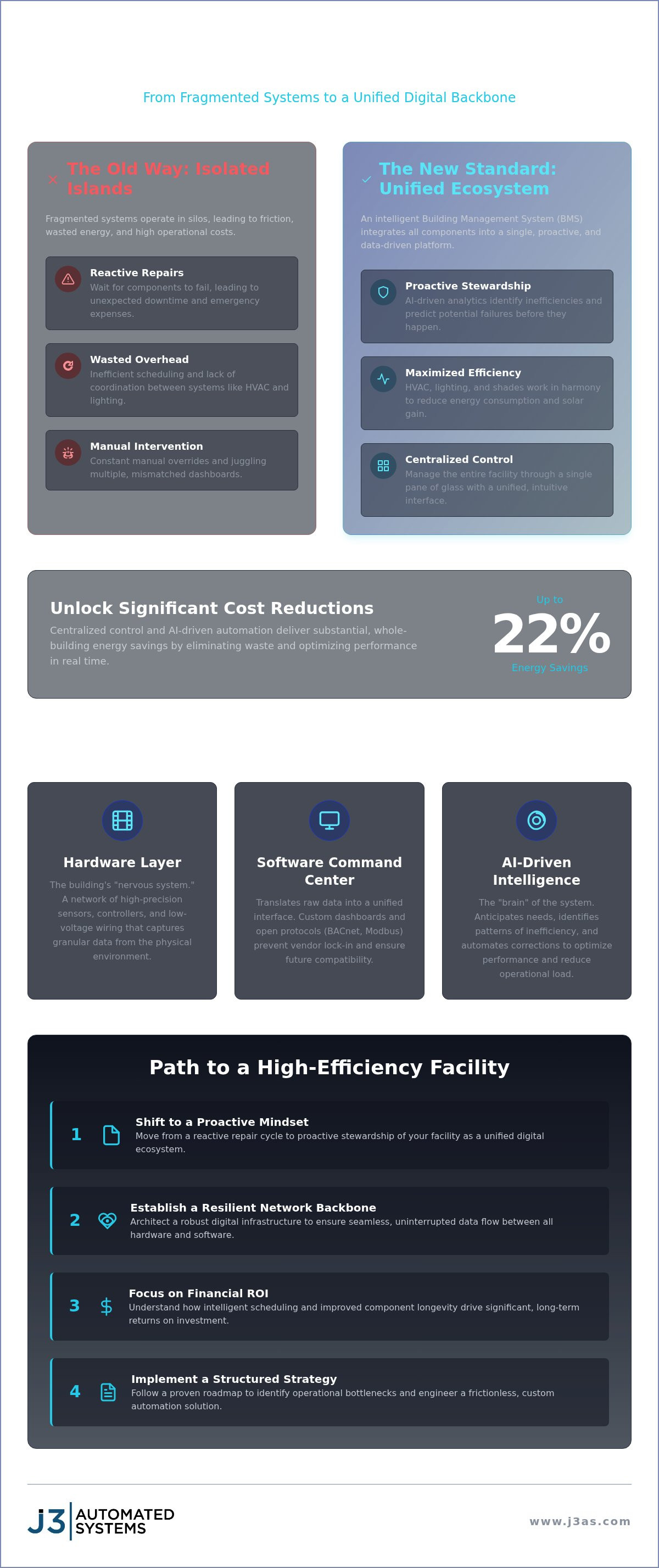
If your facility's systems operate as isolated islands of hardware, you're likely paying a premium for the resulting friction. In 2026, the standard for commercial building management systems Texas has shifted from simple climate control to a unified digital backbone that anticipates needs before they become expenses. It's exhausting to manage rising energy costs and reactive repairs while trying to maintain tenant satisfaction during an intense heat spike. You've likely realized that fragmented systems lead to wasted overhead and unnecessary operational burdens.
This guide demonstrates how to integrate HVAC, lighting, and AI-driven automation to transform your property into a high-efficiency environment that operates with effortless precision. We'll explore the latest 2026 regulatory updates, such as the transition to low-GWP refrigerants and new leak monitoring thresholds for large systems, while detailing how centralized control can deliver whole-building energy savings of up to 22 percent. By moving from reactive maintenance to an intelligent, integrated philosophy, you can secure lower operational costs and a superior experience for every occupant.
Key Takeaways
- Learn to shift from reactive repairs to proactive stewardship by evolving your facility into a unified digital ecosystem.
- Discover the architectural requirements for a resilient networking backbone that seamlessly integrates hardware sensors with AI-driven software.
- Understand the financial logic behind modern commercial building management systems Texas, focusing on how intelligent scheduling and component longevity drive significant ROI.
- Follow a structured implementation roadmap designed to identify operational bottlenecks and eliminate friction during the engineering phase.
- Explore the benefits of a single accountable partner who bridges the gap between physical automation and custom business workflows.
Engineering Efficiency: The Evolution of Commercial Building Management Systems in Texas
Modern building management is no longer a series of isolated mechanical switches. It has evolved into a sophisticated digital ecosystem where every component communicates in real time. This transformation defines the current state of Building Automation Systems (BAS), where physical hardware and digital intelligence converge. For property owners, this represents a fundamental shift from reactive maintenance to proactive, data-driven stewardship. Instead of waiting for a component to fail, the system identifies inefficiencies and corrects them automatically. This level of intelligence is essential for commercial building management systems Texas, where the margin for error is thin and the operational stakes are high.
Robust networking serves as the invisible backbone of this automation. Without a resilient digital infrastructure, even the most advanced sensors become liabilities. High-performance networking ensures that data flows without interruption, allowing the building to breathe and react as a single unit. This integration removes the burden of complexity, replacing manual oversight with a state of intelligent, effortless operation. When systems are designed with this level of foresight, they don't just manage energy; they preserve the long-term value of the physical asset.
Navigating the Texas Climate Challenge
Texas environments demand specialized engineering to handle extreme thermal loads and volatile humidity. In Austin-area facilities, precise humidity control is vital to prevent moisture accumulation and mold growth, requiring a BMS that manages dew points as strictly as dry-bulb temperature. During the intense summer heat spikes, these systems manage peak demand to help owners avoid significant utility surcharges. Localized sensors in San Antonio buildings optimize HVAC cycles by adjusting cooling output based on real-time occupancy and solar orientation. This architectural approach to engineering ensures that the building remains a stable, high-efficiency environment despite external volatility.
Beyond HVAC: The Holistic Building Ecosystem
A visionary approach to automation looks past the mechanical room to encompass the entire property experience. By merging lighting, automated shades, and climate control into a single unified interface, facility managers gain total visibility. Fragmented systems create operational friction, forcing teams to jump between mismatched dashboards and manual overrides. Implementing commercial HVAC automation systems as part of a holistic strategy improves long-term facility health and simplifies the user experience. This unified philosophy ensures that lighting and shades work in harmony with the HVAC to reduce solar gain, creating a seamless environment that prioritizes both tenant satisfaction and resource conservation. When these systems are unified, the building transitions from a collection of parts into a responsive, high-performance tool.
The Anatomy of an Intelligent BMS: Hardware, Software, and AI Integration
A sophisticated building functions as a living organism, requiring a precise alignment of physical components and digital intelligence. The foundation of modern commercial building management systems Texas rests upon the hardware layer, a network of high-precision sensors, controllers, and low-voltage wiring that serves as the building's nervous system. These components capture granular environmental data, from CO2 levels to specific thermal fluctuations across a floor plate. Without this physical accuracy, the most advanced software remains blind to the actual conditions of the property.
Software acts as the command center, translating raw hardware signals into a unified, legible interface. Custom dashboards provide property teams with centralized oversight, allowing them to manage complex operations through a single pane of glass. To ensure long-term functionality, these systems must utilize open protocols like BACnet and Modbus. This interoperability prevents vendor lock-in and allows different generations of equipment to speak the same language. When your digital infrastructure is built on these standards, you create a resilient environment that can adapt as new technologies emerge. For those seeking to unify these layers into a cohesive strategy, consulting with a visionary integrator ensures that hardware and software work in total harmony.
Integrated Control: Lighting, Shades, and AV
True integration extends beyond the mechanical room to the spaces where people work and interact. Automated shades are essential for reducing solar heat gain in south-facing Texas offices, shielding interiors from the harsh afternoon sun while minimizing the load on cooling systems. Lighting follows a similar logic of precision; intelligent systems adjust color temperature and intensity to support occupant productivity and circadian health. By integrating whole-property audio and AV into the central BMS, corporate environments become frictionless. This holistic approach ensures that a conference room is not just a space, but a responsive environment that prepares itself for a meeting the moment it's scheduled.
The AI Edge: Predictive Maintenance and Process Automation
The intelligence layer represents the final stage of evolution, where AI transforms data into foresight. We are moving away from "scheduled" maintenance, which often results in unnecessary service or overlooked failures, toward a predictive model. AI identifies equipment anomalies before they lead to downtime by analyzing subtle deviations in vibration, temperature, or energy draw that a human operator might miss. This intelligence also automates administrative burdens by linking BMS data directly to internal business tools and custom web apps. This creates a state of effortless operation where the building manages its own lifecycle, allowing facility managers to focus on high-level strategy rather than daily fires.
Calculating ROI: How Intelligent Systems Slash Commercial Operating Costs
Investing in a sophisticated digital backbone is a strategic financial decision that prioritizes long-term asset performance over short-term capital preservation. For owners of commercial building management systems Texas, the return on investment manifests through a combination of immediate utility reductions and the preservation of expensive mechanical assets. Direct energy savings typically range between 15 and 30 percent when intelligent scheduling and load-balancing protocols are correctly implemented. These systems don't just turn lights off; they orchestrate a building's entire resource consumption to align with real-time demand.
Indirect savings often prove even more impactful than utility bills. By smoothing out the operational cycles of HVAC components, an integrated BMS significantly extends the lifecycle of equipment that would otherwise face premature failure from constant, erratic cycling. Labor efficiency also improves as the system removes the need for manual inspections and routine troubleshooting. In competitive markets like Austin and San Antonio, high-tech buildings command a "Green Premium," attracting top-tier tenants who value sustainability and operational reliability. This increased lease rate, combined with lower overhead, transforms the building from a cost center into a high-yield asset.
A Defensible Framework for Smart Building ROI
Establishing a clear financial narrative requires a structured smart building ROI analysis that accounts for both hard and soft savings. Beyond energy reduction, property owners should factor in federal tax incentives and local Texas utility rebates designed to encourage high-efficiency upgrades. The cost of inaction is often the most significant risk; legacy systems bleed capital through hidden inefficiencies and reactive repair costs that compound over time. A methodical approach to engineering ensures that every dollar spent on automation contributes to a measurable reduction in the total cost of ownership.
Reducing Overhead via Intelligent Automation
There is a clear distinction between the myth vs. reality of reducing commercial operating costs. While some view automation as a luxury, it's actually a precision tool for eliminating waste. For example, synchronized lighting and shade control doesn't just improve comfort; it actively reduces the lighting-related heat load that the HVAC system must then work to remove. To bridge the gap between technical data and financial oversight, custom web apps can visualize energy consumption for stakeholders in real time. This transparency allows for agile decision-making, ensuring that the facility remains in a state of peak efficiency regardless of external market pressures or climate volatility.
Implementation Roadmap: Designing Your Texas Facility’s Automation Strategy
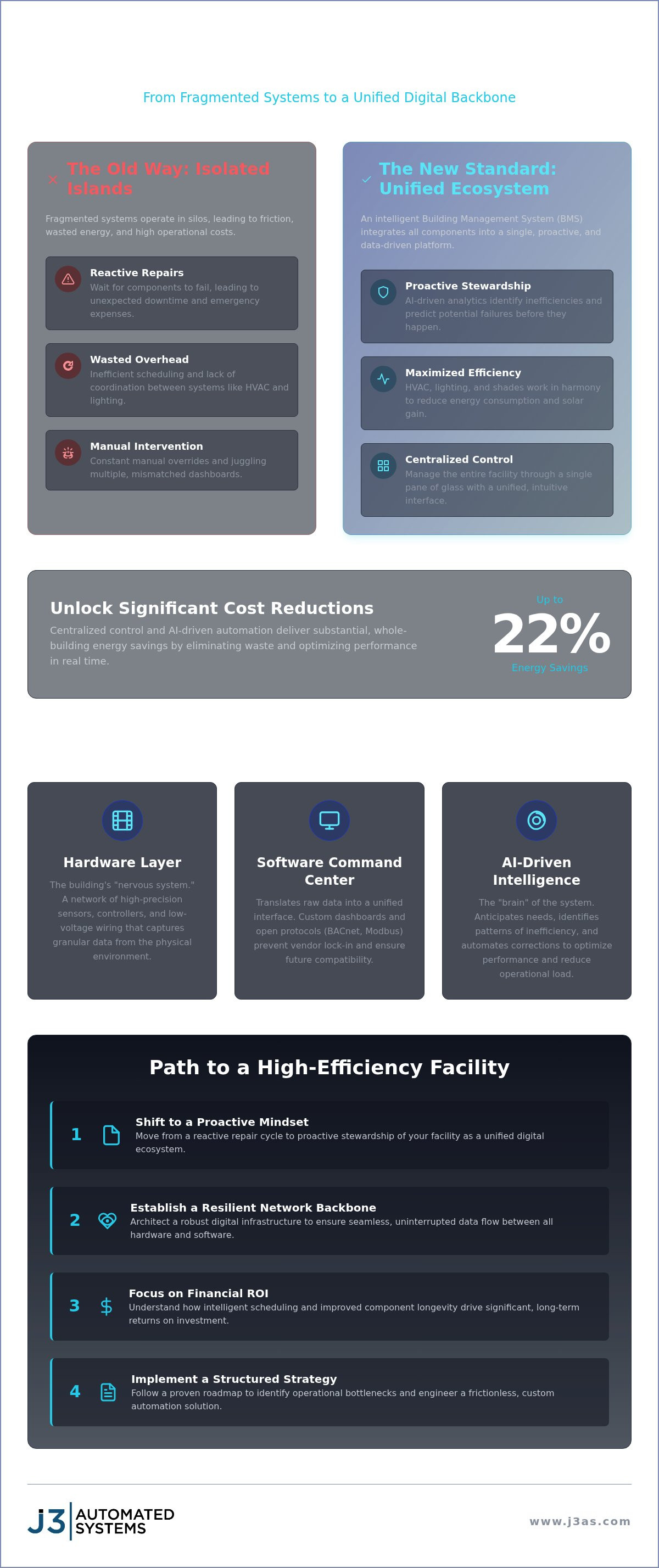
A successful automation project follows the rhythm of a well-planned lifecycle, moving from conceptual strategy to physical reality. Engineering a high-performance environment requires a structured, logical progression that eliminates guesswork. This process begins with Phase 1: Discovery and process mapping. During this stage, we identify the hidden operational bottlenecks and friction points that drain capital. Phase 2 establishes the digital backbone, focusing on the resilient networking and low-voltage wiring necessary to support a massive influx of data. Phase 3 involves hardware procurement and white-glove installation, where precision craftsmanship ensures every sensor and controller is placed for maximum efficacy. Finally, Phase 4 focuses on system commissioning and custom software tuning. This final calibration ensures the commercial building management systems Texas properties utilize are perfectly aligned with their specific operational goals.
Selecting the Right Integration Partner
Choosing a building management system installer requires more than a review of hardware catalogs. You need a partner who understands the nuances of Texas-specific codes, including the 2024 International Mechanical Code (IMC) and the 2026 transition to low-GWP refrigerants. End-to-end accountability is superior to fragmented sub-contracting; a single visionary team should manage everything from the physical sensors to the bespoke AI integration. This holistic perspective prevents the "digital silos" that often plague large facilities. When one team is responsible for the entire stack, you remove the burden of managing multiple vendors and ensure a polished final result.
Seamless Commissioning and Support
Rigorous day-one tuning prevents the common "broken system" trap where high-end hardware fails to deliver its promised ROI due to poor calibration. Commissioning is the process of validating that every component responds correctly to real-world conditions. Once the system is live, training facility staff is vital. They must know how to leverage the full power of the centralized dashboard to make data-driven decisions. Long-term support models provide a safety net as your Texas commercial portfolio grows, ensuring that your systems remain synchronized and efficient over the coming decades. If you're ready to move from fragmented effort to intelligent, effortless operation, partner with a visionary integrator to design your facility's digital future.
The Visionary Integrator: Why J3 Automated Systems is the Standard for Texas Commercial Properties
J3 Automated Systems operates at the intersection of architectural precision and digital innovation. While many vendors focus on isolated hardware components, J3 functions as a visionary consultant for commercial building management systems Texas. Our philosophy centers on removing the burden of complexity for property owners through a single, accountable partnership. By managing the entire lifecycle of a project, from initial engineering to custom AI integration, we ensure that every system operates in total harmony. Our local expertise in San Antonio, Austin, Boerne, and New Braunfels allows us to provide high-touch, premium service that understands the specific environmental and regulatory demands of the Texas market. We don't just install equipment; we engineer outcomes that prioritize long-term functionality and calm reliability.
The J3 difference lies in our ability to merge physical environments with custom digital tools. We recognize that a building is more than its mechanical parts. It is a complex ecosystem that requires a unified digital backbone to thrive. By serving as a master of complexity, we simplify the world for the client, replacing fragmented manual effort with intelligent, effortless operation. This approach transforms the facility from a cost center into a high-performance tool that supports the overarching goals of the business.
Engineering Harmony Across the Texas Triangle
A building's intelligence is only as strong as its foundation. We prioritize resilient networking as the invisible infrastructure that powers every high-end commercial AV and security integration we commission. Our work goes beyond physical automation. We develop custom web apps that serve as a transparent window into facility performance, allowing stakeholders to visualize complex data streams and automate internal business workflows. This integration of custom software with physical automation addresses the modern need for data-driven facility stewardship. We create a seamless environment where lighting, climate, and security work together to enhance the occupant experience while preserving the owner's capital.
Your Roadmap to Intelligent Automation
The transition to a sophisticated, high-efficiency facility requires more than a simple hardware upgrade. Our white-glove approach begins with deep discovery, where we map your specific business processes before turning a single screw. This ensures that the resulting commercial building management systems Texas solve real operational friction rather than just adding new technology for its own sake. Facility managers who are ready to modernize their properties gain more than just energy efficiency; they gain a dedicated steward of their experience. By prioritizing intellectual rigor and craftsmanship, J3 provides a state of calm reliability that allows you to focus on high-level strategy while your building manages itself. The path to a friction-free environment starts with a partner who sees the hidden connections between your systems and your success.
Securing Your Facility’s Digital Legacy
Transitioning to an intelligent property is more than a technical upgrade; it's a strategic commitment to operational harmony. We've explored how commercial building management systems Texas property owners rely on must bridge the gap between physical automation and business intelligence to remain competitive in 2026. By unifying HVAC, lighting, and resilient networking, you eliminate the friction of fragmented systems and secure measurable ROI through energy reduction and asset longevity. A visionary approach ensures that your building doesn't just function, but anticipates the needs of its occupants.
This level of precision requires a partner who understands the architectural nuances of the Texas climate and the complexity of custom software workflows. Our Texas-based engineering team provides end-to-end design and commissioning, serving as your single accountable partner for custom AI integration. We remove the burden of technical complexity, allowing you to focus on high-level strategy while your facility operates with effortless precision.
Engineer your facility's future with J3 Automated Systems. Your property is ready to evolve into a high-performance environment that stands the test of time.
Frequently Asked Questions
What is the average ROI for a commercial BMS in Texas?
Integrated platforms that coordinate HVAC, lighting, and plug loads can deliver whole-building energy savings of 18 to 22 percent according to industry data from August 2026. This immediate reduction in utility overhead, combined with the extended lifecycle of mechanical components, creates a compelling financial narrative for commercial building management systems Texas. Most owners see a full return on investment through reduced energy waste and the elimination of reactive emergency repairs.
Can an existing Texas building be retrofitted with a modern BMS?
Yes, existing facilities can be transformed into intelligent environments through a phased retrofit of the digital backbone. By utilizing wireless sensors and open protocols like BACnet, we can integrate legacy mechanical equipment into a unified control interface. This process removes the burden of manual oversight without requiring a total replacement of your current physical infrastructure, provided the underlying networking is resilient and secure.
How does AI integration improve building management efficiency?
AI integration shifts facility management from a scheduled model to a predictive one by identifying equipment anomalies before they lead to downtime. Machine learning algorithms analyze subtle fluctuations in energy draw and vibration to anticipate failures. This intelligence also automates complex business workflows, linking physical building data directly to custom internal tools to simplify administrative tasks for property teams.
What are the most common mistakes when choosing a BMS installer in San Antonio?
The most frequent error is treating the installation as a simple hardware procurement rather than a complex engineering project. Generic electrical contractors often lack the technical depth to integrate custom AI or manage the sophisticated networking required for modern commercial building management systems Texas. Choosing a partner who lacks end-to-end accountability often results in fragmented systems that fail to communicate, leading to long-term operational friction.
Does a BMS help with LEED certification for Texas commercial properties?
A sophisticated BMS is essential for achieving the energy performance and indoor environmental quality credits required for 2026 LEED standards. The system provides the granular data logging necessary to verify energy reduction and air quality metrics. By precisely managing HVAC cycles and lighting loads, a BMS ensures your property meets the rigorous documentation requirements for high-tier certification in competitive Texas markets.
How do integrated shades and lighting affect HVAC costs?
Automated shades and intelligent lighting work in harmony to significantly reduce the thermal load on your HVAC system. By shielding interiors from intense Texas solar gain during peak hours, automated shades prevent the building from overheating. Similarly, intelligent lighting reduces internal heat production by dimming or turning off fixtures when natural light is sufficient, allowing the cooling system to operate at a lower, more efficient capacity.
Is enterprise-grade networking necessary for a standard office BMS?
Resilient, enterprise-grade networking is the non-negotiable foundation of every modern automation project. A standard office environment generates massive streams of data that require a high-bandwidth, secure infrastructure to prevent latency and system crashes. Without this invisible backbone, your sensors and controllers cannot communicate reliably, which compromises the intelligence of the entire building and creates vulnerabilities in your digital security.
How does J3 Automated Systems handle ongoing support after installation?
We provide a methodical support model that includes day-one commissioning and continuous software tuning to ensure peak performance. Our team trains your facility staff to leverage the full power of the custom dashboard, ensuring they are never burdened by the system's complexity. As a dedicated steward of your experience, J3 remains an accountable partner, offering long-term maintenance that evolves alongside your growing commercial portfolio.