2026 Texas Commercial Security Engineering Guide
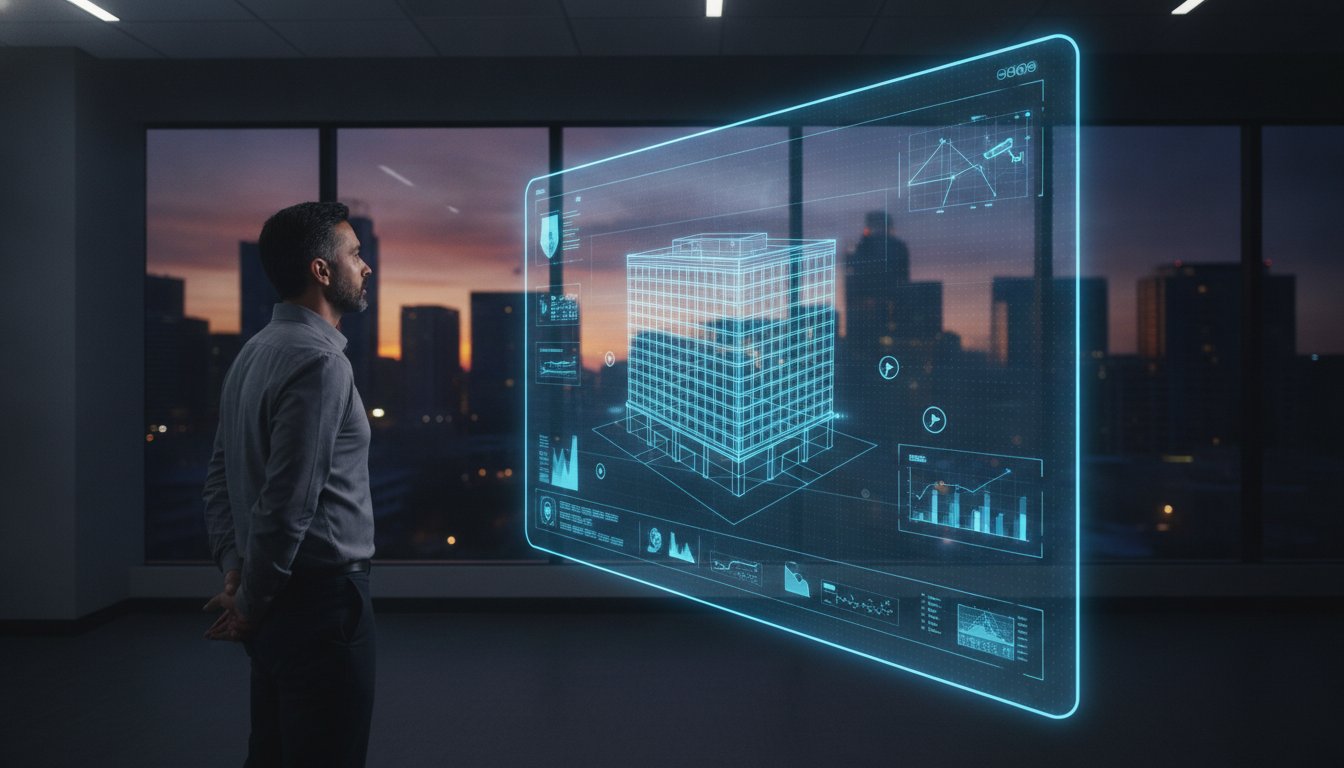
What if the collection of high-definition cameras and badge readers currently protecting your facility is actually creating more risk than it mitigates? For many facility managers across the I-35 corridor, the reality of modern operations involves juggling a dozen disconnected applications while sifting through a constant stream of false alarm notifications. It is a state of operational friction that leaves little room for genuine building intelligence. As sophisticated commercial AV and security system integrators Texas leaders rely on for high-stakes environments, we recognize that true safety isn't found in a hardware catalog. It is engineered through the precise convergence of physical and digital infrastructure.
You likely already feel the burden of a fragmented security posture, especially as the 2026 landscape introduces tighter CCTV restrictions and complex data privacy mandates. This guide promises to show you how to transform those isolated tools into a unified, frictionless ecosystem that delivers a single dashboard for all your building data. We will explore the shift from reactive hardware to proactive engineering, ensuring your strategy prioritizes verifiable ROI, automated responses, and absolute vendor accountability. From Austin to San Antonio, we are defining the new standard for the intelligent Texas workplace.
Key Takeaways
- Move beyond fragmented hardware by unifying surveillance, access control, and building intelligence into a single, frictionless ecosystem.
- See why top-tier commercial AV and security system integrators Texas professionals rely on prioritize a discovery-led engineering roadmap over simple equipment installation.
- Quantify the operational ROI of your security strategy through automated credentialing, reduced false alarms, and enhanced situational awareness across multiple sites.
- Address unique regional challenges, including climate-hardened outdoor hardware for the Texas heat and centralized management for expanding I-35 corridor operations.
- Transform your facility into a truly intelligent building by integrating physical security data with AI-driven business process automation.
What is an Integrated Security System for Commercial Properties?
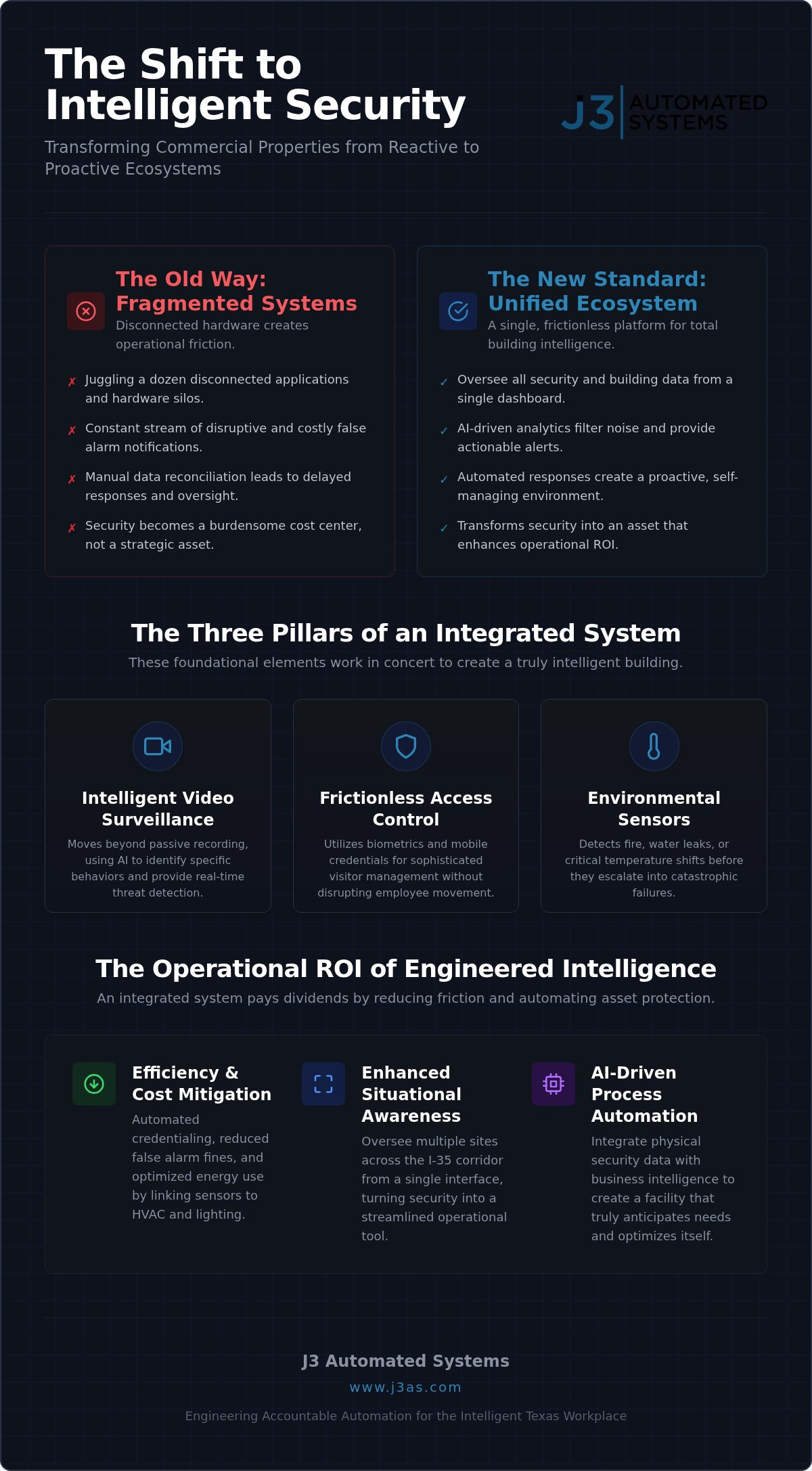
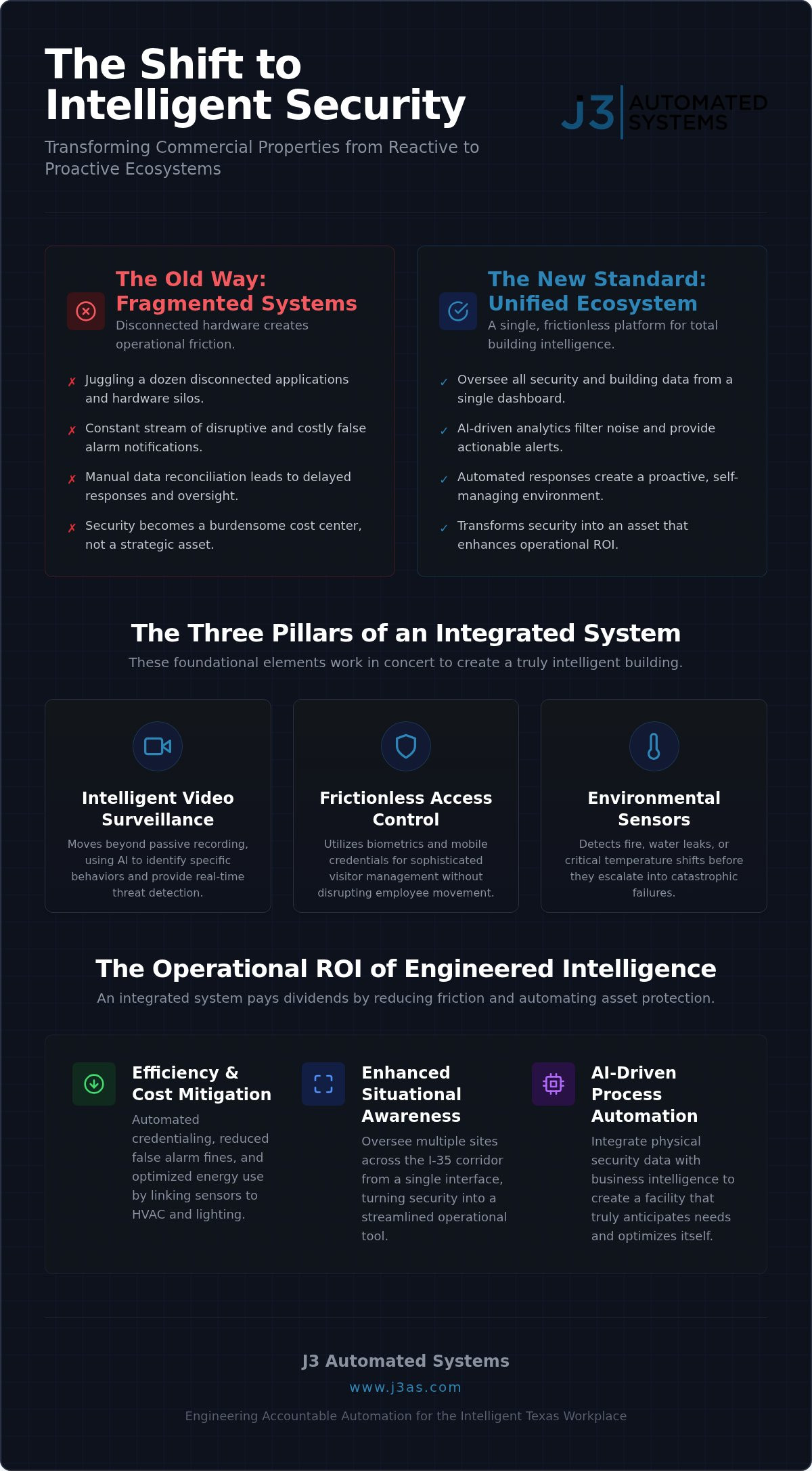
An integrated security system functions as a centralized ecosystem where surveillance, access control, and intrusion detection communicate in real-time. It marks a decisive shift from reactive hardware, which merely records events, to proactive, intelligent building environments that anticipate needs. This architecture, often powered by advanced platforms like Digital-Vision.AI, serves as the invisible backbone of modern operational efficiency, ensuring that security protocols don't hinder the flow of business. By unifying data, these systems significantly reduce the management burden for high-end Texas properties, transforming security from a cost center into a strategic asset.
Integrated vs. Standalone Security Models
Traditional standalone models often suffer from inherent friction. Managing disparate applications and hardware silos forces personnel to manually reconcile data from multiple sources, leading to delayed responses and oversight. In contrast, an integrated model ensures that every sensor acts as a part of a larger whole, creating a force multiplier effect across the entire facility. When a badge reader detects an unauthorized attempt, the surveillance system can automatically pivot cameras to the location while alerting the nearest security personnel. This level of coordination is why physical security principles must be applied with a rigorous engineering mindset. Leading commercial AV and security system integrators Texas organizations partner with emphasize that long-term scalability and system harmony provide far greater value than the short-term savings of off-the-shelf hardware discounts.
The Core Pillars of a Unified System
A truly unified system relies on three foundational elements that work in concert to protect and optimize the environment:
- Intelligent Video Surveillance: Modern systems move beyond passive recording. They utilize AI-driven analytics to identify specific behaviors or prohibited items, providing real-time threat detection that filters out the noise of false alarms.
- Frictionless Access Control: Security should be felt, not seen. By utilizing biometrics and mobile credentials, businesses can implement sophisticated visitor management that maintains a high security posture without disrupting the daily movement of employees.
- Environmental Sensors: Intelligence extends beyond human threats. Integrated sensors detect fire, water leaks, or critical temperature shifts in server rooms before they escalate into catastrophic failures.
By merging these pillars into a single digital backbone, Texas enterprises achieve a level of situational awareness that was previously impossible. This unified approach allows facility managers to oversee complex operations from a single pane of glass, ensuring that every component of the building's infrastructure supports the safety and productivity of its occupants. Even when operating outside of local jurisdictions, it is beneficial to explore Installation and maintenance of physical security and access control systems through specialists like Links Integrated Systems to understand how professional-grade hardware is maintained for long-term reliability.
The Operational ROI of Engineering Intelligence into Your Facility
Operational return on investment (ROI) is the intersection of reduced friction and automated asset protection. It isn't found in a hardware receipt; it's earned through the sophisticated application of data and systems design. For leaders working with commercial AV and security system integrators Texas trusts, the goal is a property that manages itself. Enhanced situational awareness allows facility managers to oversee multiple Texas sites from a single interface, turning security from a reactive burden into a streamlined operational tool. Intelligence thrives here. This synergy is most apparent when security protocols achieve seamless integration with commercial building management systems in Texas.
Efficiency and Cost Mitigation
Reducing operational friction starts with automated credentialing and visitor logging. By following Industry Best Practices for Credential Design, we ensure that access is both secure and fluid for authorized personnel. Intelligent multi-sensor verification significantly lowers the risk of false alarm fines, which disrupt local law enforcement and drain corporate resources. Beyond safety, there's a tangible energy benefit. Linking occupancy sensors to HVAC and lighting controls ensures that empty conference rooms aren't wasting power, directly impacting the bottom line. For facilities looking to further optimize their energy profile through renewable sources, you can visit Texas Engineered Solar LLC to learn about commercial solar solutions. These automated efficiencies allow your staff to focus on high-value tasks rather than manual gatekeeping.
Beyond commercial and industrial applications, the same focus on safety and foundational readiness is vital in educational settings, such as the licensed programs at jumpstartlearning.ca that prepare children for their academic future.
Compliance in 2026 requires more than just a locked door. The Texas Data Privacy and Security Act (TDPSA) and strict data breach notification deadlines demand a robust digital backbone. Businesses now face civil penalties of up to $7,500 per violation under the TDPSA if data is mismanaged. Navigating these legal risks often requires consultation with specialized firms like JZ Law that understand the nuances of complex regulatory and corporate sectors. Automated audit trails provide the necessary documentation for high-security industries like finance and healthcare, ensuring you're always prepared for an inspection. Verified, enterprise-grade protection protocols can also lead to lower insurance premiums, as carriers recognize the reduced risk profile of a professionally engineered facility. Future-proofing your property against evolving cybersecurity and physical threats is a continuous process. If you're ready to move beyond basic hardware, you might speak with a systems designer to map out a more intelligent roadmap.
The Engineering Roadmap: Why Design Beats Mere Installation
Hardware catalogs are deceptive; they suggest that safety is a commodity you can buy off a shelf. In complex commercial environments, off-the-shelf solutions inevitably fail because they ignore the unique operational DNA of the organization. Effective protection requires a rigorous discovery phase to map business processes long before hardware selection begins. As the leading commercial AV and security system integrators Texas businesses rely on, we view every project as an engineering challenge rather than a retail transaction. This engineering mindset also applies to the physical structures themselves, where pre-engineered solutions from bradberrysteel.com provide a resilient foundation for advanced technical systems. A single accountable team managing the entire technology roadmap ensures that nothing is lost in translation between design, procurement, and the final commissioning.
Engineering begins by identifying friction points in current employee and visitor workflows. A system that secures a door but slows down a delivery driver by five minutes is a failed design. For mixed-use properties along the I-35 corridor, this requires a specialized approach like high performance residential networking to ensure that residential comfort and commercial security coexist on a unified, resilient backbone. We often integrate custom software to bridge the gap between security data and administrative tasks, turning a camera feed into a tool for visitor management or automated payroll verification.
Procurement and System Commissioning
True resilience is built on a foundation of professional-grade components. We select resilient networking hardware capable of supporting high-bandwidth 4K surveillance without latency or packet loss. However, the most critical phase is the tuning process. Commissioning involves calibrating AI analytics to the specific architectural nuances and environmental conditions of the space, ensuring that a swaying tree or a shifting shadow doesn't trigger a false alarm. This meticulous attention to detail is why professional commissioning is the final, non-negotiable step in commercial security system design in Texas. By the time a project is handed over, the system isn't just installed; it's optimized for the specific reality of the facility.
Design-led integration removes the burden of choice from the client and replaces it with the certainty of performance. When surveillance, access, and networking are engineered as a single entity, the result is a state of intelligent, effortless operation that protects both people and assets without compromise.
Regional Considerations for Texas Commercial Properties
Texas commercial properties operate within a demanding environment that tests both digital and physical resilience. From the intense heat of San Antonio and Austin to the rapid expansion along the I-35 corridor, regional factors dictate the success of any technology roadmap. As experienced commercial AV and security system integrators Texas leaders rely on, we recognize that local compliance and connectivity are just as vital as the hardware itself. Adhering to Texas-specific life safety and fire alarm integration codes requires deep familiarity with municipal standards. Ensuring resilient networking in developing suburban hubs is equally critical for maintaining uptime in high-performance environments. To ensure your physical perimeter is as sophisticated as your digital one, you can check out Apex Gateworks Inc. for custom automated gate and fencing solutions designed for these demanding conditions.
Engineering for the Texas climate requires more than just a sturdy enclosure. Thermal management is essential for outdoor access control and camera systems, as high temperatures can degrade sensitive electronics and shorten the lifespan of high-definition sensors. Standard hardware often fails in the extreme Texas climate because it lacks the advanced heat dissipation and thermal regulation necessary to survive consecutive days of triple-digit heat. By sourcing hardware from a premier provider of advanced surveillance solutions like StaySafe365, businesses can ensure their infrastructure is built for this level of environmental resilience. We prioritize protecting low-voltage wiring from regional stressors like high humidity and pests, which can compromise signal integrity if left unshielded. This architectural approach to hardware selection prevents the premature failures that plague less rigorous installations.
Accountability is a local virtue. Partnering with a San Antonio-based team ensures rapid on-site commissioning and a deep understanding of the regional commercial landscape. While remote monitoring and AI-driven diagnostics provide an essential layer of oversight, the ability to deploy expert engineers to a physical site along the I-35 corridor remains a significant competitive advantage. This need for reliable regional support extends to all aspects of facility logistics; for instance, JTT Towing and Storage provides specialized heavy-duty recovery and truck repair for businesses operating along these same transit routes. This local expertise also extends to digital infrastructure, such as custom web app development in San Antonio, where we build the software tools that help facility managers interpret their security data.
Centralizing security for businesses with multiple sites is no longer a luxury; it's an operational necessity. We unify these disparate locations into a single digital ecosystem, allowing for consistent enforcement of protocols and real-time situational awareness from a central hub. If you are ready to harden your facility against both environmental and security risks, you can start your engineering discovery today.
J3 Automated Systems represents a departure from the traditional vendor model. We operate as visionary consultants who see the hidden connections between disparate systems, ensuring that your facility functions as a unified entity. Our philosophy moves beyond simple security to a holistic intelligent building strategy. As premier commercial AV and security system integrators Texas enterprises trust for high-stakes projects, we provide a single point of accountability for the entire technology lifecycle. From initial design and procurement to final commissioning, we remove the burden of managing multiple contractors and fragmented platforms.
From Security Data to Business Intelligence
Intelligence thrives when data is liberated from its silos. We specialize in bridging the gap between physical security sensors and AI business process automation to transform raw information into actionable insights. Occupancy data, for instance, does more than monitor unauthorized access; it allows you to optimize office square footage and reduce utility waste by automating lighting and HVAC adjustments based on real-time usage. Through bespoke software development, we create custom, unified dashboards that provide a single pane of glass for your operations. These custom web apps allow facility managers to oversee multi-property access from a single secure login, harnessing AI to automate repetitive administrative tasks like visitor logging and audit trail generation. This level of integration replaces manual effort with intelligent, effortless operation.
Your Automation Roadmap Starts Here
Transitioning from legacy hardware to a modern digital backbone requires a methodical and steady approach. We begin every engagement with a deep-thinking discovery process, taking the time to define your specific operational challenges before proposing a multi-layered solution. This roadmap ensures that your investment in building intelligence delivers verifiable long-term ROI through increased efficiency and reduced friction. We don't believe in quick fixes or off-the-shelf compromises. Instead, we offer a dedicated partnership that values precision and craftsmanship at every stage of the engineering process. If you are ready to simplify the complexity of your facility and embrace a state of intelligent operation, the first step is a comprehensive consultation. We invite you to schedule your commercial automation discovery session with J3 Automated Systems to begin engineering your facility’s future.
Defining the Future of Texas Commercial Intelligence
The shift from fragmented security hardware to a unified, intelligent building ecosystem is no longer a luxury for Texas enterprises; it's a strategic necessity. By prioritizing a discovery-led engineering roadmap over simple equipment procurement, you remove the friction of manual oversight and replace it with automated, verifiable safety. True resilience requires a partner who understands the unique environmental stressors and regulatory demands of the San Antonio and Austin commercial corridors. As specialized commercial AV and security system integrators Texas businesses rely on for end-to-end accountability, we ensure that every sensor, camera, and access point contributes to a larger narrative of operational efficiency.
Our expertise in high-end AI and BMS integration allows us to bridge the gap between physical security and business intelligence, creating a seamless digital backbone for your property. With a single accountable team managing the design, installation, and commissioning of your system, you can move forward with the confidence that your facility is both protected and optimized for the future. Your path to a frictionless, resilient workplace begins with a single, purposeful design.
Engineering Your Intelligent Protection: Contact J3 Automated Systems for a Bespoke Security Roadmap
Frequently Asked Questions
What is the difference between integrated and unified security systems?
Integrated systems connect separate hardware components through software bridges or APIs, allowing them to share data. A unified system, however, is built on a single software platform from the ground up, offering a deeper level of native communication. While integration provides functional links, unification removes the friction of managing different databases, ensuring that surveillance and access control operate as a single, cohesive entity rather than linked silos.
Can I integrate my existing legacy cameras into a new commercial system?
Most legacy cameras can be integrated into a modern ecosystem using encoders or ONVIF compliant network bridges. However, the Texas CCTV ban implemented on January 26, 2026, prohibits specific manufacturers like Hikvision and Dahua for state affiliated entities due to cybersecurity risks. We evaluate your existing infrastructure to ensure compliance and signal integrity. If your legacy hardware meets current security standards, we can often bridge it into a unified digital backbone.
How does integrated security improve building energy efficiency?
Integrated security enhances energy efficiency by utilizing occupancy data to automate building climate and lighting. When access control or motion sensors detect an empty floor, the system communicates with the BMS to adjust HVAC setpoints and extinguish lights. This synergy reduces utility waste without requiring manual intervention. For many facilities, this automated resource management—often enhanced by small-scale energy solutions from SolarPorts Development—provides a verifiable contribution to the overall operational ROI of the property.
Texas law does not mandate a universal retention period for all commercial entities, but specific industries like finance and healthcare must follow strict federal mandates. Under the Texas Data Privacy and Security Act of 2026, businesses must maintain robust data protection protocols to avoid civil penalties of up to $7,500 per violation. For many organizations, partnering with a managed service provider like JP Technical is the most effective way to implement these safeguards and manage the ongoing complexity of digital compliance. Additionally, maintaining clear audit trails is essential for businesses seeking Safe Harbor protection under SB 2610 during a data breach incident.
AI transforms access control by replacing static credentials with dynamic behavior analysis and biometric verification. It automates visitor management by pre-screening guests and generating temporary mobile credentials, which reduces the administrative burden on front desk staff. Sophisticated commercial AV and security system integrators Texas organizations trust utilize these AI layers to identify anomalies, such as tailgating or unauthorized entry attempts, in real-time to prevent security breaches before they occur.
Is cloud-based or on-premise security better for high-security Texas facilities?
High-security Texas facilities often benefit from a hybrid approach that combines the resilience of on-premise storage with the scalability of cloud management. While cloud platforms offer superior remote access and automated updates, on-premise hardware ensures that critical video data remains within the physical perimeter during network outages. The choice depends on your specific data sovereignty requirements and the bandwidth capabilities of your facility's networking infrastructure.
What is the typical ROI for an integrated commercial building management system?
The ROI for an integrated building management system is realized through the intersection of reduced labor costs and lower energy consumption. By automating routine security logging and building climate adjustments, facilities can see a significant reduction in operational friction. Mitigation of false alarm fines and the extension of hardware lifespans through proactive AI diagnostics provide a clear path to long-term financial recovery for complex commercial properties.
How does integrated security handle emergency response and fire alarm triggers?
Integrated systems handle emergencies by executing pre-programmed life safety macros when a fire alarm is triggered. This includes automatically releasing magnetic door locks for safe egress and pivoting surveillance cameras to the source of the alarm for immediate visual verification. By unifying these protocols, commercial AV and security system integrators Texas experts ensure that emergency responders have real-time situational awareness, which drastically reduces response times during critical incidents.