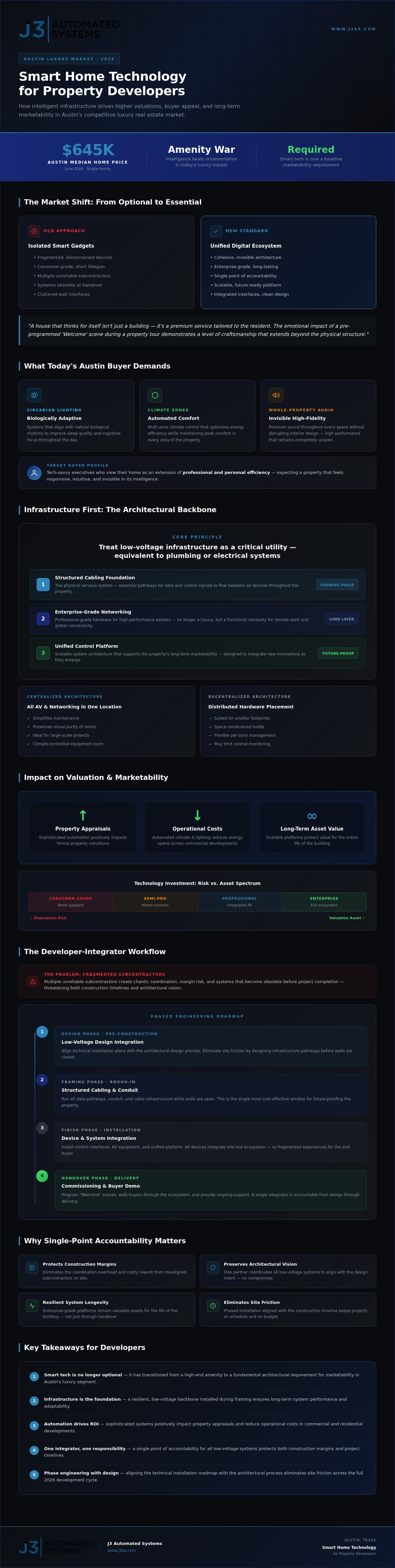
Smart Home Technology for Property Developers in Austin: Engineering Value and Marketability
In the competitive Austin market, where median home prices reached $645,000 this past June, a luxury property is no longer defined solely by its square footage or its zip code; it's defined by the intelligence of its underlying infrastructure. You likely recognize that today’s discerning buyers expect more than just a collection of smart gadgets. They demand a home that anticipates their needs through a unified, invisible ecosystem that complements the building's architecture rather than cluttering it. However, the reality of delivering this often involves a chaotic mix of unreliable subcontractors and systems that risk becoming obsolete before the project is even completed. This guide explores how to strategically integrate smart home technology for property developers Austin to drive higher valuations while eliminating the friction of fragmented low-voltage installations. We will examine the shift from basic automation to fully engineered environments, demonstrating how a single point of accountability protects both your construction margins and your architectural vision during the 2026 development cycle.
Key Takeaways
- Analyze the transition of smart systems from optional amenities to fundamental architectural requirements in the evolving Austin luxury market.
- Identify how to integrate smart home technology for property developers Austin through a low-voltage foundation that ensures long-term system resilience.
- Quantify the impact of sophisticated automation on property appraisals and the reduction of operational costs within commercial developments.
- Streamline the construction lifecycle by establishing a single point of accountability for all low-voltage and automation systems.
- Discover a phased engineering roadmap that aligns technical installation with the architectural design process to eliminate site friction.
The Evolution of Austin’s Luxury Real Estate Market
The Austin housing market has evolved into a sophisticated arena where traditional luxury markers no longer suffice. With median single-family home prices in the city holding at $645,000 as of June 2026, developers find themselves in an "Amenity War" that favors intelligence over ornamentation. Buyers are no longer impressed by isolated smart gadgets; they expect a cohesive digital architecture that functions as a silent, essential utility. This shift has transformed smart home technology for property developers Austin from a high-end upgrade into a foundational requirement for marketability.
Integrating these systems allows a developer to craft a narrative of effortless living. It creates a property that feels responsive and intuitive. Achieving this requires a delicate balance between high-performance capability and aesthetic minimalism. The goal is to remove the friction of manual control, replacing visible wall clutter with integrated interfaces that disappear into the design. A house that thinks for itself isn't just a building; it's a premium service tailored to the resident.
Meeting the Demands of the Modern Austin Buyer
The profile of the Central Texas buyer has shifted toward tech-savvy executives who view their home as an extension of their professional and personal efficiency. During a property tour, the emotional impact of a pre-programmed "Welcome" scene cannot be overstated. It demonstrates a level of craftsmanship that extends beyond the physical structure into the digital experience. We're seeing a significant rise in demand for health-centric features and environmental control. High-end developments now prioritize:
- Circadian lighting systems that align with natural biological rhythms to improve sleep and focus.
- Automated climate zones that optimize energy use while ensuring peak comfort.
- Invisible whole-property audio that provides high-fidelity sound without disrupting the interior design.
Future-Proofing Developments Against Technological Obsolescence
One of the greatest risks to a developer's reputation is the rapid decay of consumer-grade technology. Off-the-shelf gadgets often lack the longevity required for a luxury build and create fragmented user experiences that frustrate new owners. Modern home automation systems must be engineered as scalable platforms rather than static installations. By prioritizing professional-grade infrastructure during the framing phase, you ensure the property remains adaptable as new innovations emerge.
This forward-thinking approach protects the property’s valuation. It signals to potential buyers that the home is prepared for the future, not just the present. Choosing resilient, enterprise-grade networking and unified control systems ensures that smart home technology for property developers Austin remains a valuable asset for the life of the building. Success lies in shifting away from retail-level hardware toward integrated engineering that supports a premium lifestyle.
Engineering the Architectural Backbone: Infrastructure First
Successful integration of smart home technology for property developers Austin begins long before the first device is powered on. It starts with treating the low-voltage foundation as a critical utility, equivalent to plumbing or electrical systems. This architectural backbone ensures that the property can handle the increasing consumer demand for smart home technology without compromising aesthetic integrity. Structured cabling serves as the physical nervous system of a smart home, providing the essential pathways for data and control signals to flow between devices.
Choosing between centralized and decentralized system architecture is a pivotal decision for large-scale projects. Centralized systems consolidate all AV and networking hardware into a single, climate-controlled location, which simplifies maintenance and preserves the home's visual purity. In contrast, decentralized systems may be appropriate for smaller footprints where space is at a premium. Regardless of the choice, the focus remains on building a resilient, scalable foundation that supports the property's long-term marketability and value.
Resilient Networking for High-Performance Estates
A home's digital performance is only as strong as its invisible infrastructure. For high-performance estates, high performance residential networking is no longer a luxury; it's a functional necessity for remote work and global connectivity. Enterprise-grade hardware provides the reliability that consumer-grade mesh systems simply cannot match. By engineering a robust wireless and wired network from the start, developers can eliminate dead zones in large-scale architectural designs, ensuring seamless transitions between indoor and outdoor living spaces.
Low-Voltage Planning and Pre-Wire Strategy
Precision in the pre-wire phase prevents friction during the final stages of construction. We prioritize documented rack locations and specific power requirements early in the design process. This methodical planning allows us to optimize wire paths, minimizing interference with other trades. For multi-unit developments, standardizing this infrastructure creates a repeatable model of excellence. It allows for a single point of accountability, ensuring that every unit meets the same high standard of technical readiness. Developers who seek a consultation on system architecture during the framing stage often avoid the costly retrofits that plague less prepared projects.
Quantifying the ROI: Marketability and Valuation
Austin developers face a market where discerning buyers equate technological integration with structural quality. Quantifying the return on investment for smart home technology for property developers Austin requires looking beyond the hardware costs to the elevated appraisal values and shortened days on market. By offering a turn-key lifestyle solution, you remove the burden of post-purchase installation from the buyer. This creates a premium narrative that justifies a higher price per square foot while following professional guidance from the National Association of Home Builders regarding system implementation and liability management.
The financial logic is clear. When systems are engineered into the architectural plans, they transition from being line-item expenses to becoming essential valuation drivers. This shift is particularly evident in the luxury sector, where the "invisible" ROI of reduced wall clutter and improved aesthetics significantly enhances the property's appeal during high-stakes tours.
Increasing the 'Per Square Foot' Value
High-margin upgrades like automated lighting and shades provide immediate visual and functional impact. These systems contribute to a silent luxury that appeals to the emotions of potential residents. For example, integrating luxury home audio solutions into outdoor living areas effectively extends the usable entertainment space of the property. This expands the perceived value of the estate without requiring additional heated square footage, allowing developers to capture a higher premium on the final sale price.
Operational Efficiency in Commercial Developments
In the commercial sector, the ROI is measured through utility savings and long-term maintenance reduction. Implementing commercial building management systems Texas allows developers to slash utility overhead through intelligent HVAC and lighting control. These systems provide several operational advantages:
- Predictive maintenance alerts that identify equipment failure before it causes a disruption.
- Remote monitoring capabilities that allow property managers to oversee multiple units from a single interface.
- Energy efficiency metrics that serve as a powerful selling point for environmentally conscious tenants.
Beyond the immediate energy savings, these intelligent systems reduce the long-term cost of ownership. They provide a data-driven foundation for property management, ensuring that the building operates at peak efficiency throughout its lifecycle. For the developer, this translates into a more attractive asset for institutional investors who prioritize sustainable, low-friction operational models.
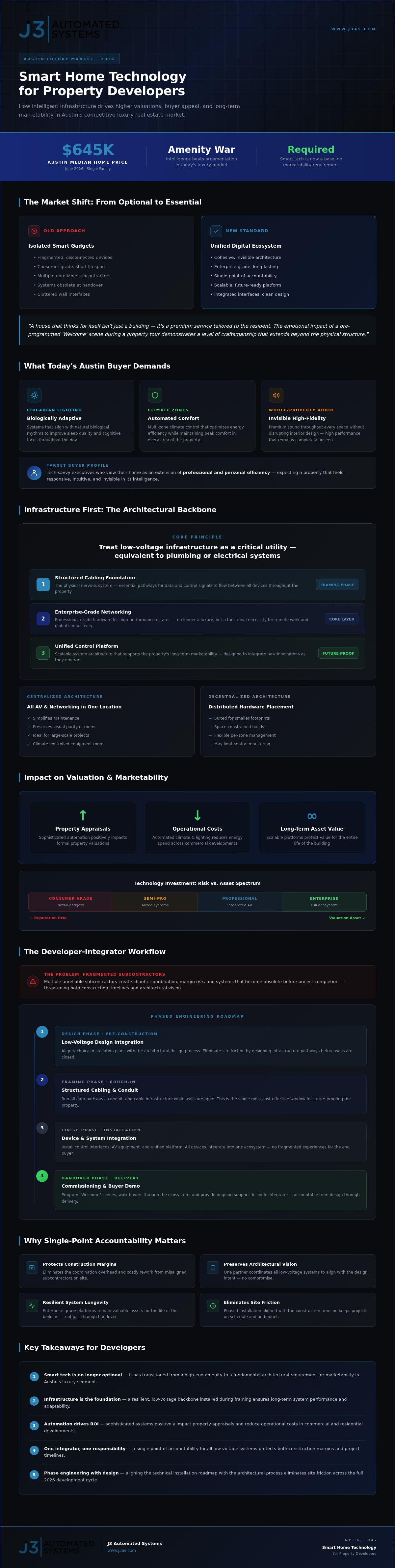
The Developer-Integrator Workflow: A Roadmap to Success
Building a high-end estate requires a methodical sequence that aligns with the general contractor's schedule. Integrating smart home technology for property developers Austin is most effective when treated as a multi-phase engineering project rather than a late-stage installation. This structured approach ensures that the digital systems are woven into the physical structure, preventing the "bolt-on" feel that often plagues luxury builds. By following a defined roadmap, you can eliminate site friction and ensure the final product operates with the same precision as its architectural design.
The process begins with an engineering-led discovery phase. We define the system scope based on the architectural vision and the lifestyle demands of the target buyer. This leads into the pre-wire phase, where the physical infrastructure is installed during framing. Once the environment is clean and climate-controlled, we move to hardware integration and commissioning. The cycle concludes with a white-glove owner orientation, ensuring the new resident feels immediate mastery over their environment. This phased model provides the clarity needed to maintain construction momentum.
Seamless Coordination with Architects and Trades
Friction between electrical, HVAC, and automation contractors often stems from a lack of unified planning. Establishing a single point of accountability for all low-voltage systems eliminates this conflict. It ensures that wire paths are optimized and that technical requirements don't interfere with structural elements. For example, integrating cinema grade home theater design into the early floor plan prevents costly structural conflicts later. Developers who prioritize this integrated engineering partnership see fewer delays and a more polished final result where technology and design coexist in harmony.
Commissioning and Owner Handoff
The final success of the project rests on the handoff experience. Every system undergoes rigorous tuning and testing before property delivery to ensure peak performance. We focus on creating simplified, intuitive user interfaces that reduce post-sale support calls to the developer. It's about delivering a home that's ready for immediate use. Providing comprehensive documentation for the future homeowner empowers them from day one. This methodical handoff preserves your reputation for quality and ensures that the smart home technology for property developers Austin serves as a lasting asset rather than a source of frustration. A successful handoff transforms a complex building into a responsive, effortless living space.
J3 Automated Systems: Your Austin Development Partner
J3 Automated Systems serves as a high-level consultant for developers who demand technical rigor and aesthetic harmony. We operate as a single point of accountability, managing the entire lifecycle of low-voltage systems from initial engineering to final commissioning. This end-to-end model eliminates the common friction points found in traditional construction, where fragmented trades often struggle to unify digital and physical environments. By choosing J3 for smart home technology for property developers Austin, you're securing a partner who understands that a property's intelligence is a direct reflection of its structural quality.
Our role transcends that of a typical equipment vendor. We function as visionary integrators who see the connections between disparate systems, ensuring they work in unison rather than as isolated gadgets. This commitment to long-term functionality means that every system we design is built for resilience and ease of use. We prioritize a "white-glove" service level that respects the architect's vision and the developer's timeline, delivering a polished result that commands respect in the marketplace.
Bespoke Solutions for Premier Properties
Every development has a unique architectural narrative that requires a tailored technological roadmap. We don't offer generic packages; we engineer systems that align with your specific project goals and the expectations of Central Texas buyers. Our capabilities extend beyond standard hardware integration into the realm of custom development. This includes everything from ai business process automation for building management to bespoke user interfaces that reflect the property's brand. Austin's top developers trust J3 because we simplify the complex, ensuring that sophisticated technology remains an asset rather than a burden.
Get Started on Your Next Project
The most successful integrations begin during the earliest design phases. We invite you to schedule a discovery session to map out a comprehensive technology roadmap for your upcoming build. During this consultation, we evaluate your project's potential for automation, identifying opportunities to increase valuation while streamlining the construction timeline. Our methodical approach ensures that every detail is meticulously planned and flawlessly executed, providing a level of service that matches the exclusivity of your developments. Take the first step toward a more intelligent, marketable property and partner with J3 for your next development to ensure your vision is supported by a foundation of technical excellence.
Elevating the Standard of Central Texas Developments
The integration of sophisticated digital ecosystems has transitioned from a secondary amenity to a fundamental requirement for the modern estate. We've examined how prioritizing a resilient low-voltage foundation and an engineering-led workflow ensures that smart home technology for property developers Austin remains a lasting asset rather than a source of technical debt. By focusing on marketability and turn-key functionality, you can secure higher property valuations while delivering the effortless, silent luxury that today's discerning buyers expect.
Protecting your architectural vision requires a partner who balances technical authority with deep local expertise. J3 Automated Systems provides HTA-equivalent engineering standards and a single point of accountability for all low-voltage systems across the Austin and San Antonio corridor. This methodical approach removes the burden of technical complexity, allowing you to focus on the core craftsmanship of your build. It's time to transform your next development into a responsive, high-performance environment that stands apart in a competitive market.
Schedule a Developer Consultation with J3 Automated Systems to begin mapping the technology roadmap for your next project. Let's build something exceptional together.
Frequently Asked Questions
How much does smart home technology add to the cost of a luxury build?
Smart home technology typically accounts for a small percentage of the overall construction budget but offers a disproportionate impact on the final valuation. While costs vary based on the complexity of the systems, developers often see this investment as a way to differentiate their properties in the Austin market. Investing in smart home technology for property developers Austin ensures that the home meets the expectations of high-end buyers who prioritize integrated lifestyle solutions over isolated gadgets.
What is the best time to involve an automation integrator in the construction process?
The ideal time to involve an integrator is during the architectural design and framing phase. Engaging a team early allows for the engineering of a low-voltage foundation that doesn't conflict with other trades like electrical or HVAC. This proactive approach prevents costly retrofits and ensures that all structural requirements for cinema-grade theaters or whole-property audio are addressed before the walls are closed. It allows for seamless coordination across the entire construction lifecycle.
Can smart home systems be easily updated by future owners?
Professional systems are designed with modularity in mind, allowing future owners to update hardware without replacing the underlying infrastructure. By installing enterprise-grade structured cabling during the build, you provide a permanent digital backbone that supports evolving technologies. This future-proofing is a significant selling point for luxury buyers in the Austin and San Antonio corridor. It ensures the property remains technically relevant and avoids the obsolescence issues common with consumer-grade, wireless-only products.
What are the most requested smart home features for Austin luxury buyers in 2026?
Austin luxury buyers in 2026 prioritize wellness-centric features like circadian lighting and high-performance residential networking. Automated shades and climate control systems that integrate with building management platforms are also in high demand. These features offer both a visual wow factor and practical energy efficiency. Discerning residents look for an invisible, unified experience where lighting, audio, and security are managed through a single, intuitive interface rather than a collection of fragmented mobile applications.
How does professional automation differ from consumer smart home products?
Professional automation relies on dedicated, hardwired communication and enterprise-grade hardware that far exceeds the reliability of consumer products. While retail gadgets often suffer from connectivity drops and fragmented control, professional integration creates a unified ecosystem. This level of smart home technology for property developers Austin provides a single point of accountability for the entire system. It delivers the white-glove experience that high-end clients expect, ensuring that the technology works reliably every time without user intervention.
Is it possible to integrate smart technology into multi-family developments?
Integrating smart technology into multi-family developments is not only possible but increasingly necessary for modern property management. Centralized building management systems allow developers to monitor HVAC and lighting across hundreds of units from a single dashboard. This streamlines operational efficiency and reduces utility overhead. It also provides a premium experience for tenants, who benefit from secure, resilient networking and automated common area amenities that enhance the overall value of the development.
What kind of support does J3 provide to property owners after the sale?
J3 Automated Systems provides a comprehensive owner orientation and long-term support to ensure a seamless transition for the new resident. We don't just install hardware; we commission every system and provide detailed documentation for the homeowner. This white-glove approach reduces support calls to the developer and ensures the owner feels confident using their new technology. Our team remains available for ongoing system tuning and updates, preserving the property's technical integrity long after the initial sale.
How can smart technology help a development achieve green building certifications?
Intelligent automation is a primary driver for achieving green building certifications like LEED or the Austin Energy Green Building rating. Systems that automate lighting and HVAC schedules based on occupancy and natural light levels significantly reduce energy consumption. By integrating building automation, developers can provide verifiable data on energy savings to certification boards. This commitment to sustainability appeals to environmentally conscious buyers and may qualify the property for specific local incentives or tax credits in Central Texas.