Cinema-Grade Home Theater Design: Engineering the Private Screening Experience
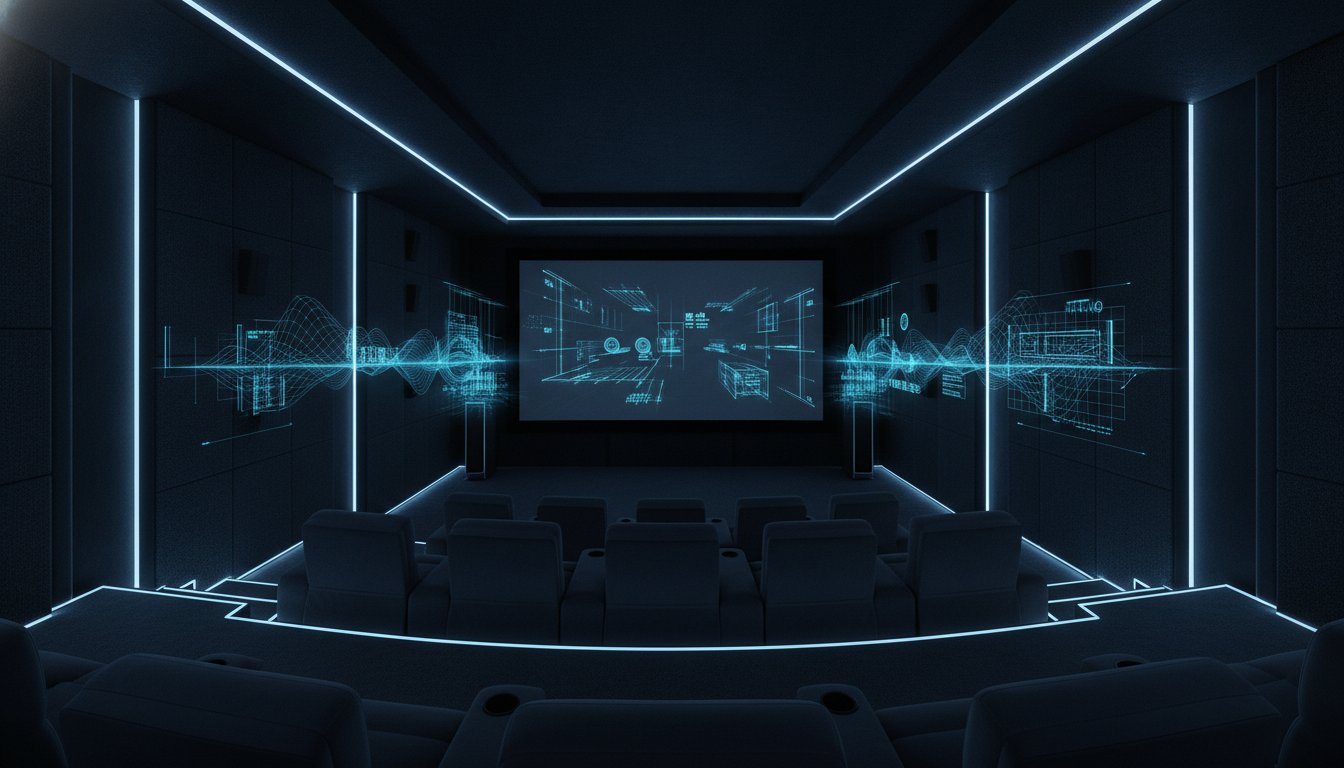
A premium equipment list does not guarantee a cinematic experience; more often than not, it simply creates a louder version of a standard living room. Achieving true cinema grade home theater design requires moving beyond the retail mindset of purchasing components and entering the realm of architectural engineering. You likely understand that the difference between a high-end media room and a professional cinema lies in the invisible details, yet the path to get there is often fraught with friction. Many homeowners find themselves managing a rotating door of fragmented contractors, only to end up with systems that are difficult to operate and acoustic environments that underperform despite the expense.
This article explores the integrated technology and meticulous planning necessary to eliminate these burdens and deliver a professional-grade screening environment. We will examine how a unified engineering approach transforms raw space into a turn-key sanctuary of light, sound, and intuitive control. By shifting the focus from individual hardware pieces to a holistic system, you can ensure your private theater rivals the world's most prestigious commercial venues through a single point of accountability.
Key Takeaways
- Distinguish between multi-purpose media rooms and dedicated private cinemas by applying rigorous industry standards from Dolby, DTS, and SMPTE.
- Master the architectural engineering principles of acoustic physics and sightline calculation to ensure peak performance from every seat in the room.
- Recognize why cinema grade home theater design necessitates separate processors and power amplifiers to achieve true high-fidelity immersion.
- Prioritize the invisible backbone of the experience by integrating enterprise-grade networking and dedicated thermal management for high-heat electronics.
- Navigate the complexity of the project lifecycle through a structured roadmap that transitions from lifestyle discovery to precise technical blueprints.
Defining the Cinema-Grade Standard for Private Residences
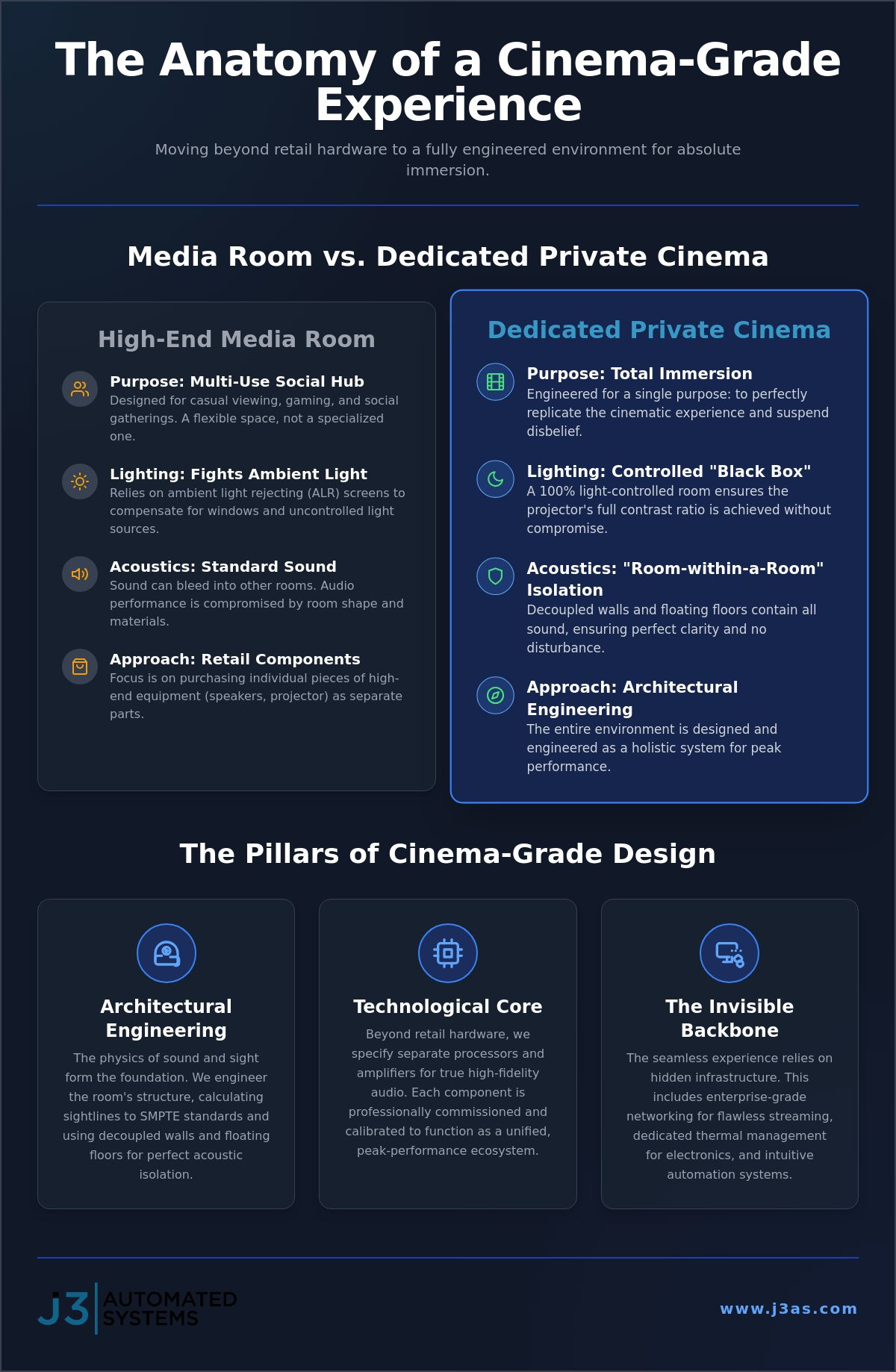
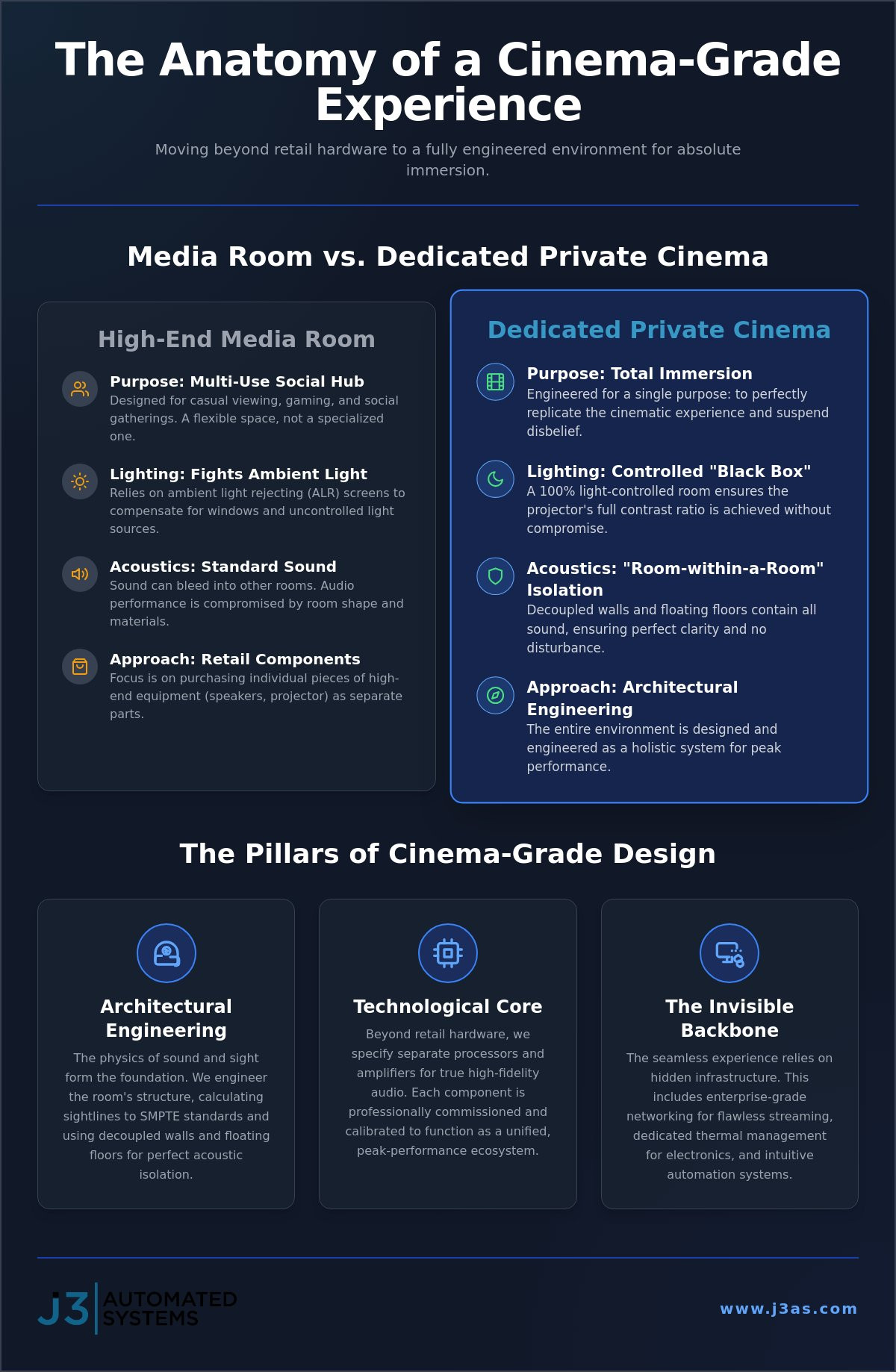
A fundamental distinction exists between a high-end media room and a dedicated private cinema. While a media room serves as a multi-purpose social hub for gaming or casual viewing, a dedicated cinema is an engineered environment designed for a single purpose: absolute immersion. Achieving a true cinema grade home theater design requires adhering to the same rigorous technical benchmarks used by professional post-production houses. These standards, established by organizations like the Society of Motion Picture and Television Engineers (SMPTE) and Dolby Laboratories, dictate everything from the exact luminance of the screen to the precise decay rate of sound within the room.
The psychological impact of this precision is profound. When a room is perfectly calibrated, the physical environment disappears. This phenomenon, often called the suspension of disbelief, allows the viewer to move from observing a screen to being present within the narrative. While many homeowners aim for a high-end home cinema experience, the technical threshold for a dedicated room is significantly higher than most realize. It isn't just about the equipment; it's about the architectural control of the environment.
The Anatomy of a Dedicated Private Cinema
- Controlled Lighting: Unlike media rooms that rely on ambient light rejection (ALR) screens to fight windows, a dedicated cinema is a "black box." This allows for a 100 percent controlled environment where the projector's contrast ratio is never compromised.
- Sound Isolation: True cinema design utilizes "room-within-a-room" construction. This prevents outside noise from entering the sanctuary and ensures that high-impact low frequencies don't disturb the rest of the property.
- Tiered Seating: Sightlines are calculated to the millimeter. Tiered platforms ensure that every viewer has an unobstructed view of the entire screen surface, regardless of where they sit.
Beyond Retail Hardware: The Engineering Mindset
Purchasing the most expensive projector or speakers on the market is only the beginning of the process. High-end components often fail to meet their potential because they lack professional system commissioning. A visionary integrator doesn't just deliver boxes; they provide a white-glove service that includes thermal management, signal path optimization, and acoustic tuning. This ensures that the hardware functions as a unified ecosystem rather than a collection of disparate parts. Cinema-grade design is the intersection of architectural physics and digital precision. By focusing on the engineering of the space rather than the labels on the equipment, you create a screening environment that is both technically superior and emotionally resonant.
Architectural Engineering: The Physics of Sound and Sight
True cinema grade home theater design begins with the structural integrity of the room itself, long before a single speaker is unboxed. While typical retail solutions focus on hardware, professional engineering prioritizes the physics of the environment. This involves managing the complex interaction between sound waves and physical surfaces. Without structural isolation, low-frequency energy from powerful subwoofers can vibrate the entire house, muddying the audio and disrupting other residents. By utilizing floating floors and decoupled walls, we ensure that energy remains contained within the theater, preserving the purity of the soundstage.
The science of sightlines is equally critical. We calculate optimal viewing angles for every seat to ensure a 45 degree field of vision, adhering to SMPTE standards. This prevents neck strain and ensures that the 4K or 8K resolution of your high-fidelity audio and visual systems is fully appreciated. When engineering these spaces, we often integrate hidden technology to maintain a clean aesthetic. Motorized lifts and recessed equipment allow the complex machinery to disappear, leaving only the experience behind. If you're ready to move beyond basic setups, you can consult with an engineering partner who understands these hidden connections.
Acoustic Treatment vs. Interior Aesthetics
A common friction point in luxury design is the conflict between acoustic performance and interior decor. Hard surfaces like stone, glass, and wood are visually stunning but acoustically chaotic, causing harsh reflections that destroy dialogue clarity. We solve this by using bespoke fabric walls that conceal high-performance absorption and diffusion panels. Integrated bass traps are built into the room's architecture to manage standing waves, ensuring that bass notes are tight and punchy rather than boomy and overwhelming. This meticulous planning allows for a room that looks like a designer lounge but performs like a world-class studio; to achieve this balance, you can explore Banken for high-end furniture that prioritizes both aesthetics and comfort.
Visual Optimization and Projector Engineering
Visual clarity is a product of precise math. We calculate throw distance and screen gain to match the projector's lumen output to the specific dimensions of the room. Using anamorphic lenses allows for a true 2.40:1 cinematic aspect ratio, eliminating the "black bars" found on standard consumer displays. Professional colorimetry and calibration then align the system with the director's intent, ensuring that every frame possesses the exact color temperature and dynamic range intended during post-production. This level of detail ensures that your theater isn't just a room with a screen, but a calibrated instrument for storytelling.
The Technological Core: High-Fidelity Audio and Visual Systems
The technological core of a private cinema is an ecosystem of high-performance components that must work in perfect synchronicity. While the architectural shell defines the limits of the experience, the active electronics define the resolution of the story. Achieving a true cinema grade home theater design requires moving beyond integrated receivers and toward a modular approach. This involves utilizing separate processors and power amplifiers to ensure every speaker has the necessary headroom to handle sudden dynamic shifts without distortion. A dedicated processor manages the complex decoding of immersive formats like Dolby Atmos, DTS:X, and Auro-3D, while independent amplifiers provide the raw current needed for high-fidelity playback.
Screen technology also demands a strategic choice based on the room's layout. Perforated acoustically transparent screens are a hallmark of professional design. They allow for the placement of the center-channel speaker directly behind the screen surface. This ensures that dialogue originates from the actors' mouths, creating a more authentic experience than solid surfaces that force speakers above or below the frame. For the visual engine, laser light sources are the definitive standard in 2026. They provide consistent luminance and a wider color gamut compared to traditional lamps, ensuring the image remains vibrant for thousands of hours without the need for frequent maintenance.
Immersive Audio Arrays
Modern private cinemas utilize object-based audio configurations such as 9.2.4 or 11.4.6 arrays. These numbers represent the ear-level speakers, the subwoofers, and the overhead height channels. In a 9.2.4 system, nine speakers provide a horizontal surround field, while four ceiling-mounted speakers create a three-dimensional hemisphere of sound. Subwoofer placement is equally vital. We don't simply place a single unit in a corner; we use multiple subwoofers strategically positioned to cancel out room modes and provide uniform bass response across every seat. This ensures that a low-frequency impact feels as powerful in the back row as it does in the front.
Display Technology for Large-Scale Private Cinema
Large Texas estates often require substantial screen sizes that demand high-lumen output. High-performance models like the Sony BRAVIA Projector 9 provide the brightness necessary to fill 150 inch screens with 4K clarity. For clients seeking the ultimate in contrast and brightness, MicroLED video walls are becoming an increasingly popular choice in luxury residential design. These modular displays offer perfect black levels and peak luminance that exceeds traditional projection. Regardless of the display type, supporting HDR10+ and Dolby Vision is essential to capture the full dynamic range of modern cinematic content, ensuring that highlights are bright and shadows retain their detail.
The Invisible Backbone: Automation, Networking, and Climate Control
The most sophisticated audio and visual components are only as reliable as the infrastructure that supports them. While the screen and speakers command attention, the invisible backbone of a cinema grade home theater design determines the long term functionality and ease of use. A common failure in luxury installations is the reliance on consumer grade networking, which lacks the bandwidth to handle high-bitrate 4K streaming alongside complex control signals. We implement enterprise-grade resilient networking to ensure that every command is executed instantly and every stream remains buffer-free. This foundation eliminates the friction of system lag, allowing the technology to serve the experience rather than distract from it.
Thermal management is another critical, yet often overlooked, engineering requirement. High-performance AV racks generate significant heat, especially when housed in enclosed equipment closets. In the humid environments of Austin and Boerne, standard residential HVAC often fails to address these localized heat loads. We integrate dedicated cooling solutions and automated thermal monitoring to protect your investment from premature component failure. This level of planning ensures that the "brain" of your theater operates within optimal temperature ranges, regardless of how long your cinematic marathon lasts. To ensure your system is built on a stable foundation, you can explore our integrated engineering services.
Centralized Control Systems
A true private cinema should require no technical knowledge to operate. We consolidate fragmented remotes and disparate apps into a single, intuitive interface. Through custom programmed scenes, a "Movie Start" command initiates a choreographed sequence: the lighting dims to a specific percentage, motorized shades seal the room from ambient light, and the projector fires up. This automation extends to proactive maintenance; we utilize AI-driven monitoring to detect system anomalies before they become visible problems. This shift from manual effort to intelligent operation creates a sense of calm reliability.
Low-Voltage Wiring and Infrastructure
Future-proofing a theater requires a forward-thinking approach to cabling. We utilize fiber optic and Category 6A wiring to provide the headroom necessary for future 8K or 16K video standards. Beyond data, the power delivery must be equally precise. Dedicated power circuits and medical-grade surge protection shield sensitive electronics from the voltage fluctuations common in Texas power grids. By treating the low-voltage infrastructure as a permanent architectural element, we ensure that your cinema grade home theater design remains relevant and functional for decades, not just years.
Navigating Your Home Theater Project in San Antonio and Austin
A project of this magnitude is a structured lifecycle rather than a simple retail transaction. Moving from a conceptual vision to a functional reality requires a methodical progression that respects both architectural constraints and technical requirements. The process begins with a dedicated Discovery Phase, where we map your specific lifestyle requirements and aesthetic preferences to the technical possibilities of the space. This isn't about choosing brands; it's about defining the performance goals that will guide the entire cinema grade home theater design. By establishing these benchmarks early, we eliminate the mid-project pivots that often lead to system friction and budget overruns.
Once the vision is clear, we move into the Engineering and Design phase. This stage produces the detailed low-voltage and architectural blueprints necessary for a seamless build. We calculate every cable run, thermal load, and acoustic reflection before a single technician arrives on-site. The physical implementation follows, characterized by a meticulous approach to hardware procurement and installation. However, the most critical step is the final Commissioning and Tuning. This is an engineering audit where we calibrate every pixel and decibel to ensure the system reaches its peak performance. We don't just hand over a remote; we deliver a verified, high-performance instrument that is backed by long-term support to evolve alongside future technology.
Choosing a Single Accountable Partner
The greatest risk to a luxury theater project is the fragmentation of responsibility. When you hire separate AV installers, electrical contractors, and automation specialists, you inherit the burden of managing their coordination. This often results in "finger-pointing" when systems fail to integrate properly. J3 acts as a single point of accountability, managing the delicate intersection between physical architecture and digital processes. We've seen this transformation firsthand in Texas estates where disparate systems were unified into a single, cohesive environment. By taking ownership of the entire roadmap, we ensure that the final result is a turn-key sanctuary rather than a collection of uncooperative gadgets.
Next Steps for Your Central Texas Estate
If you're planning a new construction or a significant renovation in San Antonio, Austin, or Boerne, the best time to engage an integrator is during the initial architectural planning. This allows us to integrate the necessary infrastructure into the very bones of the property. We can work directly with your architects and interior designers to ensure that the theater is a natural extension of your home's design language. Your automation roadmap should be as detailed as your structural plans to ensure long-term functionality and ease of use. To take the first step toward a bespoke screening experience, you can Begin your cinema-grade journey with J3 Automated Systems today.
Elevating Your Private Cinema Roadmap
A private theater is more than a room with a screen; it's a calibrated environment where architectural physics and digital precision converge. Success depends on the invisible details. Achieving cinema grade home theater design requires moving beyond the friction of fragmented contractors and toward a unified engineering philosophy. By prioritizing resilient networking and thermal management, you ensure that the technology remains a silent servant to the story.
J3 Automated Systems provides the deep-thinking partnership necessary to navigate this complexity. Our single accountable engineering team specializes in sophisticated low-voltage integration, removing the burden of system friction for clients across San Antonio, Austin, and the Hill Country. We move from lifestyle discovery to the final commissioning audit with precision. This ensures your investment delivers long-term functionality and professional-grade performance.
Schedule a Private Cinema Design Consultation
Your journey toward a professional-grade screening experience is a transformation from manual effort to intelligent, effortless operation. We look forward to helping you realize a vision that rivals the world's most prestigious theaters.
Frequently Asked Questions
How much space is required for a dedicated cinema-grade home theater?
A dedicated cinema typically requires a minimum of 15 by 20 feet to accommodate two rows of tiered seating comfortably. While smaller rooms are possible, this footprint allows for the optimal calculation of sightlines and the placement of immersive audio arrays without compromising the soundstage. Ceiling height is equally vital; 10 feet or more is preferred to allow for the vertical clearance needed for a second tier of seating.
What is the difference between a 4K projector and a 4K television for home cinema?
The primary difference is the scale of the experience and the management of light. A 4K projector creates an immersive image that fills your entire field of vision, which is a hallmark of cinema grade home theater design. While 4K TVs offer high peak brightness, they're limited by physical size and bezel friction. Projectors, especially when paired with an acoustically transparent screen, allow the audio and visual elements to originate from the same plane.
Do I need to soundproof my room if I live in a large estate?
Sound isolation is necessary even on isolated estates to lower the internal noise floor and manage low-frequency vibration. Isolating the room prevents the powerful energy of subwoofers from traveling through the home's structure and vibrating other living spaces. It also ensures that the theater remains a silent sanctuary, free from the hum of HVAC systems or the sound of footsteps in adjacent hallways. To ensure your home's cooling system is equally quiet and efficient, you can explore AC Installation with Caribbean Heating & Cooling.
Can my existing home automation system integrate with a new theater design?
Most existing automation platforms can be integrated into a new theater through a unified control interface. A visionary integrator sees the hidden connections between your lighting, climate, and AV systems, consolidating them into a single point of operation. This ensures that a "Movie Start" command simultaneously dims the lights, fires the projector, and sets the temperature for a seamless transition into the screening experience.
Why is a resilient network important for a private cinema?
High-performance theaters rely on resilient networking to manage the massive data loads required for uncompressed 4K and 8K content. Enterprise-grade infrastructure prevents the friction of buffering and ensures that control commands are executed instantly across the ecosystem. Without a robust network backbone, even the most expensive hardware will suffer from technical lag and intermittent connectivity issues during high-bitrate playback.
How long does a bespoke home theater installation typically take?
A bespoke installation typically spans 4 to 12 weeks for the physical implementation phase. However, the total project lifecycle, including discovery and architectural engineering, often aligns with the broader construction schedule of a luxury home. This methodical pace ensures that every component is meticulously commissioned and tuned before the first screening takes place, providing a polished and reliable final result.
What is acoustic calibration and why is it necessary?
Acoustic calibration is the process of using digital signal processing to align your speakers with the unique physical properties of your room. This is necessary because every environment has different reflection points and resonance characteristics that can muddy the audio. Professional tuning ensures dialogue clarity and a balanced soundstage, allowing the equipment to perform exactly as the director intended during the original sound mix.
Can a home theater be designed for a room with large windows, common in Austin homes?
Achieving a cinema grade home theater design in a glass-heavy room requires automated blackout shades and high-lumen light sources. In Austin homes where glass is a prominent architectural feature, we integrate motorized shading that seals the room from ambient light at the touch of a button. For spaces where complete darkness isn't possible, high-output laser projectors or MicroLED video walls provide the necessary contrast to maintain visual clarity.