ROI of Custom Software: 2026 Guide for Texas Leaders

The most significant drain on your firm's profitability isn't a line item on your ledger; it's the invisible friction of software that wasn't built for your specific workflow. While off-the-shelf subscriptions promise convenience, they often create a fragmented landscape where data sits in silos and manual administrative tasks drain your team's most valuable hours. Understanding the true roi of custom business software requires looking beyond the initial investment to see a strategic architectural asset. In 2026, Texas leaders are realizing that bespoke systems do more than solve problems. They provide a scalable digital backbone that compounds in value as your organization grows.
You likely already recognize that rigid tools are capping your company's ability to scale efficiently. This guide will show you how to eliminate that operational friction and achieve quantifiable labor savings through intelligent AI integration. We will explore the latest 2026 Texas R&D tax credit updates and the specific ways high-end automation transforms manual burdens into streamlined, intelligent processes. We'll also examine how a single, accountable engineering team can help you transition from a state of digital fragmentation to one of effortless, integrated operation.
Key Takeaways
- Identify the "Friction Tax" currently limiting your profitability and learn how bespoke systems replace manual workarounds with architectural precision.
- Discover how the roi of custom business software compounds over time by integrating scalability and intelligence into your company’s digital backbone.
- Compare the true five-year total cost of ownership between generic SaaS and custom-engineered tools to make an informed investment decision.
- Use Business Process Mapping to audit operational bottlenecks and establish a quantitative roadmap for your projected financial returns.
- Learn why a single accountable team is essential for navigating the complex journey from initial software discovery to final commissioning.
Beyond the Invoice: Understanding the "Friction Tax" on Business Growth
The "Friction Tax" is the silent predator of organizational momentum. It represents the cumulative, often unmeasured cost of manual workarounds, duplicate data entry, and the technical debt accrued from using tools that weren't designed for your specific operations. While many organizations view software as a simple utility, a visionary leader understands that the true Return on Investment (ROI) isn't found in a lower monthly subscription price. It's found in the removal of systemic resistance. In the hyper-competitive 2026 environment, businesses can't afford the drag of "standard" tools. Staying competitive requires a level of precision that off-the-shelf software simply cannot provide.
The Hidden Costs of Fragmented Legacy Systems
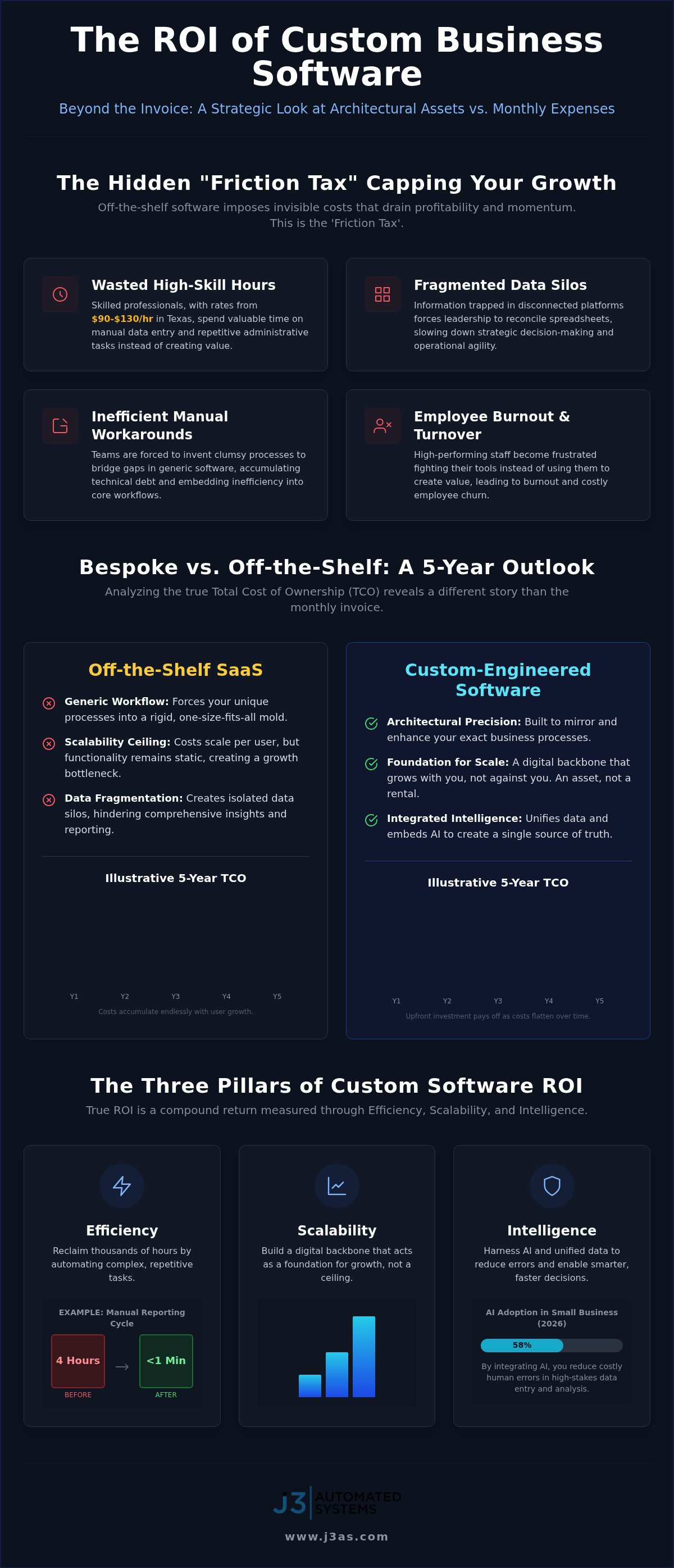
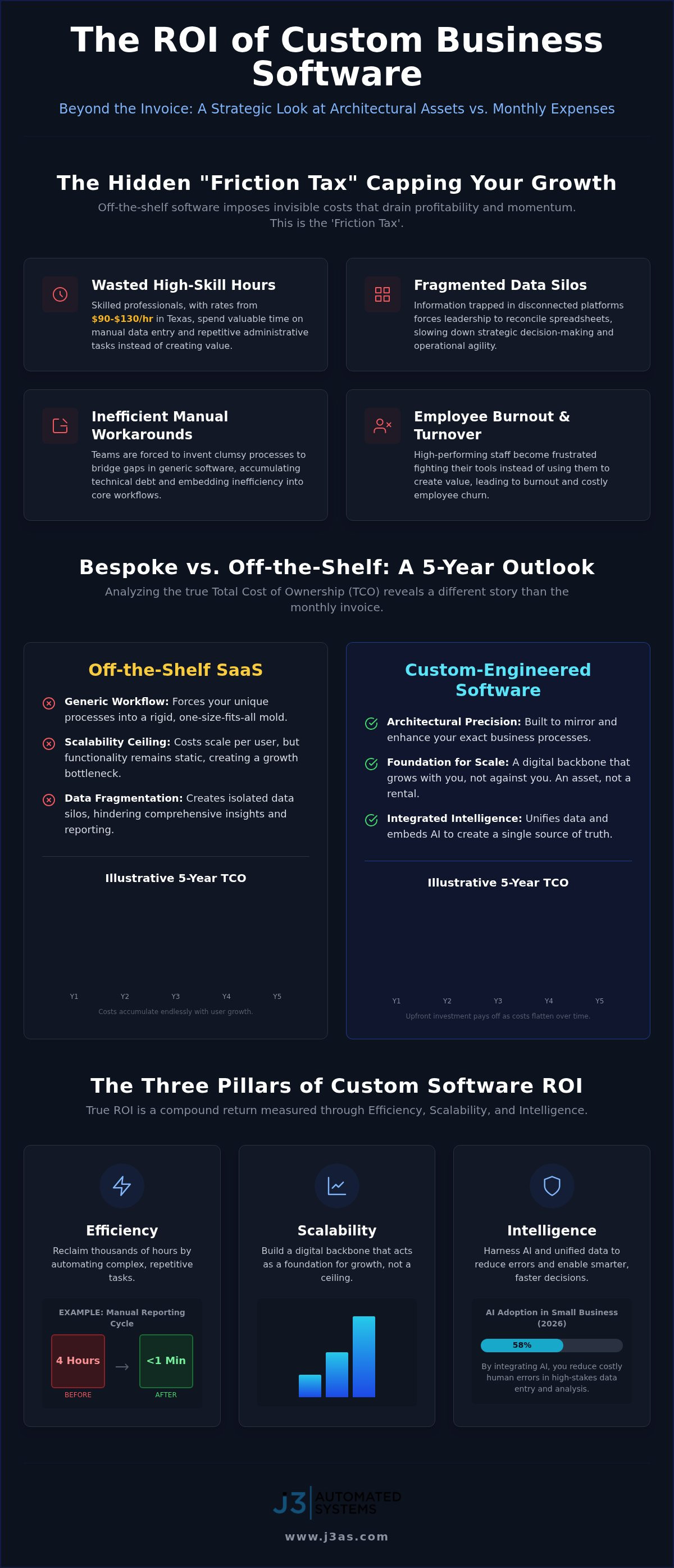
Data silos are more than just a technical inconvenience; they are a primary drain on executive decision-making speed. When information is trapped across multiple, disconnected platforms, your leadership team spends hours reconciling spreadsheets rather than executing strategy. In the current Texas labor market, where mid-level developer rates range from $90 to $130 per hour, paying skilled professionals to perform repetitive administrative tasks is an inefficient use of capital. This systemic friction does more than hurt the bottom line. In San Antonio firms, it's a leading cause of employee burnout. High-performing staff members don't want to fight their tools; they want to use them to create value. When the software becomes a barrier, turnover is the inevitable result.
Why Off-the-Shelf Solutions Often Create a Scalability Ceiling
Many businesses fall into the "subscription trap," where costs scale linearly with user counts while functionality remains static. This creates a rigid ceiling that prevents true growth. Off-the-shelf platforms are built for the average user, meaning they force your unique business workflows into a generic mold. This clunky nature stands in stark contrast to the white-glove efficiency of a custom system. By investing in bespoke internal tools, you're building a digital backbone that grows with your company. This architectural approach ensures that your systems act as a foundation for long-term resilience rather than a bottleneck. Calculating the roi of custom business software requires looking past the invoice to see how an integrated system empowers your team to move with fluidity and purpose. Custom systems eliminate the burden of adapting your business to your software, allowing the technology to adapt to you instead.
The Three Pillars of Software ROI: Efficiency, Scalability, and Intelligence
True return on investment is multi-dimensional. It isn't just about immediate cash flow; it's about the compounding value of a system that works harder over time. By moving away from siloed tools, leaders can adopt a framework that measures success through efficiency, scalability, and intelligence. This holistic view is supported by a guide for managers on IT return on investment, which highlights the need for rigorous business process modeling before implementation. When you treat software as an architectural asset rather than a monthly expense, you unlock a digital backbone that supports every facet of your operation.
Direct Labor Savings via AI and Process Automation
Automation is no longer just about following rules; it's about engineering intelligence. With 58% of small businesses now utilizing generative AI in 2026, the focus has shifted toward AI business process automation to handle complex, repetitive tasks. Imagine a custom dashboard that harvests data from across your organization, reducing a four-hour reporting cycle to mere seconds. Our "Visionary Integrator" approach maps these workflows with precision, ensuring that the roi of custom business software is realized through reclaimed labor hours that can be redirected toward high-value strategy.
Operational Fluidity and Error Reduction
The financial impact of human error in high-stakes data entry can be devastating. By investing in custom web app development in San Antonio, companies create a single source of truth that eliminates the burden of reconciliation. This seamlessness creates a state of calm reliability. When your digital systems remove the burden from your staff, you see a measurable lift in both morale and accuracy. If you're ready to see how these systems could align with your goals, you can review our architectural approach to integration.
Future-Proofing Through Scalable Architecture
Owned digital assets provide a level of security that rented SaaS never can. While generic platforms often lock you into escalating licensing tiers, a custom system evolves alongside your business. In the rapidly expanding Austin and San Antonio corridors, market shifts require a digital backbone that can pivot without a total overhaul. The projected 22.6% compound annual growth rate for the custom software market through 2030 underscores this shift toward permanent, scalable solutions. A well-engineered platform isn't just a tool; it's a long-term asset that ensures your roi of custom business software continues to grow as your company expands.
Bespoke vs. Off-the-Shelf: Analyzing the Total Cost of Ownership (TCO)
Evaluating the roi of custom business software requires an engineering-first mindset that looks far beyond the initial implementation invoice. Generic SaaS products often present an attractive entry price, but their long-term financial trajectory is frequently misleading. Over a five-year horizon, the "rented" model often reveals a series of hidden burdens that erode profitability. In contrast, a bespoke system represents a capital investment in a permanent asset. While the upfront costs are higher, the long-term expenditure stabilizes as the value of the system compounds. This shift from an operational expense to a strategic asset is what separates visionary leaders from those simply managing technical debt.
The Subscription Trap: Licensing Fees and Hidden Upsells
For a growing San Antonio team, per-user licensing fees act as a tax on your company's success. As you scale your workforce, your monthly overhead increases automatically without providing a corresponding increase in functionality. Many off-the-shelf platforms also gate essential features behind "premium" tiers or charge extra for third-party integrations that should be standard in any professional environment. This vendor lock-in leaves businesses vulnerable to sudden price hikes and forced upgrades that don't align with their specific needs. In 2026, research indicates that annual maintenance for custom systems typically averages between 6% and 10% of the initial development cost. This offers a predictable and often lower long-term expenditure compared to the escalating costs of high-tier SaaS subscriptions.
The Integration Tax: When "Off-the-Shelf" Requires Custom Duct Tape
One of the most significant uncalculated costs in modern business is the "integration tax." This occurs when organizations attempt to force disparate generic tools to communicate, often resulting in a fragile web of middleware and manual data syncing. Many firms find themselves hiring developers anyway, just to build "duct tape" solutions for gaps in their generic software. This fragmented approach leads to significant time loss as employees struggle with incompatible interfaces and data silos. A unified digital backbone eliminates this friction entirely. By partnering with a single accountable team for custom software for business efficiency, you ensure every component of your system is designed to work in harmony from day one. This architectural precision removes the burden of manual intervention, allowing your staff to focus on high-level strategy rather than data entry. It's the difference between managing a collection of tools and commanding a single, intelligent system.
A Quantitative Roadmap: How to Calculate Your Projected Returns
Calculating the roi of custom business software requires a methodical transition from abstract goals to concrete metrics. It begins with Business Process Mapping, a rigorous engineering exercise that visualizes your current operations to identify where intelligence can replace manual effort. This isn't just about technical implementation; it's about defining a strategy for digital transformation for local businesses that aligns with long-term financial objectives. By assigning value to both reclaimed time and improved client experiences, you can build a roadmap that justifies the investment through compounding returns.
Step 1: The Friction Audit (Identifying Labor Leaks)
The first stage involves tracking "shadow work," which includes the repetitive tasks employees perform simply to compensate for inadequate software. Labor leak is the silent killer of Texas SMB profitability. In the current 2026 market, mid-level professional rates in Austin and San Antonio often sit between $90 and $130 per hour. If a single manager wastes five hours per week on manual data reconciliation, that represents an annual loss of approximately $28,600 based on a $110 hourly benchmark. When multiplied across a leadership team, these leaks represent a significant drain on capital that a custom system could easily reclaim.
Step 2: Projecting Revenue Acceleration
Beyond simple savings, bespoke systems act as a catalyst for revenue growth. Faster internal workflows lead to higher throughput, allowing your team to close more deals and manage more projects without increasing headcount. Custom web portals also enhance the customer experience, providing a white-glove interface that differentiates your brand from competitors using generic tools. In the fast-moving Texas corridors, being the fastest responder in your local market is a primary driver of market share. This competitive advantage is a critical, yet often overlooked, component of the roi of custom business software.
Step 3: Calculating the Payback Period
It's vital to distinguish between a simple "break-even" point and the generation of compounding value. While off-the-shelf subscriptions are a recurring cost that never ends, bespoke internal business tools are assets that you own. Most high-impact custom systems reach their initial payback period within 12 to 18 months, after which the savings and efficiency gains contribute directly to your bottom line. To understand how these numbers apply to your specific organization, you should schedule your architectural discovery session to evaluate your current digital backbone.
Engineering Your Digital Backbone: The J3 Approach to Custom Systems
J3 Automated Systems operates as a visionary integrator, seeing the hidden connections between your digital tools and your physical environment. Our "Discovery to Commissioning" process ensures that your roi of custom business software is maximized through meticulous planning and craftsmanship. We begin by defining the problem with intellectual rigor before presenting a multi-layered solution. By bridging the gap between commercial building management systems and bespoke internal tools, we create a unified ecosystem that eliminates friction at every touchpoint.
The Power of a Single Accountable Team
Project risk often stems from fragmented communication between multiple, disconnected vendors. When a single team handles mapping, engineering, and implementation, you gain a partner who is fully accountable for the final result. This "white-glove" service model is especially valuable for firms in the San Antonio, New Braunfels, and Austin regions, where local support ensures ongoing system tuning. We don't just deliver a product; we steward your digital experience to ensure long-term functionality. Our expertise in custom web apps and AI integration provides a scalable digital backbone that grows alongside your organization.
Next Steps: From Fragmentation to Intelligent Operation
The journey from operational drag to effortless operation begins with a single strategic decision. By choosing to build a scalable digital backbone, you're investing in the future resilience of your company. We invite you to move beyond the limitations of generic SaaS and embrace a system designed for your specific vision. It's time to remove the burden of inefficient technology and reclaim your team's focus. Schedule your custom software discovery session with J3 Automated Systems to begin mapping your digital roadmap and unlock the full roi of custom business software. This intelligent transformation ensures your business remains agile, integrated, and poised for compounding success in 2026 and beyond.
Architecting Your Competitive Advantage
The distinction between a market leader and a struggling firm in 2026 often rests on the structural fluidity of their digital systems. By eliminating the "friction tax" of fragmented tools and replacing it with a cohesive digital backbone, you're doing more than just upgrading your technology. You're securing a permanent asset that compounds in value over time. Calculating the roi of custom business software involves recognizing the shift from recurring operational expenses to a strategic, owned architecture that scales without penalty. It's a transition from managing complexity to commanding a unified system.
J3 Automated Systems brings a visionary integrator approach to every project, providing a single accountable team for Texas businesses. Our deep expertise in AI and process mapping ensures that your move from manual effort to intelligent operation is both seamless and precise. This architectural rigor removes the burden of administrative drag, allowing your leadership to focus on high-level growth and market expansion. Ready to transform your operations into a state of calm reliability? Engineer Your Digital Backbone: Schedule a Discovery Session. Your organization deserves a digital infrastructure that works as hard as your team does.
Frequently Asked Questions
How long does it typically take to see a positive ROI on custom software?
High-impact bespoke internal business tools typically achieve a positive return within 12 to 18 months. Unlike generic software subscriptions that represent a permanent, escalating expense, custom builds are capital assets that you own. Once the initial development phase is complete, the financial gains from reclaimed labor and increased throughput contribute directly to your bottom line. This predictable timeline allows Texas leaders to plan their digital roadmap with sophisticated confidence.
Is custom software only for large enterprises in San Antonio, or can SMBs benefit too?
Small and medium businesses often see the most dramatic returns by eliminating the systemic friction that caps their growth. While enterprises use custom tools for scale, SMBs in San Antonio use them for agility and to remove the "friction tax" of manual workarounds. Building a scalable digital backbone allows a smaller team to perform with the efficiency of a much larger organization, providing a high-tier competitive advantage in the local market.
How do I know if my business process is ready for AI integration?
Your process is ready for AI integration if it involves repetitive, data-intensive tasks that currently drain your team's labor hours. We begin with a rigorous Business Process Mapping phase to identify these hidden connections. If your staff spends more than five hours per week on manual data entry or reconciliation, the roi of custom business software becomes self-evident. Intelligence is most effective when it replaces predictable, high-volume administrative burdens.
What is the "Total Cost of Ownership" for custom software compared to SaaS?
The total cost of ownership for custom software involves a higher initial investment followed by stable, predictable maintenance costs, usually 6% to 10% annually. In contrast, SaaS products often hide costs behind per-user licensing and premium integration tiers that scale as your business grows. Over a five-year horizon, owning your digital assets frequently results in a lower cumulative expenditure while providing a system tailored specifically to your unique workflows.
Can custom software integrate with my existing physical building automation systems?
Yes, our engineering-first approach specializes in bridging the gap between digital processes and physical environments. We integrate custom web applications directly with commercial building automation systems, including HVAC, lighting, and networking infrastructure. This holistic integration creates a state of harmony across your entire property. By unifying your physical and digital assets, you remove the burden of managing disparate systems and achieve a higher level of intelligent, effortless operation.
What happens to the ROI if my business needs change in two years?
Custom systems are designed with modular architecture, allowing them to evolve alongside your organization. If your business model pivots in two years, your software can be adjusted without the need for a total replacement or expensive third-party upgrades. This adaptability is a core component of the roi of custom business software. It ensures that your investment remains a functional asset rather than becoming a rigid scalability ceiling that limits your future potential.
How does J3 ensure the software actually gets adopted by my team?
J3 ensures adoption through our "Discovery to Commissioning" process, which prioritizes the user experience from the initial mapping phase. We design tools that remove the burden of clunky interfaces, creating a "white-glove" atmosphere for your staff. When software simplifies a worker's day by automating repetitive tasks, adoption happens naturally. Our single accountable team remains involved through the final commissioning to ensure the system is tuned for peak performance.
Is bespoke software more secure than off-the-shelf solutions for Texas businesses?
Bespoke software offers superior security because it is built with a security-first development lifecycle tailored to your specific risk profile. Generic off-the-shelf solutions are often targets for mass exploits because they share a common codebase across thousands of companies. A custom system reduces your attack surface by eliminating unnecessary features and implementing precise access controls. This architectural precision provides a feeling of calm reliability for Texas businesses navigating the cyber threats of 2026.