Integrating Large Format Screens in Home Theaters: An Engineering Perspective
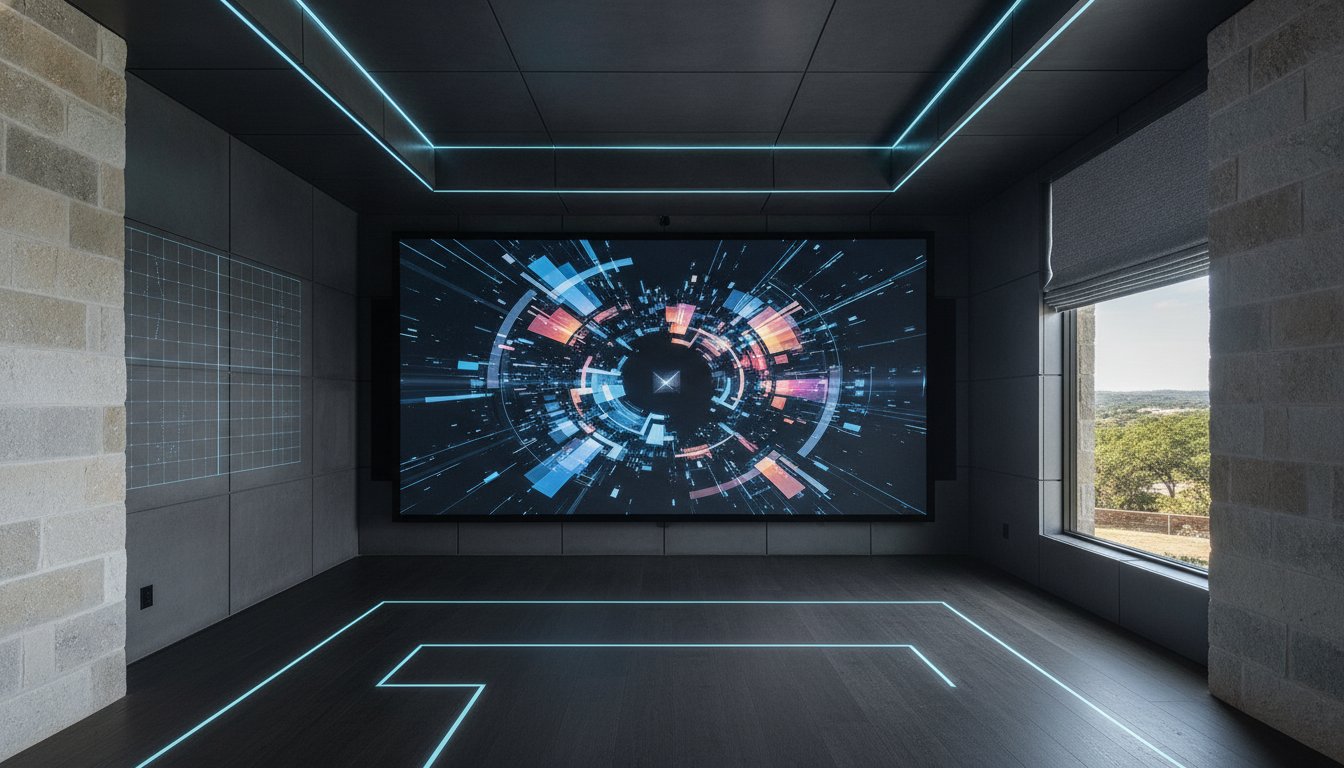
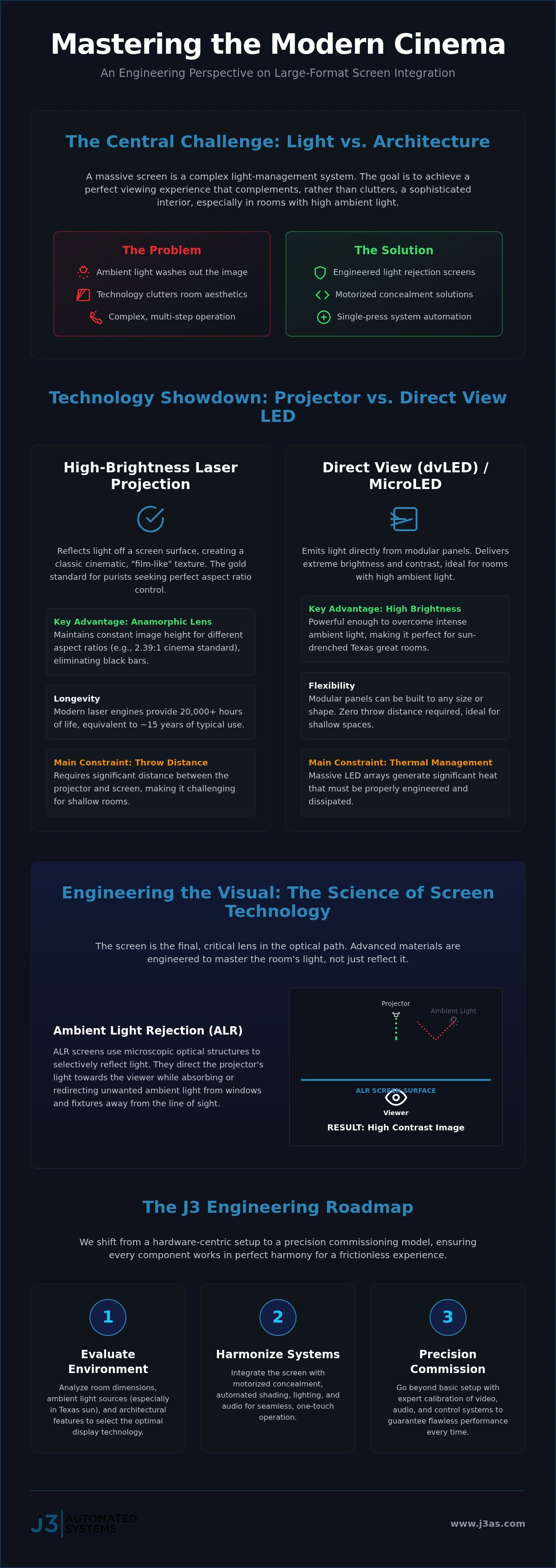
A massive screen isn't a piece of furniture; it's a complex light-management system that either masters its environment or is mastered by it. When you're integrating large format screens in home theaters, the challenge extends far beyond finding a wall with enough clearance. It requires a deep understanding of how light interacts with architecture, especially when the Texas sun threatens to wash out your investment. You've likely experienced the frustration of technology cluttering a room's aesthetic or the complexity of trying to sync audio and lighting for a simple movie night.
You deserve a system that works perfectly every time with a single button press. This article provides an engineering perspective on mastering the technical complexities of selecting and commissioning cinema-grade screens that complement your sophisticated interior design. We'll examine the critical role of high-brightness laser projection, the precision of acoustically transparent materials, and the automated shading systems required to achieve a frictionless viewing experience. By shifting the focus from hardware setup to holistic system commissioning, you can transform any space into a high-performance private cinema.
Key Takeaways
- Evaluate the distinct advantages of laser projection versus Direct View LED to select the optimal technology for your specific viewing environment.
- Master the technical complexities of integrating large format screens in home theaters by applying the science of light rejection to combat ambient glare.
- Achieve a seamless aesthetic by utilizing motorized concealment solutions that preserve the architectural integrity of your living space.
- Solve regional engineering challenges like thermal management for massive LED arrays and high-lumen performance in sun-drenched Texas interiors.
- Transition from a hardware-centric approach to a precision commissioning model that ensures every system component works in perfect harmony.
The Large Format Evolution: Projectors vs. Direct View LED
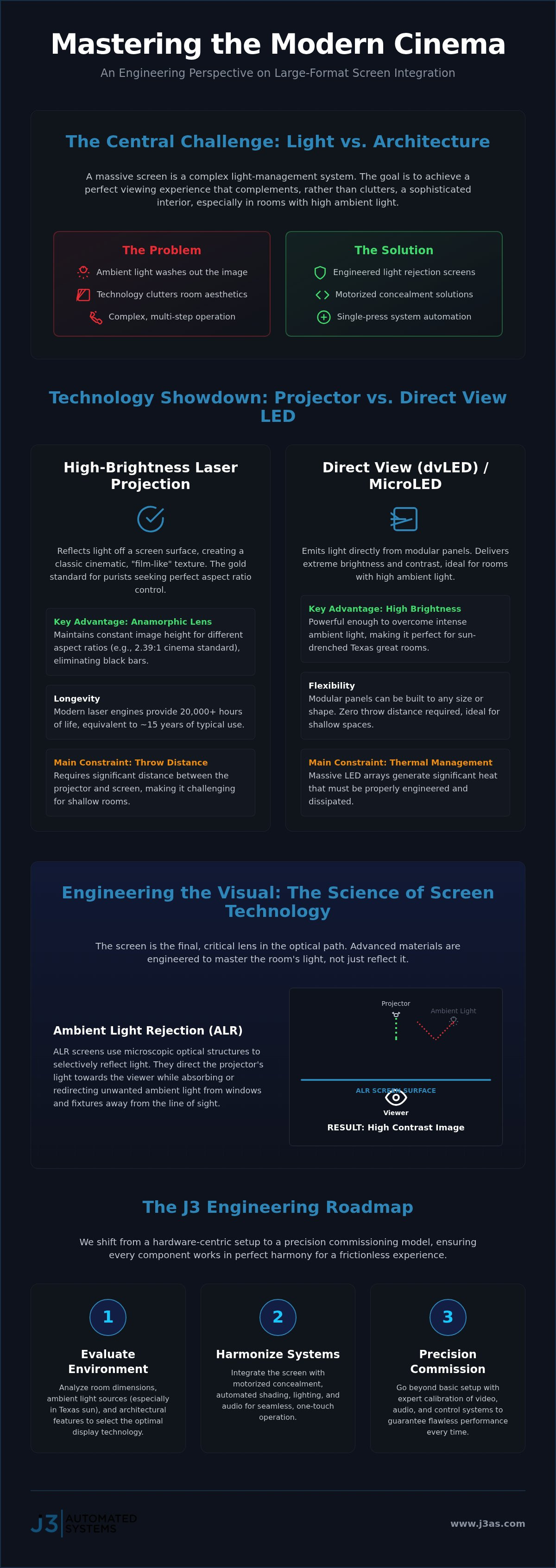
The choice between projection and light-emitting panels is no longer a simple matter of budget. It's a fundamental engineering decision that dictates the room's architecture, cooling, and lighting control. While projection has long been the standard for scale, the evolution of large-screen television technology in the form of Direct View LED (dvLED) has created a new paradigm for integrating large format screens in home theaters. This shift requires a nuanced understanding of how light behaves within a luxury environment.
True immersion is a product of pixel density and contrast rather than raw diagonal inches. While a projector creates a cinematic look by reflecting light off a substrate, dvLED panels emit light directly toward the viewer. This difference changes how we perceive depth and detail. Engineering a visual environment requires balancing this immersion factor with the room's physical constraints, ensuring the technology serves the experience without overwhelming the interior design. The battle between light reflection and light emission is won through precise contrast management and black level control.
The Projection Renaissance in 2026
Native 8K laser engines, such as the JVC DLA-NZ900, have redefined what's possible with reflected light. These systems deliver commercial-grade brightness that was once reserved for professional screening rooms. For the purist, projection remains the gold standard because it allows for the use of an anamorphic lens. This hardware maintains a constant image height across different aspect ratios, perfectly accommodating the 2.39:1 format that has become the standard for modern cinematic production. It's a solution that preserves the "film-like" texture many enthusiasts demand.
Direct View LED: The MicroLED Revolution
Direct View LED removes the throw distance constraint entirely. This allows for massive displays in shallow rooms where a projector's light path would be physically obstructed. These systems are particularly effective when integrating large format screens in home theaters within Texas estates, where floor-to-ceiling glass is common. High-brightness modular panels can compete with the intense ambient light of an Austin sunroom in ways that even the most powerful projectors cannot. Modular engineering allows these screens to be built to any specific dimension, creating a seamless visual surface that integrates perfectly with bespoke cabinetry or architectural features.
Longevity has also seen significant improvements. Modern laser projectors now offer a lifespan of 20,000 hours or more, providing roughly 15 years of consistent use without the maintenance burden of traditional bulbs. While LED panels offer similar durability, the engineering focus shifts to heat dissipation and diode consistency over time. Both technologies now provide the reliability required for a high-performance system that works perfectly every time.
Engineering the Visual Environment: Light Management and Screen Science
The screen is far more than a passive surface; it's the final lens in a theater's optical path. When integrating large format screens in home theaters, the engineering challenge lies in managing the physics of light within a specific architectural context. A screen that performs brilliantly in a dedicated blacked-out cinema will fail in a sun-drenched Texas "Great Room." Success requires a deep understanding of screen chemistry and the geometry of light reflection.
Ambient Light Rejection (ALR) and Ceiling Light Rejection (CLR) technologies utilize multi-layered optical filters to solve this. These materials are engineered with microscopic structures that redirect off-axis light, such as sunlight from a window or glow from a ceiling fixture, away from the viewer. Meanwhile, they reflect the projector's light path directly into the seating area. Optical gain is the ratio of light reflected by a screen compared to a standard white reference. While high-gain screens can boost brightness, they often introduce "hot-spotting" and narrow the horizontal viewing cone. An engineered approach balances these factors to ensure every seat enjoys a uniform, high-contrast image.
Managing Ambient Light in Open-Concept Theaters
In Austin and San Antonio luxury estates, open-concept living often means the theater must compete with floor-to-ceiling glass. Multi-layered ALR screens are essential here, but they must be meticulously matched to the projector's throw angle to avoid visual distortion. This level of precise system commissioning ensures that the image remains vibrant and saturated, regardless of the time of day or the room's lighting configuration.
Resolution Matching and Moire Interference
As native 8K engines become the standard, the physical texture of the screen becomes a critical variable. Traditional woven materials, while excellent for acoustic transparency, can create moire interference. This occurs when the projector's pixel grid aligns awkwardly with the screen's physical weave, creating distracting wavy patterns. To prevent this, engineering specifications for high-density displays now favor ultra-smooth, non-textured materials.
- Texture and Sparkle: High-gain coatings can sometimes exhibit "sparkle," a shimmering effect caused by reflective particles. We specify materials that maintain pixel integrity without adding artificial artifacts.
- Color Accuracy: The screen must be neutral to preserve the projector's color temperature. Professional ISF calibration treats the engine and the screen as a unified system to achieve true-to-life color reproduction.
- Acoustic Transparency: Micro-perforated materials allow for speaker placement behind the screen without sacrificing the 8K visual detail required for modern large-format viewing.
Harmonizing Architecture and Technology: Concealment and Flow
Luxury living spaces often demand a dual identity. A sophisticated great room must transition into a cinema-grade environment without the technology imposing on the interior design. This "Hidden Technology" philosophy focuses on removing visual friction, ensuring that massive displays only appear when called upon. When integrating large format screens in home theaters, the goal is to maintain the architectural flow of the home while delivering an uncompromised visual experience.
The engineering behind this transition involves more than just a motor. It requires a synchronized ballet of hardware and software. By integrating screens with automated lighting and shade control, the entire room transforms with a single command. Lights dim, shades descend, and the screen deploys in perfect unison. This holistic approach ensures that the technology complements the space rather than cluttering it. It allows a multi-purpose room to remain an elegant social area until the moment the movie begins.
Motorized Concealment Systems
Precision is the hallmark of a high-end installation. We utilize silent-drive motors equipped with precision tracking to ensure repeatable screen positioning within millimeters. In San Antonio estates, these systems often integrate into custom millwork or flush-mount ceiling housings. Trapdoor mechanisms provide a zero-footprint aesthetic, completely concealing the screen and its housing when the system is inactive. Floor-rising solutions offer an alternative for spaces where ceiling access is restricted, allowing a 120-inch surface to emerge from a low-profile cabinet or a hidden floor slot.
Acoustic Transparency: Sound Through the Image
True cinematic immersion requires the audio to originate from the center of the visual action. This is achieved through the engineering of micro-perforated or woven screen materials. These surfaces allow sound waves to pass through the screen with minimal interference, enabling the placement of large center-channel speakers directly behind the image. It's a technique that anchors the dialogue to the actors' faces, mirroring the setup of a professional mixing stage.
Achieving this "voice of god" effect requires meticulous calibration. While these materials are designed for transparency, they inevitably cause some high-frequency attenuation. We compensate for this loss through advanced digital signal processing (DSP), restoring the clarity and detail of the original soundtrack. This synergy between screen science and audio engineering creates a seamless experience where the technology disappears, leaving only the performance. By integrating large format screens in home theaters with this level of detail, we ensure the soundstage is as expansive as the visual field.
Designing for the Texas Estate: Regional Engineering Challenges
Texas estates present environmental challenges that standard home theater designs often overlook. The intense heat and relentless sunlight of the region aren't merely aesthetic hurdles; they are rigorous engineering constraints. Integrating large format screens in home theaters within Austin and San Antonio requires a specialized approach to thermal and light management to ensure the technology survives and thrives in these conditions. Without a localized engineering perspective, even the most expensive hardware can fail under the stress of the environment.
Direct View LED arrays are essentially massive light-emitting heat sources. During a peak Texas summer, dissipating the thermal energy from a 150-inch panel is critical to prevent premature diode degradation and maintain room comfort. We address this by integrating the theater with commercial building management systems Texas. This synchronization allows the home's climate control to proactively adjust based on the screen's power state, maintaining a precise temperature equilibrium without taxing the localized HVAC. It's a systems-thinking approach that prioritizes long-term functionality over a quick setup.
Combating the Texas Sun
Many luxury homes in Central Texas feature floor-to-ceiling glass, creating a high-lumen environment that can wash out even the most powerful displays. Achieving a true HDR experience requires a 0.005 nit black floor, an impossible feat without automated shading for large windows. Our engineering process involves coordinating screen brightness with multi-layered blackout shades that block visible light and provide a thermal barrier. We select materials specifically for their high solar reflectance and resistance to UV degradation, protecting the interior and the hardware from long-term exposure.
Infrastructure and Networking Requirements
The invisible backbone of a large-format system is its data and power delivery. Streaming uncompressed 8K content requires high performance residential networking that can handle massive throughput without latency. We design dedicated low-voltage wiring paths and enterprise-grade power conditioning to support the electrical load of cinema-grade hardware. This infrastructure must be resilient enough to handle the surges common in regional storms, ensuring your system works perfectly every time. To protect your investment with a system designed for Texas conditions, contact our engineering team for a site evaluation.
The J3 Engineering Roadmap: Precision Commissioning
A sophisticated viewing environment isn't merely the sum of its hardware components. It's the result of a methodical, multi-layered process that transforms raw technology into a seamless experience. When integrating large format screens in home theaters, the difference between a standard installation and a cinema-grade masterpiece lies in the roadmap. We view each project as a unique engineering challenge that requires a single, accountable team to manage everything from initial sightline analysis to final pixel calibration.
Our approach shifts the focus from simple equipment procurement to comprehensive system commissioning. It's not about selecting the most expensive brand; it's about identifying the specific material and technology that solves the architectural constraints of your space. This ensures that the final result isn't just functional, but optimized for the specific light, acoustics, and lifestyle requirements of your estate.
The Consultative Design Process
Precision begins long before the first bracket is mounted. We collaborate with architects and interior designers during the framing stage to ensure the infrastructure for massive screens is baked into the home's DNA. This early intervention allows us to engineer flush-mount housings and dedicated cooling paths that would be impossible to retrofit later. The Discovery phase serves as the essential foundation for any bespoke cinema project, ensuring the technical roadmap aligns with the client's unique vision. By mapping the visual experience to your daily habits, we create a unified automation roadmap that bridges the gap between AV, lighting, and security.
The Value of Professional Commissioning
The most common failure in luxury theaters is the reliance on "out of the box" settings. Factory presets are designed for showroom floors, not for the nuanced environment of a private Texas residence. Professional commissioning involves a rigorous calibration process where we tune the visual and audio systems as a single entity. We adjust for the specific gain of the screen material, the color temperature of the projector engine, and the acoustic response of the room. This level of detail is what produces the "voice of god" audio effect and the deep, ink-black levels discussed in previous sections.
- Frictionless Operation: We prioritize a user interface that removes the burden of complexity, allowing for a perfect experience with one button press.
- System Longevity: Meticulous mounting and alignment prevent mechanical stress on motorized components, extending the life of your investment.
- Accountability: A single team manages the entire project lifecycle, eliminating the fragmentation that often plagues high-end builds.
Our commitment doesn't end at the final walkthrough. We provide ongoing support and updates to ensure your system remains a pillar of resilient property technology. As standards evolve and new sources emerge, your system is engineered to adapt, maintaining its peak performance for years to come. Integrating large format screens in home theaters with this level of foresight ensures that the technology remains a source of joy rather than a source of friction.
Elevating Your Private Cinema through Engineering Excellence
The transition from a standard media room to a world-class viewing environment requires a fundamental shift in perspective. It's the move from viewing technology as a collection of devices to seeing it as a unified architectural system. We've examined how the evolution of laser engines and dvLED panels necessitates a deep understanding of light physics and thermal management, especially within the unique architectural landscape of Central Texas. Integrating large format screens in home theaters is a complex undertaking that demands more than simple installation; it requires a commitment to aesthetic harmony and precision commissioning.
As a single accountable team of specialists certified in Lutron and high-end AV, we bring a proven track record to luxury estates in San Antonio and Austin. We specialize in removing the burden of technical complexity, providing a frictionless experience that functions perfectly with one button press. Your vision of a cinema-grade environment is achievable when engineering rigor meets bespoke design. To begin the journey toward a truly immersive home experience, Schedule a Design Consultation for Your Private Cinema today.
Frequently Asked Questions
What is the difference between a high-end projector and a MicroLED wall?
High-end projectors reflect light off a surface; MicroLED walls emit light directly from millions of individual diodes. This fundamental difference means MicroLED offers superior peak brightness and perfect black levels, which is ideal for sun-drenched Austin great rooms. Projectors remain the choice for purists seeking a film-like texture in dedicated dark rooms. Integrating large format screens in home theaters requires choosing between these light-management philosophies based on your room's specific architecture.
Can I use a large format screen in a room with a lot of windows?
You can successfully deploy a large screen in high-light areas by utilizing Direct View LED or high-gain Ambient Light Rejection (ALR) materials. These technologies are engineered to combat the intense Texas sun common in San Antonio estates. By pairing these screens with automated blackout shades, we achieve the deep black levels required for high dynamic range content even during the brightest part of the day.
How do I hide a 150-inch screen when I'm not using it?
We utilize motorized concealment systems to remove visual friction when the theater is inactive. Options include flush-mount ceiling drops that disappear into a trapdoor or floor-rising mechanisms hidden within custom cabinetry. These systems are precisely engineered to integrate with your home's interior design, ensuring a zero-footprint aesthetic that preserves the architectural flow of your living space until it's time for the movie to begin.
What is an acoustically transparent screen and why do I need one?
An acoustically transparent screen uses micro-perforated or woven material to allow sound waves to pass through the visual surface. This is essential for placing center-channel speakers directly behind the image, anchoring the dialogue to the actors' faces. This setup creates a seamless audio-visual experience where the soundstage perfectly matches the scale of the action, a hallmark of professional cinema-grade engineering that creates true immersion.
Do large format screens require special electrical wiring?
Integrating large format screens in home theaters often demands specialized electrical infrastructure, particularly for massive Direct View LED arrays. These systems can draw significant current and generate heat that requires dedicated circuits and enterprise-grade power conditioning. Our engineering team designs the low-voltage wiring paths and power distribution to ensure the system is resilient against regional power surges and maintains long-term stability for all components.
How does screen gain affect my viewing experience in a wide room?
Screen gain measures the reflectivity of the material; higher gain increases brightness but narrows the horizontal viewing cone. In wide San Antonio media rooms with expansive seating, a lower-gain screen is often preferred to ensure a uniform image for every viewer. We calculate the optimal gain during the discovery phase to balance peak luminance with the specific geometry of your seating arrangement and ambient light levels.
Why should I hire an integrator instead of buying a screen online?
Buying hardware online leaves you responsible for the complex physics of light management, calibration, and system harmony. J3 Automated Systems provides a single accountable team that handles the end-to-end engineering, installation, and commissioning. We don't just sell products; we deliver a fully tuned system where the AV, lighting, and shades work in perfect unison with a single, effortless button press.
What are the maintenance requirements for a cinema-grade screen system?
Cinema-grade systems require periodic professional calibration to account for laser or diode drift over time. Beyond basic cleaning of optical surfaces, maintenance includes firmware updates for resilient property technology and checking the precision of motorized screen tracking. Our roadmap includes ongoing support to ensure your system continues to perform at its peak engineering specifications years after the initial installation in your Texas home.