Fail-Safe Home Internet Setup: Engineering Absolute Uptime for Texas Estates
A premier Texas estate with a single internet connection is essentially an unfinished project. When your professional obligations and home security depend on a constant digital pulse, a routine ISP outage becomes a significant breach of your property's functionality. Dropped Zoom calls and offline security arrays are simply symptoms of a network that lacks the necessary structural resilience. Implementing a fail-safe home internet setup is the only way to treat your connectivity as a mission-critical utility rather than a fragile convenience. You deserve a system that anticipates failure and corrects it before you even notice a flicker in performance.
This article outlines how to architect a professional-grade network that eliminates outages through multi-WAN redundancy and enterprise hardware. We will guide you through the transition from basic consumer setups to a sophisticated environment where primary fiber and 5G backups work in harmony. You'll learn how to achieve a seamless transition between providers with zero manual intervention. We will also examine the engineering required to maintain ultra-reliable speed and security across every corner of your property, ensuring your digital infrastructure is as robust as the home it serves.
Key Takeaways
- Understand why a single ISP represents a critical liability and how to architect a network that eliminates the single point of failure.
- Discover the specific hardware requirements for a fail-safe home internet setup, focusing on enterprise-grade routers with hardware-accelerated failover.
- Evaluate the performance benefits of pairing symmetrical fiber with high-speed backups like Starlink or 5G wireless to maintain a constant digital pulse.
- Learn the difference between failover and load balancing to determine which configuration best supports your estate's specific bandwidth and reliability needs.
- Explore how a professionally engineered network provides the essential foundation for whole-property automation and integrated security systems.
Understanding the Anatomy of a Fail-Safe Home Internet Setup
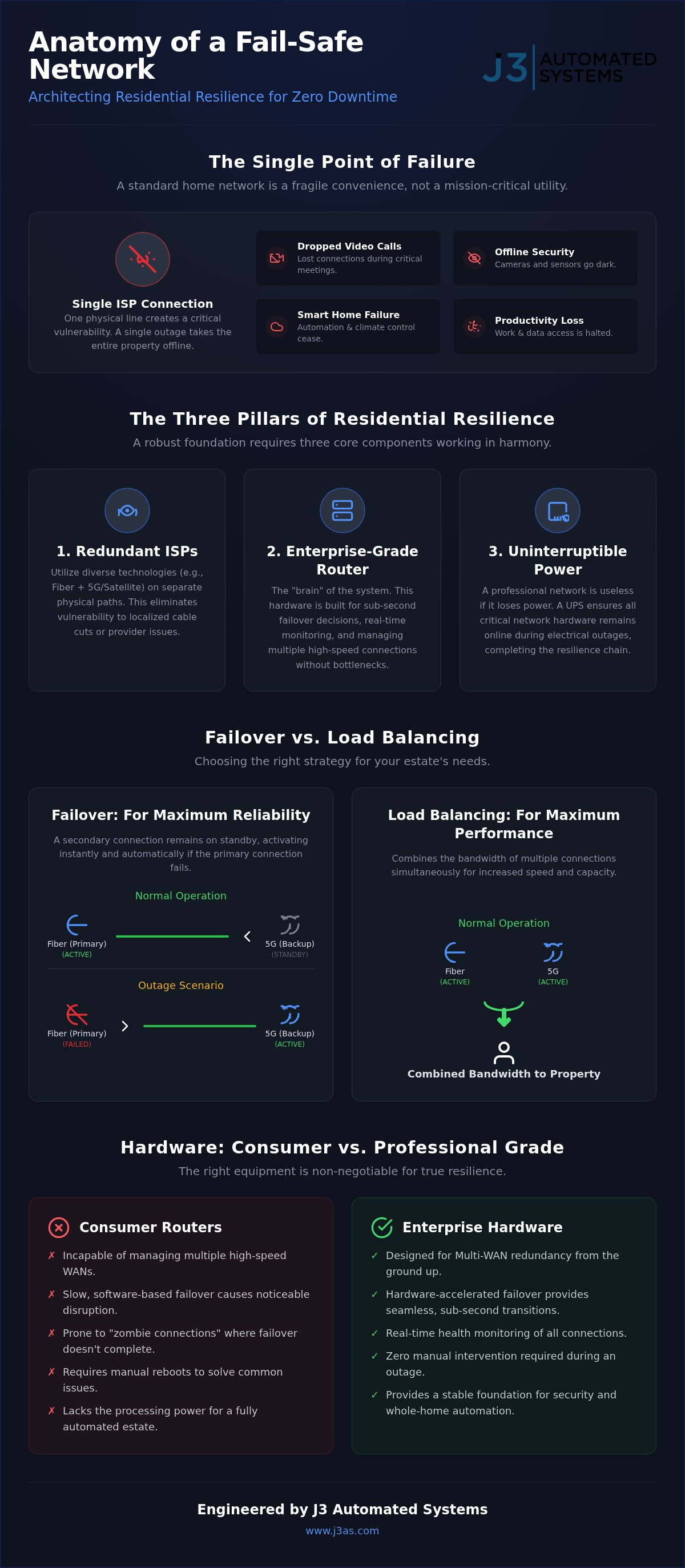
A fail-safe home internet setup isn't a single product you buy off a shelf. It's a calculated architecture designed to eliminate the single point of failure inherent in most residential connections. For most estates, that failure point is the solitary fiber or cable line entering the property. If a backhoe down the street severs that line, the entire home loses its intelligence. Engineering a truly resilient network means moving beyond this fragile dependency. It requires a system that monitors the health of your connection in real-time and responds instantly when performance degrades.
Standard consumer routers are fundamentally incapable of this level of stewardship. They are built for simple environments where a manual reboot is an acceptable solution. In a luxury estate, manual intervention is a failure. These off-the-shelf devices lack the processing power and sophisticated logic to manage multiple high-speed inputs simultaneously. They often struggle with Failover protocols, leading to "zombie connections" where the router thinks it's online while your devices remain disconnected. Selecting hardware for a fail-safe home internet setup requires prioritizing stability over retail convenience.
This resilience serves as the high performance residential networking backbone that supports everything from your home office to your security array. Without it, your smart home is merely a collection of disconnected gadgets. You need a foundation that treats data as a critical resource.
The Three Pillars of Residential Resilience
True uptime stands on three foundations. First, you need redundant ISPs using diverse technologies. Symmetrical fiber paired with Starlink satellite is a powerful combination for Texas properties. Using two providers on the same physical cable line offers no protection against a local infrastructure break. Second, you must employ enterprise-grade routing. This is the brain of the system, capable of making sub-second decisions about traffic routing. Finally, uninterruptible power supplies (UPS) are mandatory. A fail-safe network is useless if the hardware shuts down during a Texas thunderstorm.
Why DIY Workarounds Fall Short for Luxury Homes
Many homeowners attempt to bridge gaps with software bonding or mobile hotspots. These solutions introduce significant latency penalties that disrupt high-stakes communication. Software-only workarounds often create bottlenecks that interfere with automated lighting and security cameras. A professional system ensures an invisible transition. You shouldn't have to restart your Zoom call or log back into your VPN when the primary provider fails. The goal is total continuity, where the digital environment remains stable regardless of external service fluctuations.
Step 1: Architecting Multi-WAN Redundancy for Zero Downtime
Architecting a fail-safe home internet setup begins with the selection of diverse Wide Area Network (WAN) inputs. For a premier Texas estate, symmetrical fiber serves as the indispensable primary connection. Providers like GVTC or AT&T Fiber offer the low-latency foundation required for high-stakes video conferencing and real-time automation. However, relying on a single physical line is a structural vulnerability. True resilience requires a secondary path that operates on an entirely different infrastructure. This is often where the technical distinction between Dual-WAN vs. Link Aggregation becomes critical; you aren't simply looking for more speed, but for a redundant gateway that remains active when the primary circuit goes dark.
Adhering to the "Diverse Path" rule is essential for absolute uptime. If your secondary connection is a cable modem that shares the same utility trench or entry point as your fiber, a single landscaping accident or localized equipment failure will sever both. A superior architecture pairs a terrestrial fiber line with a non-terrestrial or wireless backup. This ensures that even if the physical lines on your street are compromised, your estate remains connected through the air. Calculating your bandwidth requirements for this failover state is equally vital. While your primary link may handle gigabit traffic, your backup must be engineered to sustain essential services: security arrays, climate control, and dedicated office bandwidth.
Starlink as the Ultimate Secondary Connection in Texas
Starlink has fundamentally changed the redundancy landscape for estates in Boerne and the Hill Country. Its infrastructure independence makes it the ideal companion to a fiber circuit. To ensure reliability, the hardware requires a completely unobstructed view of the northern sky, free from the oak canopies common in Central Texas. We integrate these systems into professional rack-mounted environments, bypassing consumer-grade mesh units in favor of direct ethernet handoffs to your enterprise router. This creates a stable, high-speed backup that activates the moment your primary ISP experiences a hiccup.
Physical Infrastructure and Low Voltage Planning
A sophisticated network requires more than just high-end service providers; it demands a robust physical foundation. Implementing low voltage wiring for smart homes ensures that multiple modems and satellite gateways can communicate without interference. This involves dedicated conduit runs to optimal mounting locations and sufficient rack space in a climate-controlled technology closet. Proper planning prevents the clutter of external antennas and ensures that every piece of hardware is protected from the Texas heat. If you are ready to move beyond basic connectivity, consulting with a professional integrator can help you map out a resilient infrastructure tailored to your property's unique layout.
Selecting Enterprise-Grade Hardware for Residential Resilience
The router functions as the central intelligence of your digital environment. While consumer-grade devices often struggle to maintain a stable state during service fluctuations, enterprise hardware provides the processing overhead required for a truly fail-safe home internet setup. These systems utilize hardware-accelerated failover, which monitors link health at the packet level. If a primary connection experiences jitter or total loss, the router executes a transition in milliseconds. This precision prevents the "session drop" common in retail hardware, where a simple IP change can force a manual reboot of every connected device on the property.
Sophisticated residential networks are increasingly adopting SD-WAN (Software-Defined Wide Area Network) technologies. This approach allows for intelligent traffic steering based on real-time link quality. If your fiber connection remains active but suffers from significant packet loss, an SD-WAN-capable router can automatically shift high-priority voice and video traffic to your backup link. At J3, we architect these systems using high-performance brands like Ubiquiti, Cisco, or Araknis. These manufacturers provide the intellectual rigor and long-term stability required to manage a complex, multi-provider environment without the friction of frequent hardware failures.
The Role of Managed Switches in a Resilient Network
Resilience extends beyond the perimeter into the internal distribution layer. Managed switches allow for VLAN segmentation, which isolates sensitive work-from-home traffic from the high-volume data generated by smart appliances and streaming devices. This architectural separation prevents a malfunctioning IoT device from saturating the entire network or compromising security. Additionally, utilizing Power over Ethernet (PoE) enables the system to perform remote-reboots of modems or access points. If a gateway becomes unresponsive, the system can power-cycle the specific port automatically, restoring service without requiring a manual intervention.
Battery Backups and Power Conditioning
A network's intelligence is irrelevant without a stable power source. A rack-mounted Uninterruptible Power Supply (UPS) is a mandatory component for any Texas estate prone to grid instability or summer storms. These units provide more than just emergency runtime; they offer power conditioning that shields sensitive enterprise hardware from the frequent voltage spikes common in San Antonio and the Hill Country. This protection ensures that your connectivity remains online even during a temporary blackout. This level of electrical stewardship creates a reliable foundation for other critical systems, such as automated lighting and shade control, which depend on an always-active network to execute programmed scenes and security protocols.
Configuring Failover vs. Load Balancing for Maximum Performance
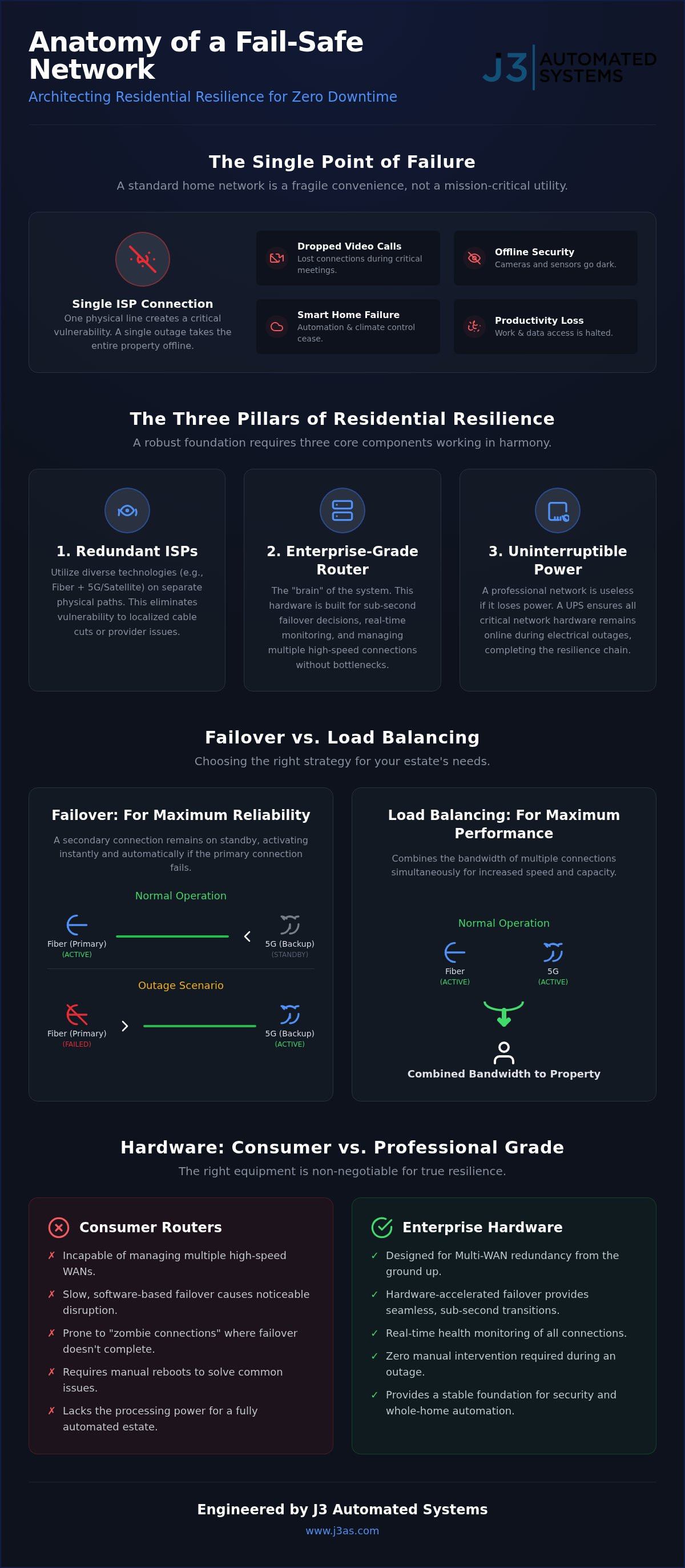
Once the physical architecture and enterprise hardware are established, the focus shifts to the logical orchestration of your data. A fail-safe home internet setup requires a deliberate choice between failover and load balancing modes to manage how traffic moves through your property. Failover mode keeps your secondary connection in a "cold" state, activating it only when the primary link experiences a total failure or significant degradation. This is often the preferred configuration for estates utilizing secondary links with data considerations, such as certain satellite or cellular plans, as it preserves bandwidth for when it's truly needed.
Load balancing offers a more dynamic approach by utilizing both connections simultaneously. This configuration increases your total available bandwidth, distributing the digital load across multiple providers to prevent bottlenecks. To make this effective, we implement policy-based routing. This advanced logic allows the system to distinguish between traffic types. For example, your high-stakes Zoom calls and professional VPN sessions are pinned to the low-latency fiber line, while high-volume IoT data or guest network traffic is routed through the secondary link. This granular control ensures that your most critical activities always have the clearest path to the cloud.
To ensure these transitions occur without friction, the system must perform continuous health checks. Rather than simply checking if a cable is plugged in, the router is configured to "ping" external, high-availability servers. This proactive monitoring detects "zombie" connections-scenarios where the ISP gateway appears active, but data has ceased to flow. When the system detects a failure, it executes a transition in milliseconds, maintaining your active sessions without a flicker in performance.
Optimizing for Work-from-Home and Video Conferencing
High-performance remote work demands more than just raw speed; it requires prioritized stability. We implement Quality of Service (QoS) rules that act as a digital express lane for your professional communication. This prevents a large software update or a high-definition stream in another part of the house from causing jitter during a board meeting. This level of precision is a core component of secure networking for remote work, ensuring that your home environment matches the reliability of a corporate headquarters. It effectively eliminates "The Frozen Screen" by managing the handoff between providers before the application times out.
Monitoring and Automated Alerts
A truly managed system provides absolute visibility into its own health. We configure push notifications and automated alerts that inform you the moment your primary ISP experiences an outage. These same tools allow J3 to provide white-glove support from our San Antonio headquarters. We can remotely troubleshoot your network and coordinate with providers, often resolving a local service issue before you even realize a failure occurred. This proactive maintenance model removes the technical burden from the homeowner, transforming complex networking into a silent, reliable utility. If you're ready to architect a network that never sleeps, contact J3 Automated Systems to design your fail-safe infrastructure.
Engineering Total Property Uptime with J3 Automated Systems
Designing a fail-safe home internet setup for a premier Texas estate requires more than just high-end hardware; it demands a visionary approach to system integration. At J3 Automated Systems, we don't merely install equipment. We architect bespoke network roadmaps that treat your property's digital infrastructure as a unified, high-performance environment. This engineering mindset ensures that your connectivity remains resilient regardless of external service fluctuations or localized hardware stress. By moving beyond the fragmented DIY approach, we provide a foundation where every component, from the primary fiber gateway to the furthest outdoor access point, operates under a single philosophy of absolute uptime.
This level of network resilience is the essential heartbeat of commercial security system design Texas estates require. A security array is only as effective as the network that carries its data. When your internet fails, your remote alerts and cloud-based monitoring often fail with it. Our engineered networks ensure that your protective systems remain online and accountable, even during a total ISP outage. We extend this stability across your entire property, utilizing specialized wireless backhauls and burial-grade fiber to deliver seamless Wi-Fi to guest houses, equestrian facilities, and remote outbuildings. This campus-wide approach eliminates the "dead zones" that often plague large Hill Country properties.
The "Single Accountable Team" advantage is what truly sets a J3 engineered system apart. We take full responsibility for the design, implementation, and long-term stewardship of your network. You don't have to navigate the friction of multiple vendors or troubleshoot complex IP conflicts on your own. We serve as your deep-thinking partner, providing a white-glove service level that removes the technical burden and ensures your property remains a sanctuary of intelligent, effortless operation.
The ROI of a Professionally Engineered Network
Investing in a fail-safe home internet setup is a strategic move to protect your professional productivity. For the executive or business owner, a single hour of downtime during a critical negotiation is far more costly than the infrastructure required to prevent it. Beyond business continuity, a robust network significantly increases the value of the estate. High-end technology infrastructure is now a standard expectation for luxury properties in San Antonio and Austin. Perhaps most importantly, it reduces the daily friction of modern life. When your technology is invisible and reliable, you can focus on your work and family without the constant distraction of digital failure.
Getting Started with Your Network Transformation
Our process begins with a comprehensive discovery phase, where we map your property's unique connectivity needs and identify potential vulnerabilities in your current setup. We then move into custom engineering, tailoring a solution that fits the specific architectural requirements of your home and the geographic challenges of the surrounding Hill Country. Whether you are in Boerne, New Braunfels, or the heart of Austin, we are ready to transform your network into a mission-critical utility. Schedule a consultation with J3 Automated Systems to engineer your resilient network.
Securing Your Estate’s Digital Future
True connectivity requires an architectural approach that treats your home network as a mission-critical utility. By moving beyond the limitations of a single provider and embracing multi-WAN redundancy, you eliminate the vulnerabilities that disrupt high-stakes professional work and property security. A professionally engineered foundation ensures that your transitions between ISPs are invisible; it keeps your smart systems and communication channels active regardless of external service failures. Implementing a fail-safe home internet setup isn't a luxury for Texas estates; it's a fundamental requirement for maintaining a sophisticated digital lifestyle.
J3 Automated Systems specializes in high-end residential automation, providing end-to-end design and commissioning for the most demanding environments. Our team brings local expertise to San Antonio, Austin, and the Hill Country, acting as a single point of accountability for your property's technological harmony. We invite you to move beyond the friction of unreliable connections and experience the calm of a network that simply works. Engineer your fail-safe home network with J3 Automated Systems and reclaim the peace of mind that comes with absolute uptime.
Frequently Asked Questions
What is the difference between failover and load balancing for home internet?
Failover is a reactive redundancy measure where a secondary connection remains idle until the primary link fails. In contrast, load balancing utilizes both internet connections simultaneously to increase total property bandwidth. For a fail-safe home internet setup, the choice depends on your specific needs; failover preserves secondary data for emergencies, while load balancing maximizes performance across all devices.
Can I use Starlink as a backup to my fiber internet connection?
Starlink is a premier secondary WAN choice because it provides total infrastructure independence from terrestrial fiber lines. While fiber is vulnerable to physical damage in utility trenches, Starlink communicates directly with satellite constellations. This diverse pathing ensures that a single localized accident or equipment failure doesn't sever both of your connections simultaneously.
Will my Zoom call drop when the router switches from my primary to my backup ISP?
A professionally engineered system executes the transition in milliseconds, which typically prevents active Zoom or VPN sessions from timing out. While consumer-grade routers often require a significant delay to re-establish a digital handshake, enterprise hardware monitors link health at the packet level. This hardware-accelerated failover allows for a seamless transition that remains invisible during high-stakes communication.
Do I need two separate modems for a fail-safe home internet setup?
Yes, a truly redundant architecture requires a dedicated modem or gateway for each individual service provider. These separate devices are then connected to a single multi-WAN enterprise router, which serves as the central intelligence for the property. This physical separation ensures that a hardware failure in one modem does not compromise the integrity of your secondary connection.
Is enterprise-grade networking hardware really necessary for a home office?
Enterprise hardware is essential for professionals who require the same reliability at home that they expect in a corporate headquarters. Standard consumer routers lack the processing overhead and sophisticated traffic-steering logic needed to manage multiple inputs without friction. Investing in enterprise-grade gear provides the stability and long-term functionality required to treat your network as a mission-critical utility.
How much does it cost to have a professional fail-safe network installed in San Antonio?
Professional installation costs vary based on the scale of the estate and the complexity of the architectural integration required. Factors such as the number of outbuildings, existing low-voltage cabling, and the specific hardware selected will influence the project scope. You should consult with a specialized integrator to receive a bespoke assessment tailored to your property's unique connectivity requirements.
Can a fail-safe setup protect my smart home security cameras from going offline?
A fail-safe setup is the primary defense against security camera downtime caused by ISP service interruptions. By providing a redundant path to the cloud, your cameras can continue to upload footage and transmit alerts even if your primary fiber line is compromised. This integration is vital for maintaining the continuous protection of your estate during external network failures.
What happens to my internet connection during a power outage if I have a backup ISP?
Your internet connection will only remain active during a power outage if all networking equipment is supported by an uninterruptible power supply (UPS). While an ISP's local infrastructure often has its own backup power, your modems, routers, and switches must be connected to a rack-mounted UPS to ensure continuous uptime when the local grid fails.