Engineering the Digital Bridge: Integrating Custom Software with Legacy Systems
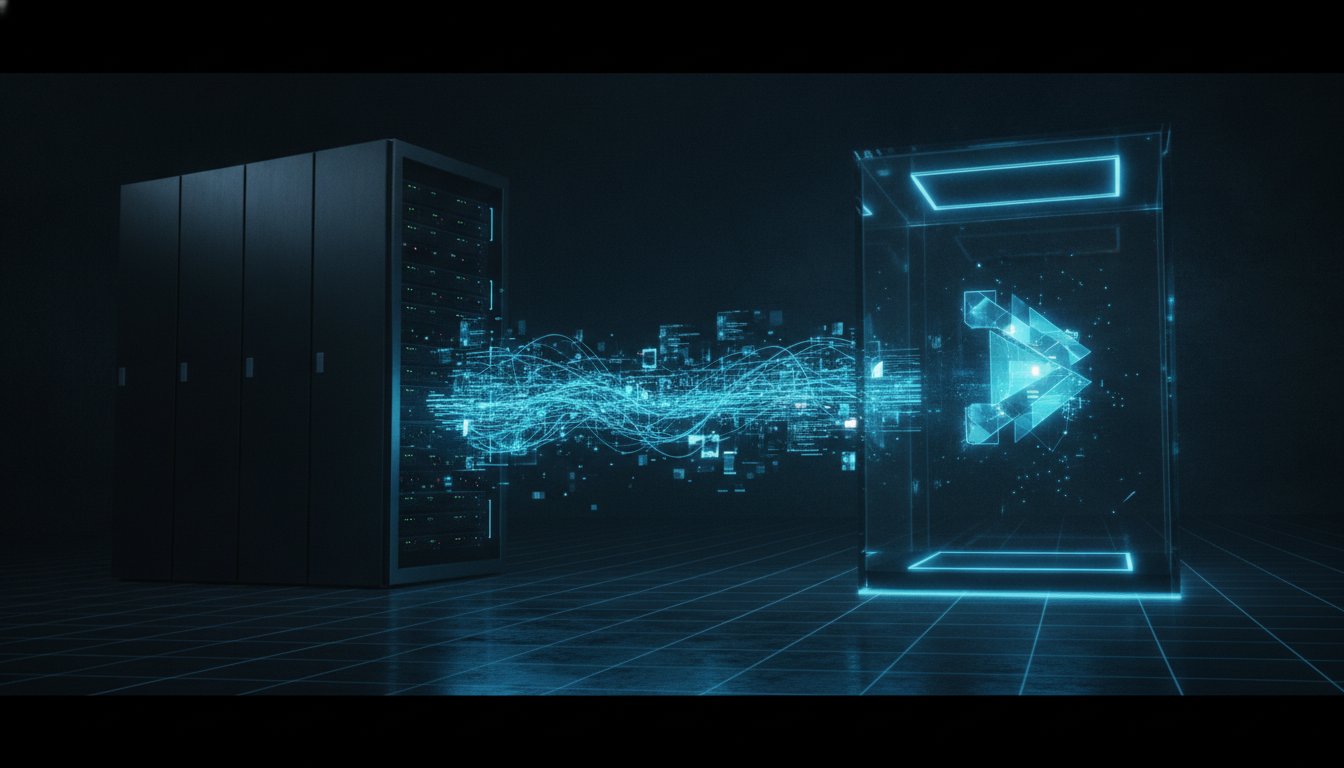
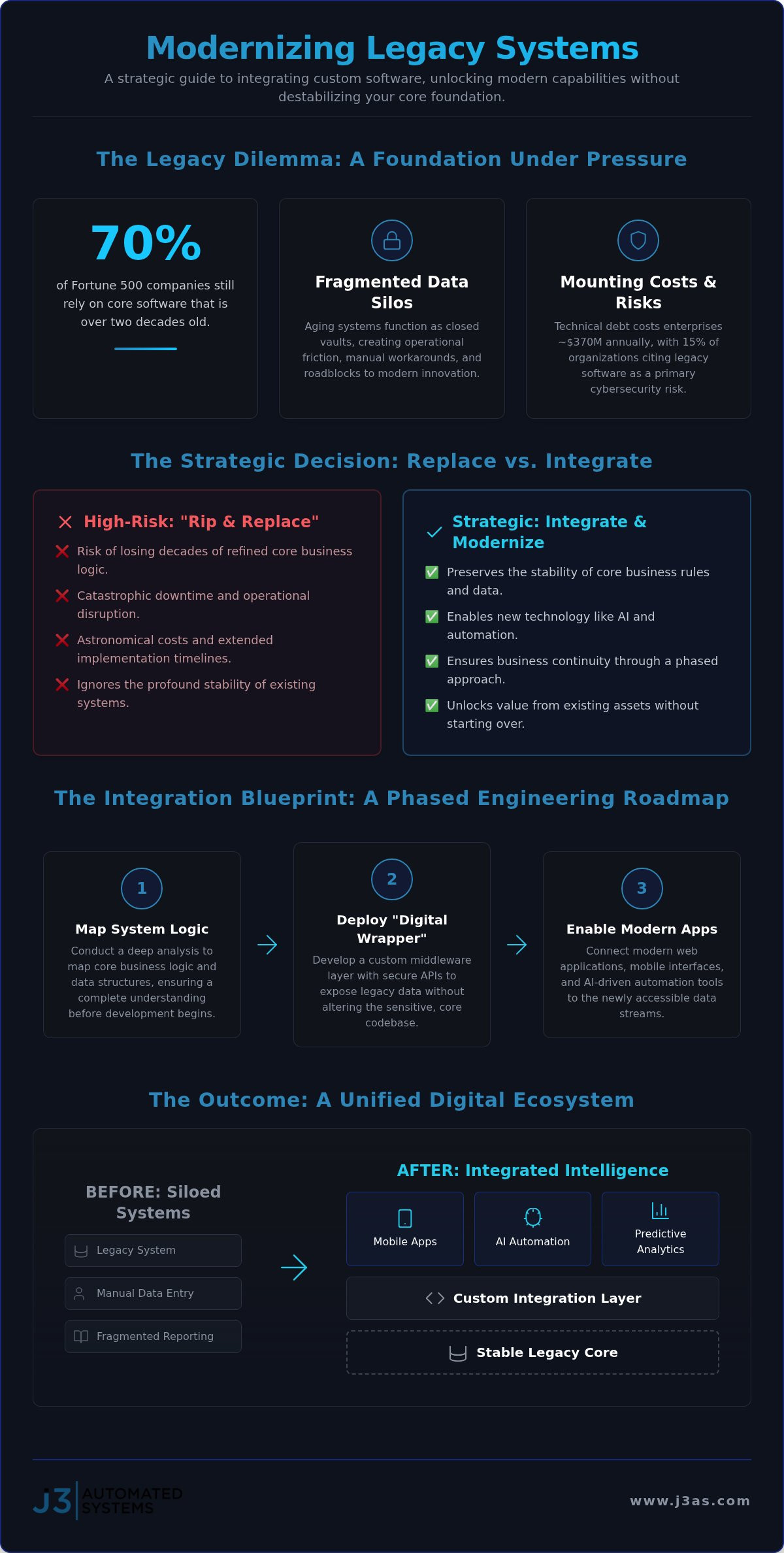
Seventy percent of Fortune 500 companies still rely on software that is over two decades old, a reality that speaks to the profound stability of core business logic. While these legacy systems remain the reliable heart of many enterprises, they often function as closed vaults that resist the fluidity of modern innovation. You likely recognize the friction of fragmented data silos and the mounting costs of maintaining architectures that weren't built for the age of intelligence. Integrating custom software with legacy systems offers a sophisticated alternative to the high-risk "rip and replace" cycle, allowing you to unlock modern capabilities without destabilizing your foundation.
You shouldn't have to choose between the reliability of your existing stack and the transformative power of new technology. This guide reveals how an architectural orchestration of bespoke tools can bridge the gap, turning aging infrastructure into a responsive digital backbone. We will examine the strategic frameworks that enable automated workflows and AI integration, ensuring your business moves with precision and renewed momentum.
Key Takeaways
- Master the "Digital Wrapper" strategy to expose legacy data through secure APIs, enabling modern web applications to communicate seamlessly with your existing architecture.
- Navigate the strategic decision-making process for integrating custom software with legacy systems by weighing long-term operational gains against the risks of technical debt.
- Implement a phased engineering roadmap that ensures business continuity by mapping deep system logic before deploying custom middleware layers.
- Transform fragmented data silos into a unified digital ecosystem capable of supporting AI-driven automation and advanced predictive analytics.
- Preserve the stability of your core business logic while eliminating the friction of manual data entry and the escalating costs of aging systems.
The Legacy Dilemma: Navigating Fragmented Systems in 2026
Many Texas enterprises operate on a foundation of technology that has functioned reliably for decades. Understanding what is a legacy system requires looking past the age of the code to the immense value of the logic it contains. These systems aren't merely "old" hardware; they're the repositories of years of institutional knowledge and stable business rules. However, as we move through 2026, these foundations often become silos. They operate in isolation, unable to speak the language of modern cloud environments or mobile interfaces. This creates a state of digital paralysis where the very tools that built the company now hinder its evolution.
Executives often feel pressured to abandon these systems entirely through a "rip and replace" strategy. This is frequently a strategic error. It ignores the immense risk of losing core business rules that have been refined over a generation. Instead, the focus should shift toward integrating custom software with legacy systems. This approach preserves the stability of the past while building a bridge to the intelligence of the future. It's about engineering fluidity without the catastrophic downtime or the astronomical costs of a total overhaul.
The Friction Point: Why Systems Stop Talking
Friction arises when proprietary data formats meet modern open standards. Legacy environments often utilize closed architectures that don't play well with others. This stagnation creates more than just an operational inconvenience; it creates a significant security vulnerability. Research indicates that 15% of organizations cite legacy software as a primary cybersecurity risk factor. When systems stop talking, manual workarounds become the norm. Employees spend hours on redundant data entry, increasing the likelihood of human error and slowing the pace of business to a crawl.
The Opportunity Cost of Technical Debt
Technical debt isn't just a line item on a balance sheet. It's a throttle on growth. For enterprises in Austin and San Antonio, disconnected systems lead to delayed reporting and customer friction. Implementing AI business process automation becomes nearly impossible when your data is trapped in a silo. You can't train a modern model on information it can't access. The cost of this fragmentation is high. By 2026, the annual cost of technical debt to enterprises has reached roughly $370 million. The solution lies in building a "Digital Backbone" that unifies these disparate tools into a single, intelligent ecosystem.
Architectural Strategies for Seamless Software Integration
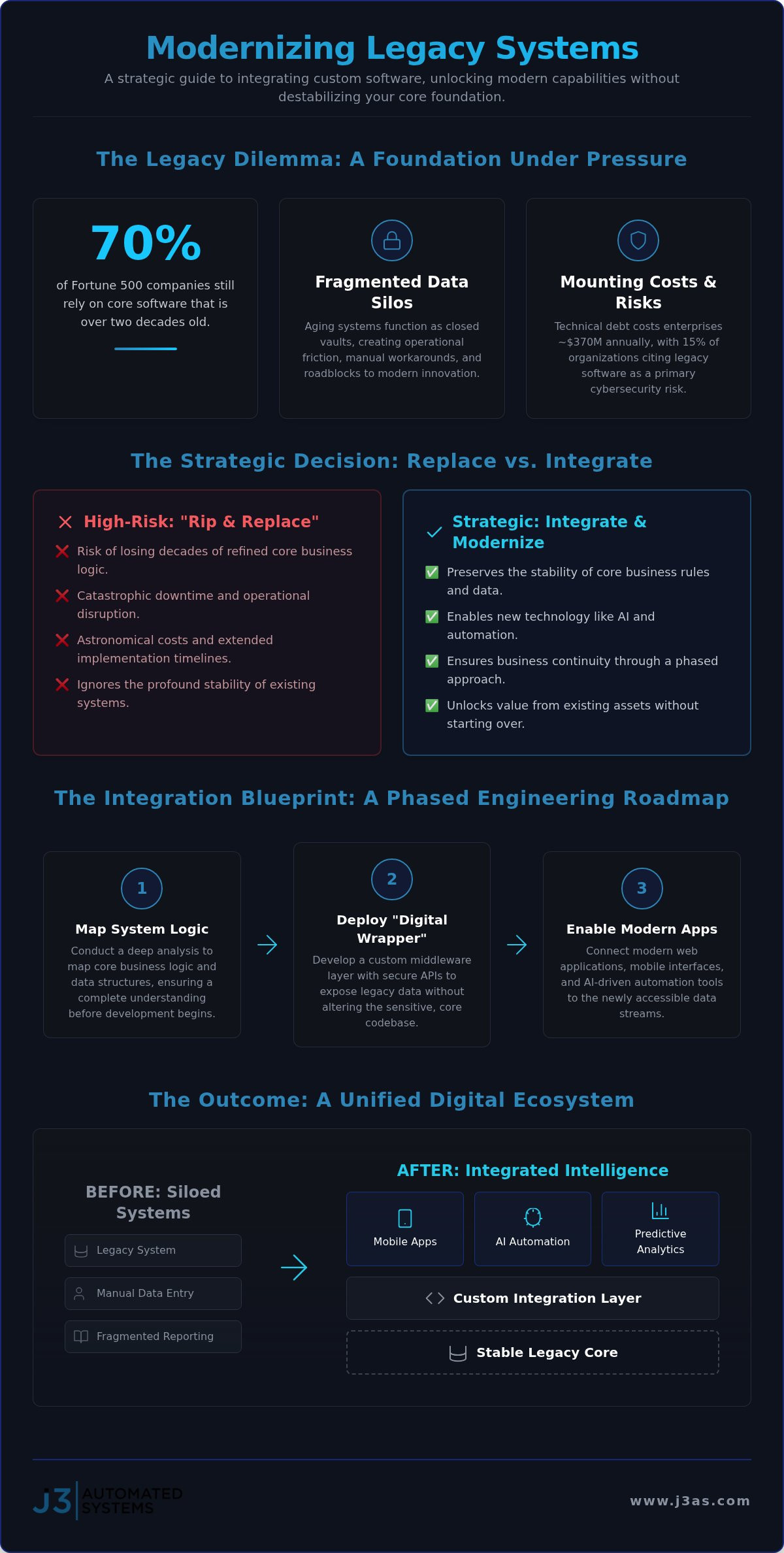
Bridging the gap between a decades-old database and a modern mobile interface requires more than just a simple connection. It demands an architectural orchestration that treats the legacy system as a stable foundation while building outward. Integrating custom software with legacy systems often begins with the "Digital Wrapper." This strategy uses APIs to expose isolated data, allowing it to flow into modern web applications without modifying the original, sensitive codebase. By creating this protective layer, we ensure that the core logic remains untouched while the user experience evolves.
Real-time consistency is the hallmark of a well-engineered bridge. Database synchronization ensures that old and new environments reflect the same truth at any given moment. This is often achieved through event-driven architecture, where the legacy system triggers modern responses instantly. Whether it's updating an inventory count or firing an automated alert, these architectural choices become the prerequisites for intelligence. For enterprises seeking to stabilize their digital backbone, consulting with a visionary integrator can clarify the path forward.
API Wrappers and Microservices
By transforming legacy code into a library of modern, callable services, businesses can extend the life of their core technology indefinitely. Our approach to custom web app development in San Antonio frequently employs these wrappers to provide field teams with mobile access to on-premise data. This maintains system integrity while granting the fluidity required for 2026 operations. It's a method that respects the past while enabling the future, ensuring that your existing investment continues to deliver value.
The Custom Integration Layer
Off-the-shelf connectors often falter when faced with bespoke business processes or complex physical environments. A truly seamless ecosystem requires a custom integration layer, a sophisticated "translator" that manages the conversation between modern front-ends and legacy back-ends. This layer ensures low-latency communication even in high-performance environments where speed is non-negotiable. Unlike generic tools, a bespoke middleware solution can account for the nuances of local building management systems, specialized AV setups, or complex HVAC controls, unifying physical and digital processes under a single philosophy.
As businesses look to Modernize Legacy Tech With AI, these custom layers become essential. They don't just move data; they prepare it. Without a synchronized and cleaned data flow, modern AI tools remain blind to the historical context stored within your primary stack. Engineering this bridge allows you to layer advanced intelligence onto your existing records, turning years of data into actionable business insights without the burden of a system replacement.
Strategic Evaluation: To Rebuild, Replace, or Integrate?
Choosing a path forward is an architectural decision that defines the next decade of operation. Total replacement sounds appealing until you realize that many established enterprises rely on software over 20 years old for its deep stability. The "Rip and Replace" trap often leaves businesses with a shiny new interface but missing the complex, edge-case logic that the old system handled perfectly. Integrating custom software with legacy systems allows you to maintain that core engine while shedding the friction of outdated interfaces. It's a choice that favors precision over disruption.
The ROI of integration often surpasses a full rebuild because it minimizes operational downtime. You aren't paying to reinvent the wheel; you're paying to put a modern transmission on a proven engine. When considering strategies for updating business technology, look for the path that preserves data integrity while removing the burden of manual workarounds. A well-engineered bridge ensures that your historical records remain a competitive asset rather than a liability.
The Integration Decision Matrix
A structured matrix helps determine if a system is a candidate for integration. You must evaluate system stability, data accessibility, and future scalability. For many Texas enterprises, the tech stack isn't just software; it includes physical assets like commercial building management systems. If your core logic is stable but your accessibility is blocked, integration is the logical choice. However, if the underlying hardware is physically failing or the original source code is entirely lost, a phased replacement might be necessary. We identify "critical path" systems first, ensuring that the most vital operations receive the modern connectivity they require.
Modernizing the User Experience (UX)
Separating the interface from the logic is a powerful way to boost employee productivity. By creating unified dashboards that pull from multiple legacy sources, you present a single source of truth to your team. This reduces training time for new hires and minimizes the cognitive load on long-term staff. Modern UX doesn't require a new backend; it requires a thoughtful bridge that translates complex data into intuitive custom tools. This hybrid approach ensures your digital backbone remains strong while your front-end moves at the speed of modern business. The result is a unified digital ecosystem where old and new tools work in harmony, removing the friction from daily workflows.
The J3 Roadmap: A Phased Engineering Approach to Integration
Successful transformation requires a methodical progression that respects the complexity of existing environments. We don't believe in the frantic energy of quick fixes; instead, we follow a deliberate project lifecycle designed to minimize risk while maximizing intelligence. Integrating custom software with legacy systems is an exercise in meticulous planning. Our roadmap begins with exhaustive discovery and moves through architectural design to ensure every new connection serves a specific purpose. This phased approach allows for a steady transition from fragmentation to a state of intelligent, effortless operation.
The development and iteration phase focuses on building bespoke connectors that unify your tools. We don't just build software; we engineer a long-term state of harmony across your entire stack. This includes rigorous testing of internal tools and automated workflows to ensure they interact seamlessly with your core business logic. Once the bridge is commissioned, our ongoing support ensures that your digital ecosystem remains resilient and responsive to future needs, preserving the stability of your technology investment for years to come.
Mapping the Invisible Workflow
Complexity often hides in the workarounds employees create to bypass aging software limitations. We start by uncovering this "hidden" logic through deep stakeholder interviews. By identifying shadow IT and undocumented data flows, we map the reality of how your business operates today. This process isn't just about technical documentation; it's about aligning the technical roadmap with your long-term commercial objectives. We pinpoint exactly where friction occurs, ensuring the new digital backbone addresses the specific bottlenecks throttling your growth in San Antonio and Austin.
Engineering for Zero Downtime
Operational continuity is a non-negotiable requirement for high-tier enterprises. We utilize parallel running techniques to test new integrations while your existing systems remain live and functional. This allows us to verify data integrity and system responses in a controlled environment before full deployment. Our risk mitigation strategies protect your critical business data at every stage, providing the calm reliability you expect from a premium partner. As a visionary integrator in Texas, we provide a single accountable team to manage every nuance from the first map to the final implementation.
Beyond Connectivity: Unlocking AI and Operational Intelligence
Connectivity represents the necessary bridge, but intelligence is the ultimate destination. Once you have navigated the complexities of integrating custom software with legacy systems, your data is no longer a static archive. It becomes a dynamic asset capable of fueling advanced automation. Research indicates that over 75% of organizations now leverage AI for modernization efforts, moving beyond simple data transfers to create systems that think and act. By engineering this digital backbone, you transform years of historical records into a goldmine for predictive models that anticipate market shifts and operational needs.
Predictive analytics allows Texas enterprises to move from a reactive posture to one of strategic foresight. Instead of merely reviewing what happened last quarter, you can utilize years of legacy data to forecast future demand or identify equipment failure before it occurs. This level of intelligence requires a unified ecosystem where information flows without friction between your core engine and modern analytical tools. It's the transition from a fragmented collection of tools to a singular, intelligent enterprise that operates with quiet brilliance.
Custom AI Integration
We engineer bespoke AI tools designed to parse and act upon the specific nuances of your legacy data. This removes the "human-as-middleware" burden that often plagues San Antonio offices, where employees spend hours manually reconciling reports from disconnected systems. By automating complex decision-making processes, we free your team to focus on high-level strategy rather than administrative repetition. These custom tools don't just sit on top of your stack; they are woven into the architecture, ensuring that every automated workflow is grounded in the deep logic of your business.
Holistic Automation: Software Meets Physical Space
The most sophisticated integrations extend beyond the screen and into the physical environment. A truly unified digital ecosystem creates a synergy between internal business tools and the physical infrastructure of your property. This might involve connecting your custom internal software to commercial building management systems or ensuring seamless communication with high-performance residential networking for modern estates. When your digital workflows and intelligent environments speak the same language, the result is an effortless operation that feels both inevitable and reassuring.
The future of the intelligent enterprise in Texas is one of total harmony, where the distinction between "old" and "new" technology disappears into a single, high-performance environment. Achieving this state of fluidity requires a partner who understands the hidden connections between disparate systems. Consult with J3 Automated Systems to engineer your digital bridge and unlock the full potential of your technology stack.
Building the Future on a Proven Foundation
The path to an intelligent enterprise doesn't require dismantling the systems that built your success. It requires an architectural shift from isolation to connectivity. By integrating custom software with legacy systems, you transform fragmented data silos into a unified digital backbone. This approach preserves the deep, stable logic of your existing technology while layering on the modern fluidity of AI and intuitive user interfaces. You gain the capabilities of 2026 without the catastrophic risks of a full system replacement.
Precision engineering and meticulous planning are the hallmarks of a successful transformation. J3 Automated Systems serves as your master of complexity, bringing a sophisticated architectural approach to the Texas commercial and luxury residential markets. Our single accountable team manages every nuance of the project lifecycle, from initial process mapping to final implementation. We remove the burden of technical debt, creating a state of calm reliability and long-term functionality for your business operations. Partner with J3 to engineer your bespoke automation roadmap. Your existing technology is ready for its next evolution.
Frequently Asked Questions
What is considered a legacy system in 2026?
A legacy system is any technology that remains critical to your daily operations but lacks modern interoperability or open architectures. In 2026, this often includes on-premise software over two decades old or systems built on languages like COBOL. While these platforms are incredibly stable, they function as closed vaults. They hold your most valuable business logic but resist modern cloud or AI connectivity without a custom bridge.
Can custom software really connect to a system with no API?
Yes, connection is entirely possible through direct database integration or engineered middleware layers. We don't rely solely on pre-existing APIs to create a unified ecosystem. Instead, we architect "Digital Wrappers" that translate legacy data into modern, callable services. This allows for integrating custom software with legacy systems even when the original developers didn't provide a modern interface, ensuring your data flows with precision.
How long does it typically take to integrate custom software with a legacy database?
Project timelines vary based on architectural complexity, but a phased implementation typically spans several months. The discovery and process mapping phase usually requires three to four weeks to uncover hidden workflows. Development of the custom integration layer follows, with parallel testing ensuring zero downtime. We prioritize a methodical, steady pace to maintain the stability of your core business logic while building your new digital backbone.
Will integrating new software make my legacy system more vulnerable to security threats?
Properly engineered integration actually enhances your security posture by creating a modern, patched gateway for data access. Legacy systems are often vulnerable because they are isolated and no longer receive security updates. By layering a secure custom web app over the old architecture, we implement modern encryption and authentication protocols. This shields the sensitive core logic from direct exposure while providing the connectivity your team needs.
Is it cheaper to integrate or to buy a new off-the-shelf SaaS product?
Integration is often more cost-effective when you account for the hidden expenses of total replacement. While a SaaS subscription looks cheaper upfront, you lose the bespoke logic that makes your business unique. You also face massive costs in data migration and staff retraining. Integrating custom software with legacy systems preserves your existing investment while adding modern intelligence, offering a significantly higher long-term return on investment.
What happens to my data during the integration process?
Your data remains secure and untouched within the primary legacy environment throughout the entire lifecycle. We utilize parallel running and real-time database synchronization to ensure consistency without risking the original records. Our team maps every data flow meticulously before implementation. This architectural approach ensures that your historical records are treated as a stable asset throughout the transition to a modern, intelligent, and unified digital ecosystem.
How does custom AI help in a legacy software environment?
Custom AI acts as an intelligent layer that parses and automates repetitive administrative tasks trapped in aging systems. It eliminates the need for manual data reconciliation between fragmented tools. By integrating custom software with legacy systems, you allow AI models to access decades of historical data. This enables predictive analytics and automated reporting that were previously impossible, turning years of records into actionable business insights for your enterprise.
Do I need to hire a separate team for the software and the physical system integration?
No, J3 provides a single accountable team for both digital processes and physical systems. We specialize in the intersection of custom software and building automation, such as HVAC or lighting controls. This holistic perspective ensures that your internal tools and physical environment work in harmony. You avoid the friction of managing multiple vendors who don't understand the hidden connections between your digital workflows and your physical space.