Engineering Efficiency: The Definitive Guide to Business Process Mapping for Custom Software

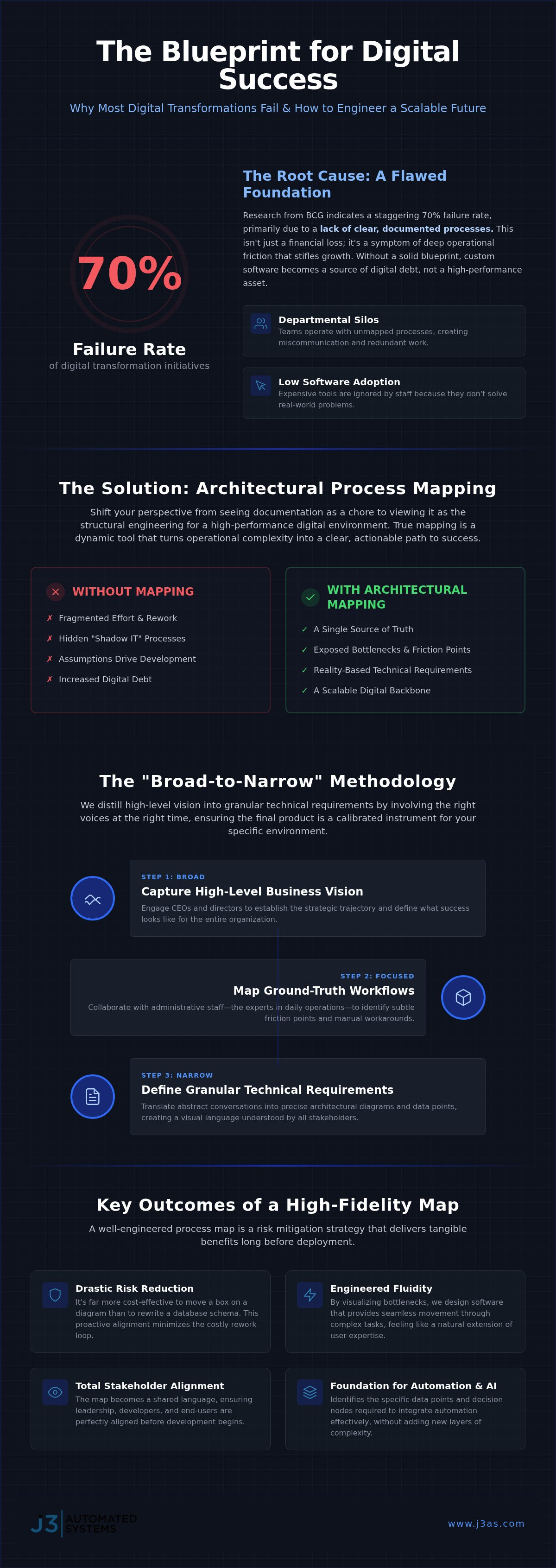
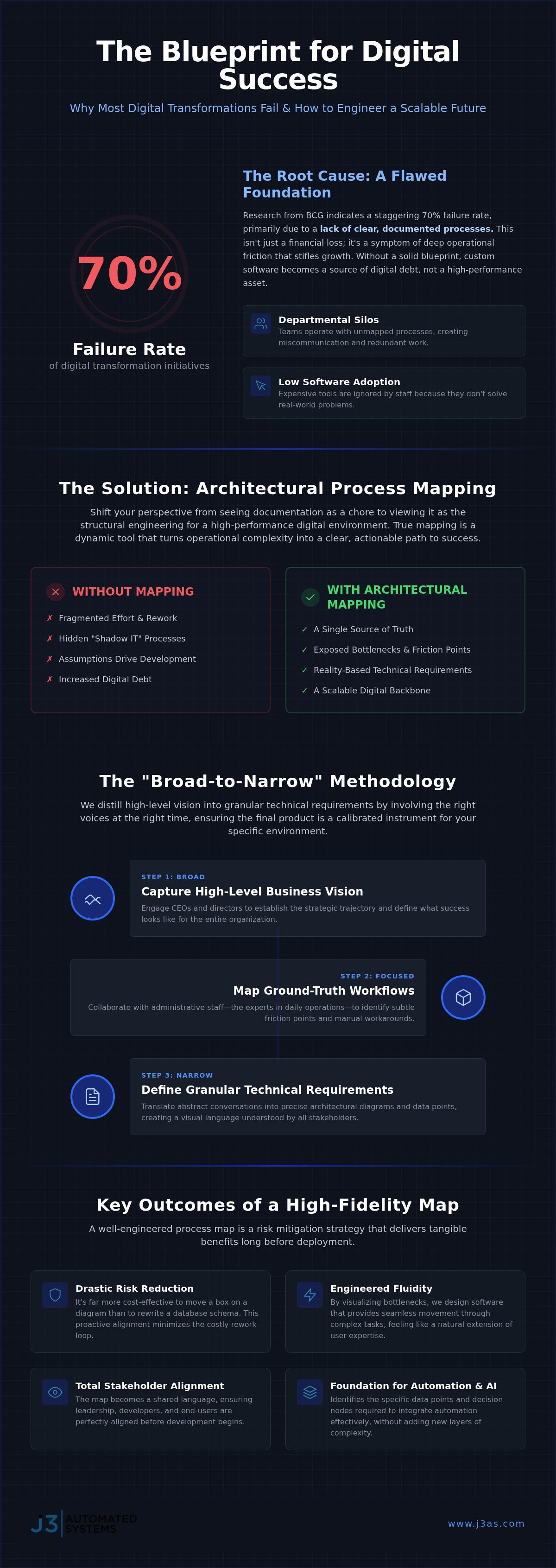
Recent research from BCG indicates that 70% of digital transformation initiatives fail, largely due to a lack of clear process documentation. This statistic represents more than just lost capital; it signifies the high cost of operational friction that many rapidly growing businesses in San Antonio and Austin face daily. You've likely experienced the frustration of departments working in silos or the burden of expensive software that your team simply refuses to use. We understand that these administrative bottlenecks are not just inconveniences, but barriers to your vision.
This guide explores how architectural business process mapping for custom software transforms operational complexity into a seamless, high-performance digital environment. By treating your workflows as a queryable asset, we can eliminate the hidden connections that cause drag. You'll discover a clear roadmap for development that replaces fragmented effort with a scalable digital backbone. We will examine the precise steps to engineer fluidity into your systems, ensuring your next software investment becomes a tool of quiet brilliance rather than a source of digital debt.
Key Takeaways
- Shift your perspective from viewing documentation as a chore to seeing it as the structural engineering required for a high-performance digital environment.
- Understand how business process mapping for custom software serves as a protective shield against expensive software failure and departmental silos.
- Master the "Broad-to-Narrow" methodology to capture the specialized knowledge of administrative staff and translate it into precise technical requirements.
- Identify the specific process data points necessary to integrate AI business process automation effectively without introducing new layers of complexity.
- Learn why maintaining a single accountable team from initial mapping through final deployment ensures your vision remains intact throughout the development lifecycle.
Beyond Documentation: Why Business Process Mapping is the Architecture of Successful Custom Software
Many organizations view Business Process Mapping as a passive exercise in documentation. They treat it as a static diagram that sits in a drawer once the project begins. However, at the enterprise level, mapping serves as the engineering blueprint that dictates the structural integrity of your digital transformation. Without this foundation, custom software often becomes a collection of features that fail to solve the underlying operational complexity. True mapping is a dynamic tool used to visualize the invisible architecture of your business, turning abstract ideas into grounded technical requirements.
Fragmentation is the silent killer of efficiency. When departments operate with unmapped processes, they create digital debt before the first line of code is written. Effective business process mapping for custom software bridges the gap between how leadership thinks the business works and how it actually functions on the ground. It establishes a single source of truth, ensuring developers build for reality rather than assumptions. This precision prevents the creation of expensive tools that employees eventually ignore. It allows the engineering team to see the hidden connections between disparate systems, turning operational complexity into a clear, actionable path toward automation.
The Anatomy of a High-Fidelity Process Map
A sophisticated map identifies every participant, decision node, and data handoff within a workflow. We distinguish between strategic goals, operational requirements, and tactical execution to ensure the software supports every layer of the organization. J3 prioritizes the identification of friction points during this discovery. These are the specific moments where manual effort stalls, data becomes siloed, or communication breaks down between departments. By visualizing these bottlenecks, we can design software that provides fluid movement through even the most complex administrative tasks, ensuring the final product feels like a natural extension of the user's expertise.
Mapping as a Risk Mitigation Strategy
Precision in the mapping phase drastically reduces the rework loop that plagues many development projects. It's far more cost-effective to move a box on a diagram than to rewrite a database schema or reconfigure an AI model. This process ensures total stakeholder alignment before development begins, removing the burden of the unknown from the project lifecycle. Mapping also exposes "shadow IT," which includes those unofficial spreadsheets and manual workarounds that often bypass official systems. By bringing these hidden processes into the light, we create a scalable digital backbone that supports Texas-sized growth without the drag of redundant manual labor. This proactive approach ensures that business process mapping for custom software remains the foundation of a high-performance asset rather than a liability.
The Discovery Phase: How J3 Engineers Map Complexity into Fluid Digital Workflows
Discovery represents the most critical junction in the project lifecycle. At J3, we employ a "Broad-to-Narrow" methodology that begins with your high-level business vision and distills it into granular technical requirements. This process ensures that the final product isn't just a collection of features, but a calibrated instrument designed for your specific environment. Effective business process mapping for custom software requires us to look past the surface level of daily tasks to find the underlying logic that drives your organization forward. We translate abstract conversations into precise architectural diagrams, creating a visual language that both stakeholders and engineers understand with absolute clarity.
Success in this phase depends on involving the right voices at the right time. While CEOs and directors provide the strategic trajectory, administrative staff offer the essential ground-truth of daily operations. These team members understand the subtle friction points and manual workarounds that often go unnoticed by leadership. By integrating these diverse perspectives, we use advanced techniques in Process Mapping to ensure every workflow is captured accurately. This comprehensive approach transforms fragmented departmental knowledge into a unified blueprint, setting the stage for a seamless transition into custom web app development in San Antonio.
Identifying the Logic of Your Operations
We begin by mapping the lifecycle of your data. This involves identifying every input, every transformation step, and every desired output within your current system. To ensure long-term functionality, we conduct an "Accountability Audit" to determine exactly who owns each step of the workflow. This removes ambiguity and prepares your team for the precision of an automated environment. Operational fluidity is the state where digital systems mirror human intent without friction, serving as the ultimate goal of our discovery phase.
Bridging the Gap Between Human Effort and Digital Execution
A sophisticated map distinguishes between areas where human judgment is vital and where automation can take over the burden of repetitive tasks. We don't just build for the "happy path" where everything goes right; we meticulously document edge cases to prepare the software for the inevitable exceptions. This foresight ensures your system remains resilient during periods of rapid growth. As your operations expand across the Texas corridor, your digital infrastructure must evolve in tandem. By establishing this roadmap early, we ensure your investment remains a high-performance asset for years to come. If you are ready to see how your current workflows translate into a scalable digital backbone, you can review our integration services to begin your transformation.
Strategic Differentiation: Mapping for Traditional Software vs. AI-Driven Automation
Traditional software development often relies on linear, predictable workflows. You define a clear trigger, a sequence of logical steps, and a specific result. However, business process mapping for custom software takes on a new dimension when we introduce AI business process automation. This shift requires us to move beyond simple documentation of tasks to a deeper analysis of the underlying data patterns. We don't just map the steps; we map the intelligence required to optimize them. This strategic differentiation ensures that your digital infrastructure isn't just automated, but truly smart, adapting to the complexities of modern Texan enterprises.
AI integration demands a higher level of process granularity because the technology relies on high-fidelity data to function. We identify specific nodes where predictive models add the most value, such as forecasting demand or triaging complex customer inquiries. While traditional mapping solves for "if this, then that," AI-driven mapping solves for "based on this data, what is the best path?" This transition from static workflows to dynamic, AI-optimized paths represents the difference between a tool that simply follows orders and a partner that enhances your team's capability.
Mapping for Data Integrity and AI Training
AI thrives on high-quality data fuel, which means we must ensure that every process node captures information correctly. We identify repetitive administrative tasks that are ripe for AI intervention, focusing on where the most friction exists. Our mapping includes the "feedback loop," a critical component for continuous learning. This allows the system to refine its accuracy based on human interactions, ensuring that the software evolves alongside your operational needs. By documenting these data transformation steps, we create a resilient foundation for long-term machine learning success.
The Evolution of the Flowchart: From If/Then to Probabilistic Logic
Standard flowcharts often fail to capture the nuances of AI decision-making. In a probabilistic environment, we map "confidence scores" rather than rigid binary outcomes. We define human-in-the-loop triggers for instances where the AI's confidence falls below a certain threshold, ensuring that professional oversight remains at the heart of your operations. This approach balances the sheer speed of automated processing with the high-touch reliability your clients expect. We replace the rigid script of traditional software with a fluid framework that manages complexity with quiet, architectural brilliance.
A Roadmap for Texas Enterprises: Preparing Your Operations for Digital Transformation
The San Antonio-Austin growth corridor is rapidly evolving into a singular, high-performance economic engine. For Texas enterprises, scaling within this environment requires more than just increasing headcount; it demands an architectural shift in how work is performed. Informal, verbal handoffs that once sufficed in a single office now create significant friction as you expand across regional lines. Precision business process mapping for custom software provides the structural clarity needed to bridge these gaps. It allows a business headquartered in San Antonio to maintain operational consistency as it scales into Austin, Boerne, and beyond.
Before investing in new technology, you must audit the "analog" bottlenecks that currently slow your momentum. These are the manual workarounds and fragmented communication channels that often hide within departmental silos. By consolidating these disparate tools into a unified custom web app development strategy, you create a single source of truth for your entire organization. This transition also requires preparing your team for a cultural shift toward process transparency. When workflows are mapped and visible, accountability becomes self-evident, removing the burden of micromanagement and replacing it with intelligent, autonomous operation.
The Texas Scale: Mapping for Multi-Location Efficiency
Standardizing processes across multiple locations is the only way to ensure regional compliance and long-term scalability. Whether you are managing a fleet of service vehicles or a complex supply chain, your digital workflows must mirror your physical reality. Interestingly, we often see that commercial building management systems in Texas intersect directly with digital process maps. The way your team interacts with their physical environment—from lighting and climate control to security protocols—is a vital component of your overall operational logic. Integrating these physical and digital systems creates a holistic environment where efficiency is built into the very foundation of your workspace.
The "Frictionless" Checklist for Texas SMBs
To begin your journey toward a scalable digital backbone, we recommend a methodical evaluation of your current state. Use this checklist to identify where your current systems are failing to support your growth:
- Step 1: Inventory every software tool currently in use. Document every "shadow IT" spreadsheet and unofficial app your team relies on to get the job done.
- Step 2: Trace the path of a single customer order from lead to invoice. Identify every person who touches the data and every moment where a delay typically occurs.
- Step 3: Identify where data is manually re-entered between systems. These points of manual entry are high-risk nodes for human error and represent the most immediate opportunities for automation.
If you are ready to consolidate your fragmented systems into a single, high-performance tool, contact our Texas engineering team to begin your discovery phase and eliminate the administrative friction holding you back.
From Blueprint to Deployment: Why Accountability Matters in Custom Software Engineering
The most vulnerable moment in any digital transformation project is the hand-off between the strategists who map the process and the engineers who write the code. When these roles are siloed across different firms, the original vision often dissolves into technical compromises. We believe that the mappers should also be the builders. This unified approach to business process mapping for custom software ensures that every nuance of your workflow is preserved during development. By maintaining a single point of accountability, we eliminate the friction that typically occurs when abstract requirements meet the realities of technical implementation. It's this continuity that prevents the 70% failure rate often cited in digital initiatives.
A high-performance system requires a stewardship that lasts beyond the initial launch. As your business evolves, your process documentation must serve as a living document that guides future updates and expansions. Maintaining this alignment prevents the accumulation of digital debt and ensures your systems remain harmonious over time. J3’s white-glove approach provides single-point accountability for both core software and AI business process automation. This ensures that as your operations grow, your digital backbone remains resilient, intelligent, and perfectly calibrated to your specific goals.
The J3 Difference: Visionary Integration
Our philosophy of visionary integration extends beyond the digital screen. We recognize that for many Texas enterprises, operational efficiency involves a complex interplay between physical environments and digital tools. Whether we are aligning automated systems with your administrative tasks or integrating complex internal tools, our commitment to craftsmanship remains absolute. This meticulous planning ensures that your software performs with a sense of calm reliability. We transform fragmented effort into a state of intelligent, effortless operation, allowing your leadership team to focus on Texas-sized growth rather than troubleshooting administrative bottlenecks.
Your Next Steps Toward Operational Mastery
Operational mastery begins with a clear understanding of your current terrain. By identifying the hidden connections between your various systems, you can begin to remove the burden of manual labor and replace it with engineered fluidity. Scheduling a discovery session allows us to uncover the specific friction points that impede your progress and design a roadmap tailored to your unique requirements. This tailored automation roadmap starts with a single, focused conversation about your vision for the future. We invite you to move from complexity to clarity with a partner who values precision as much as you do.
Engineer your operational harmony with J3 Automated Systems and discover the power of a system built for long-term performance.
Architecting Your Digital Future
The transition from operational complexity to seamless performance isn't a matter of chance; it's the result of meticulous planning. We've explored how business process mapping for custom software serves as the essential blueprint for any successful digital transformation. By identifying hidden friction points and establishing a single source of truth, you protect your investment from the common pitfalls of fragmentation. Whether you're integrating AI-driven automation or scaling across the Texas growth corridor, the precision of your initial map dictates the long-term harmony of your systems.
J3 Automated Systems provides the Texas-based engineering expertise needed to turn these architectural visions into reality. Our white-glove service for commercial enterprises and residential estates ensures that every technical decision aligns with your high-level objectives. We offer proven ROI in AI-driven workflow optimization by maintaining accountability from the first diagram to the final deployment. It's time to remove the burden of administrative bottlenecks and replace them with a system engineered for quiet brilliance. We look forward to helping you master your complexity and achieve lasting operational fluidity.
Schedule Your Process Mapping Discovery Session with J3
Frequently Asked Questions
What is the difference between business process mapping and modeling?
Mapping is the visual documentation of your current state, while modeling is the predictive simulation of a future design. Think of mapping as the architectural blueprint of an existing structure and modeling as the stress test of a new engineering plan. Mapping identifies current nodes and friction points, whereas modeling analyzes how changes in variables affect performance. Both are essential for creating a resilient digital backbone.
How long does the business process mapping phase usually take for custom software?
The business process mapping for custom software phase typically spans two to four weeks, depending on your operational complexity. This timeline allows our engineering team to conduct deep-dive discovery sessions, identify hidden connections, and produce a high-fidelity architectural blueprint. For Texas enterprises with multiple locations, we ensure every regional nuance is captured. This methodical pace prevents expensive rework, ensuring a state of intelligent, effortless operation from launch.
Do I need to map every single process in my company before starting development?
No, you should prioritize the high-impact workflows that directly affect your primary business goals. We focus on a broad-to-narrow approach, identifying the core value chain before drilling down into specific administrative bottlenecks. Mapping peripheral or low-frequency tasks often yields diminishing returns. By concentrating on the critical processes that drive the most operational friction, we create a scalable digital backbone without introducing unnecessary complexity or project delays.
Can business process mapping help if we already have existing software?
Yes, mapping is often the most effective way to diagnose why existing systems are underperforming. It reveals where data is siloed or where unofficial workarounds have replaced intended protocols. By visualizing how your team actually uses current tools, we can identify integration gaps and determine if a custom internal tool is needed to bridge disparate systems. This process replaces fragmented effort with a unified, high-performance digital environment.
Who from my team should be involved in the mapping discovery sessions?
A successful discovery session requires a balance of strategic vision and tactical ground-truth. We recommend involving senior leadership to define the project's trajectory and administrative staff to explain the granular reality of daily tasks. These subject matter experts often see the friction points that leadership misses. Including diverse voices ensures the final software feels like a natural extension of your team's expertise rather than a burden imposed from above.
What happens if our business processes change during the software development phase?
We utilize an architectural approach that accounts for the fluid nature of rapid-growth environments in San Antonio and Austin. Because we maintain a single accountable team for both mapping and implementation, we can adjust the digital blueprint in real-time. This agility ensures the software evolves alongside your business. Meticulous planning during the initial phase reduces the likelihood of radical shifts, while our engineering rigor handles necessary refinements with ease.
How does process mapping help with AI integration?
Mapping identifies the specific data nodes and decision points where predictive models add the most value. It ensures the data fuel required for AI integration is captured accurately and consistently across your organization. Without this granular level of detail, AI models often fail to provide actionable insights. We map the probabilistic logic and feedback loops necessary for continuous learning, turning static workflows into dynamic, intelligent systems that manage complexity autonomously.
Will process mapping reveal if we need custom software or just better training?
Yes, business process mapping for custom software often distinguishes between systemic failures and human knowledge gaps. If the map shows that the current workflow is logically sound but poorly executed, better training might be the solution. However, if the map reveals that data must be manually re-entered across different systems, it signals a structural need for a bespoke web application to eliminate that friction and restore operational harmony.