
Myth vs. Reality: How to Reduce Commercial Operating Costs with Automation

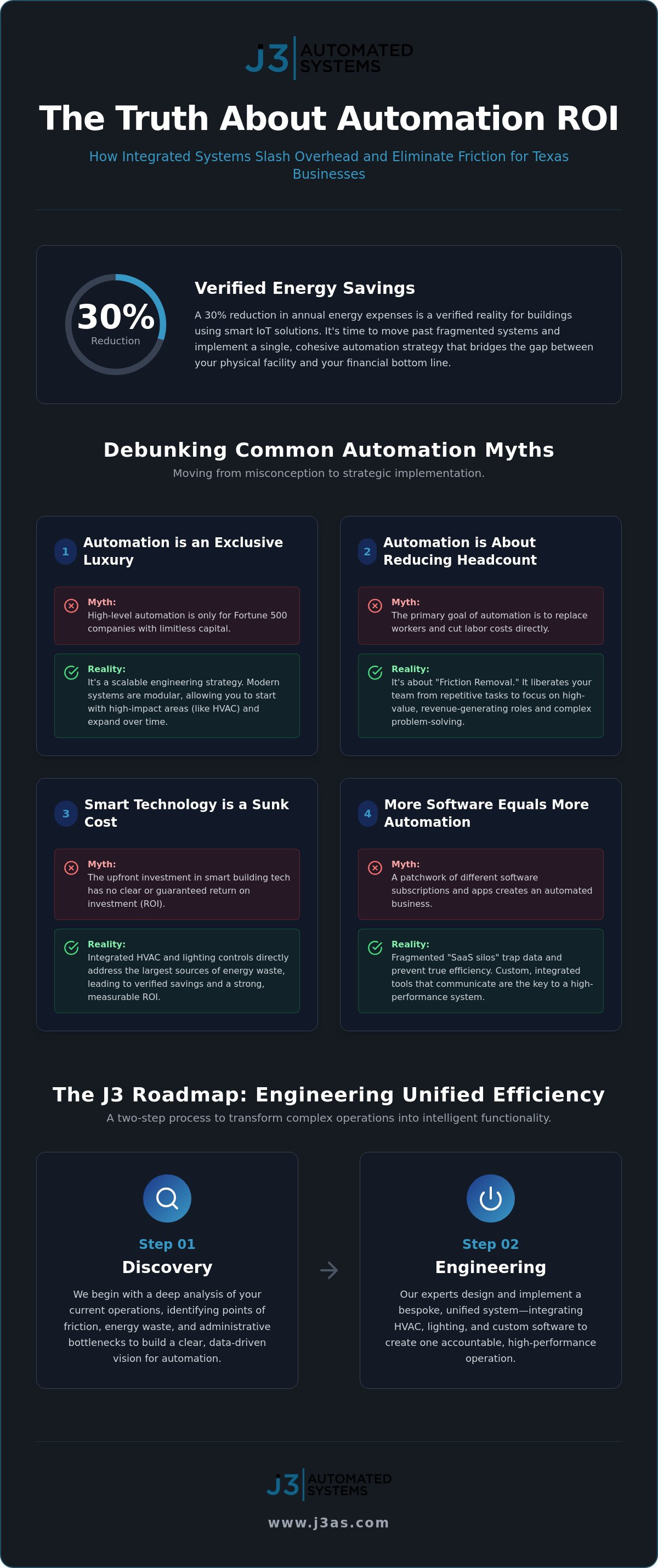
A 30% reduction in annual energy expenses is a verified reality for buildings using smart IoT solutions, yet many Texas executives still view high-level integration as an optional luxury. You likely already feel the weight of rising utility bills during a relentless San Antonio summer or the friction of administrative turnover that stalls your daily workflows. It is frustrating to manage fragmented systems that refuse to communicate, leaving you with a patchwork of tools instead of a cohesive operation. To effectively reduce commercial operating costs automation must be implemented as a single, cohesive system that bridges the gap between your physical facility and your financial bottom line.
We promise to reveal the truth behind automation ROI and show how integrated systems actually slash overhead for Texas businesses. This guide examines the specific ways bespoke HVAC controls and AI-driven workflows remove the burden from your staff while significantly lowering monthly bills. We will move from the foundational logic of system integration to the practical application of a single, accountable building management strategy. By the end, you will understand how a masterfully engineered approach transforms complex operations into a state of intelligent, effortless functionality.
Key Takeaways
- Automation is a scalable engineering strategy rather than an exclusive luxury, offering Texas businesses a sophisticated way to manage resources and maintain a competitive edge.
- Transition from viewing automation as a tool for headcount reduction to a method for friction removal, eliminating the costly administrative errors that stall operational growth.
- Discover how to reduce commercial operating costs automation by integrating HVAC and lighting systems to address the most significant contributors to passive energy waste.
- Move beyond the limitations of fragmented software subscriptions by engineering custom internal tools that align precisely with your unique operational requirements.
- Master the J3 roadmap of Discovery and Engineering to unify your physical environment and digital processes into one accountable, high-performance system.
Myth 1: Automation is an Exclusive Luxury for Global Enterprises
A common misconception among business owners is that high-level automation belongs solely to Fortune 500 companies with limitless capital. They see shimmering glass towers and assume the technology within is out of reach for a regional operation. This is a fundamental misunderstanding of modern engineering. Automation is not a trophy for the elite; it is a strategic tool for the efficient. To effectively reduce commercial operating costs automation must be viewed as a scalable engineering strategy rather than a one-time hardware acquisition. The goal is to move beyond the collection of disparate gadgets and toward a unified, intelligent ecosystem.
Many firms fall into the "entry point" fallacy, believing they must wait for a massive budget before making a move. In reality, a well-defined roadmap is far more valuable than a large initial check. Starting with a clear vision allows you to implement systems that provide immediate relief while remaining compatible with future growth. This methodical approach ensures that every investment contributes to a cohesive whole rather than adding to a pile of disconnected technology. It is about removing friction, not just spending money.
This philosophy of removing friction is equally vital in high-stakes environments like corporate events, where specialists like NextGen AV ensure that audio-visual production remains seamless and professional, allowing the focus to remain on the message rather than the technology.
The Scalability of Intelligent Systems
Modern Building Automation Systems (BAS) are inherently modular, allowing for a "broad-to-narrow" implementation. You don't need to automate an entire campus at once to see results. A distribution center in San Antonio or a medical office in Austin can begin by targeting high-impact areas where waste is most prevalent. This might mean starting with automated HVAC controls in energy-intensive zones or developing custom web apps to streamline administrative workflows.
In industrial settings, this efficiency often extends to physical asset management; for example, distribution centers can discover Container Authority to streamline the procurement of bulk industrial containers and storage solutions.
Unlike "SaaS silos" that trap your data in expensive, non-communicating subscriptions, integrated internal tools are designed to talk to one another. Custom software development has become remarkably accessible for regional Texas firms. It allows you to build specific solutions for your unique business processes, ensuring that your digital tools work as hard as your physical infrastructure. When these systems are engineered to be fluid, they become an asset that scales alongside your revenue.
Economic Drivers in the Texas Market
The San Antonio-Austin corridor faces specific labor market pressures that make automation an operational necessity in 2026. High turnover in administrative roles and rising labor costs create a volatile environment for businesses relying on manual processes. Automation acts as a hedge against this volatility. It provides a level of consistency that human systems simply cannot match, especially when dealing with repetitive financial or scheduling tasks.
Commercial real estate costs in Central Texas continue to demand higher efficiency from every square foot. An automated facility doesn't just save on energy; it optimizes how the space is used. The shift from seeing these systems as "nice-to-have" features to essential infrastructure is already happening. Businesses that embrace this shift early find themselves with a significant competitive advantage. They aren't just saving money; they're building a more resilient, accountable foundation for the future.
This commitment to building resilient, tech-driven foundations is mirrored in other sectors, such as the automotive industry, where AutoDream utilizes smart technology to connect buyers and sellers across a global marketplace.
Myth 2: Automation is Primarily About Reducing Headcount
The fear of the replaced worker is a persistent shadow in the discussion of efficiency. Many business owners in the San Antonio and Austin corridor hesitate to embrace technology because they view it through a lens of human replacement. This is a narrow and ultimately flawed perspective. When we look at how to reduce commercial operating costs automation should be framed as "friction removal." It is not about thinning the roster; it is about liberating your most valuable assets, your people, from the soul-crushing weight of repetitive, low-value tasks.
This newfound capacity allows teams to pursue high-value initiatives such as global networking. Organizations often turn to specialized schools like Learning Explorer to provide their staff with the language skills necessary to thrive in international commerce.
A sophisticated business strategy recognizes that human intelligence is best applied to revenue-generating roles and complex problem-solving. Research into altering government performance demonstrates that intelligent automation serves to enhance systemic output rather than simply cutting labor. By automating the mundane, you allow your team to focus on high-touch client service and strategic growth. This reallocation of talent not only improves your bottom line but also acts as a powerful driver for employee retention. People are far more likely to stay with a firm that values their creativity over their ability to copy data from one spreadsheet to another.
Removing Administrative Friction
Hidden costs often lurk within manual data entry and fragmented reporting structures. Every time a staff member manually bridges the gap between two non-communicating systems, your operational efficiency takes a hit. Custom web apps and AI business process integration create a seamless flow of information across departments. These tools handle the "heavy lifting" of scheduling, invoicing, and data reconciliation with a speed and consistency that manual efforts cannot match. It's a shift from reactive management to proactive oversight, where your staff spends their time interpreting data rather than just moving it.
The Value of Accuracy and Compliance
Human error is an expensive variable in commercial billing and inventory management. A single misplaced decimal or a missed regulatory deadline can result in significant financial penalties and eroded client trust. Automation provides a "single source of truth" that ensures data integrity across your entire operation. Automated audits reduce the immense burden of regulatory compliance, allowing you to maintain perfect records without the need for constant manual oversight. This level of precision creates a calm, reliable environment where errors are engineered out of the system, replaced by a state of intelligent, effortless operation.
This commitment to precision and efficiency is especially critical when managing complex documentation; for instance, Dynamic Contracts Consultants LLC provides specialized support in proposal and grant writing, using AI-driven development and customized templates to ensure high-stakes submissions are both accurate and competitive.
In the realm of high-value capital projects, maintaining this level of integrity often requires specialized oversight; expert bank instrument validation services provide the rigorous due diligence needed to secure complex financial programs.
Myth 3: Smart Building Technology is a Sunk Cost with No ROI
The perception that smart building technology is a drain on capital rather than a generator of value is a costly misunderstanding. In the context of the Texas climate, where external temperatures frequently exceed 100 degrees, the building itself often becomes the largest operational expense. Viewing automation as a sunk cost ignores the immediate and compounding returns found in precision environmental management. To effectively reduce commercial operating costs automation must be applied to the physical systems that consume the most resources, transforming them from passive liabilities into high-performance assets.
Organizations that deploy smart IoT solutions can see 15% to 30% energy reductions within the first year of implementation, according to data from cohesionIB (December 2025). This isn't just about turning off lights; it's about engineering a building that breathes and adapts to its occupants. When building systems are fragmented, they work against each other. An integrated approach ensures that every component, from the chiller to the window shade, operates in a state of orchestrated harmony, removing the burden of manual facility oversight.
To further bolster these efficiency gains, many commercial entities are integrating renewable energy systems into their infrastructure; you can learn more about EEHD Erneuerbare Energien Handel und Distribution GmbH to see how solar solutions can contribute to a sustainable ROI.
HVAC and Lighting: The Low-Hanging Fruit of ROI
Manual lighting and shade control represent a significant source of passive energy waste. In San Antonio and Austin, solar heat gain through windows can force HVAC systems to work significantly harder than necessary. Automated shades respond to the sun's position in real-time, blocking heat before it enters the space, while intelligent lighting adjusts based on natural day-lighting and occupancy. This reduces the cooling load and prevents the over-chilling of empty conference rooms or hallways. The true ROI of a Building Management System is found in its ability to eliminate the invisible energy waste that occurs when manual oversight fails to account for shifting environmental variables.
Predictive Maintenance and Asset Longevity
Moving from reactive maintenance to predictive engineering is a hallmark of a mature automation strategy. Traditional building management involves waiting for a component to fail before calling for an expensive emergency repair. Intelligent monitoring identifies anomalies in motor vibration or refrigerant pressure before a breakdown occurs. This proactive stance extends the operational life of expensive commercial hardware, and by coordinating with local experts like Anton Plumbing Heating & Cooling, you can eliminate the premiums associated with after-hours service calls.
For businesses seeking similar excellence in specialized drainage and gas fitting, CQR Plumbing provides professional solutions that align with these high standards of commercial maintenance.
A resilient physical infrastructure also requires the seamless integration of security and networking. When your BMS is unified with your digital backbone, you gain a level of visibility that protects both your physical assets and your operational continuity. This holistic perspective ensures that your building remains a stable, high-functioning environment regardless of external pressures. By removing the friction of manual facility management, you create a space that supports both your financial goals and your team's productivity.
Myth 4: More Software Tools Equal More Automation
The proliferation of specialized software has led many executives into the "SaaS Trap," a state where an abundance of subscriptions actually increases operational complexity rather than reducing it. While each individual tool may promise efficiency, the friction created by a fragmented digital landscape often outweighs the benefits. True intelligence is not found in the number of icons on your dashboard. To meaningfully reduce commercial operating costs automation must serve as a unified layer that bridges the gap between your physical building management and your digital business processes.
Off-the-shelf solutions frequently fail because they are designed to exist in a vacuum. They don't speak to your HVAC system, and they certainly don't understand the specific nuances of your Texas-based operations. When software tools remain isolated, your staff is forced to act as the "human bridge," manually transferring data and reconciling reports. This manual intervention is precisely what we aim to eliminate. By utilizing platforms like Syntes AI as the connective tissue between your existing systems, we transform a collection of disparate tools into a single, high-performance ecosystem.
The Pitfalls of Fragmented Systems
Every non-communicating tool in your stack carries an "integration tax," a hidden cost paid in lost time and data silos. Custom web apps and internal tools provide the necessary architecture to streamline cross-platform data, ensuring that information flows with fluidity across every department. The advantage of a single accountable team is paramount here. When the same engineers who design your physical infrastructure also architect your digital workflows, the result is a level of seamlessness that off-the-shelf products cannot replicate.
Custom AI Integration for Workflow Fluidity
Moving beyond generic chatbots, bespoke AI business process automation focuses on the specific friction points within your unique culture. We begin by mapping your internal processes to identify high-impact opportunities where intelligence can replace manual effort. This white-glove approach ensures that the technology fits the business, rather than forcing the business to adapt to the technology. If you are ready to move beyond fragmented tools and toward a unified strategy, explore our approach to custom AI and systems integration.
The J3 Roadmap: Engineering a Unified Efficiency Strategy
The transition from acknowledging operational friction to achieving a state of intelligent operation requires more than a simple software purchase. It demands a structured, logical progression through a dedicated project lifecycle. At J3 Automated Systems, we utilize a rigorous framework of Discovery, Engineering, and Commissioning to ensure that every system is built for long-term functionality. This approach moves beyond the surface-level fixes offered by off-the-shelf vendors, positioning us as a high-level consultant and steward of your entire automation roadmap. To effectively reduce commercial operating costs automation must be treated as a comprehensive engineering discipline rather than a series of isolated tasks.
Local expertise in the San Antonio and Austin corridor is essential for the physical deployment of these systems. While digital tools can be managed from anywhere, the physical systems that target overhead, such as HVAC and lighting controls, require a deep understanding of regional building standards and environmental demands. By merging physical building automation with digital AI workflows, we create a unified efficiency strategy that addresses costs from every possible angle. This holistic perspective ensures that your digital processes and physical environment work in harmony to reduce commercial operating costs automation through precision and intelligence.
Discovery and Process Mapping
True efficiency begins with a deep-dive audit before a single piece of hardware is installed. We map your unique business processes to uncover hidden operational costs that manual oversight often misses. This architectural approach to problem-solving is consistent across all our work, whether we are designing Cinema-Grade Home Theater Design or a complex commercial BMS. By identifying the hidden connections between different systems, we ensure the final result is fluid and inclusive of your specific operational needs. We move from the "why" to the "how" with a deliberate pace that ensures no detail is overlooked.
Implementation and White-Glove Support
During the engineering and installation phase, you can expect a polished, professional atmosphere that respects your operational continuity. We provide a single accountable team for both the physical infrastructure and the digital logic, removing the burden of managing multiple, non-communicating vendors. This commitment to long-term performance ensures your systems remain resilient and seamless as your business scales. The final step is moving from problem awareness to an engineered solution that provides calm reliability for years to come. If you are ready to remove the friction from your operations, schedule a consultation with J3 Automated Systems to map your automation roadmap.
Achieving Operational Harmony through Intelligent Engineering
True operational efficiency is found at the intersection of physical infrastructure and digital intelligence. By dismantling the myths of high entry costs and human replacement, Texas business leaders can reclaim significant overhead currently lost to energy waste and administrative friction. To effectively reduce commercial operating costs automation must be viewed as a cohesive, long-term roadmap rather than a collection of disjointed software subscriptions.
Our team serves as a dedicated steward for your facility, offering deep expertise in the Texas commercial climate and the specific market needs of our region. By integrating bespoke AI and custom software with your physical infrastructure, we remove the friction that stalls growth. We provide a single accountable team for every phase of engineering and installation, ensuring your investment delivers a polished, reliable result.
Begin your automation roadmap with a professional J3 consultation.
We look forward to engineering your path toward a more efficient and profitable future.
Frequently Asked Questions
How long does it typically take to see a return on investment (ROI) from commercial automation?
Payback periods for smart building technology can be as short as 18 months, with some organizations seeing a three-year ROI of 133% according to industry research. The exact timeline depends on the scale of your facility and the current level of inefficiency. High-impact areas like HVAC and lighting typically provide the fastest returns by addressing the most significant contributors to monthly overhead. This structured approach ensures that your initial investment generates a sustainable, long-term financial advantage.
Can automation systems be integrated into older commercial buildings in San Antonio?
Yes, automation systems can be retrofitted into historic or older commercial structures throughout the San Antonio area. Modern engineering allows us to integrate wireless sensors and non-invasive hardware that respect the architectural integrity of older buildings. These upgrades are often the most effective way to reduce commercial operating costs automation by bringing legacy systems up to modern efficiency standards. We focus on removing the friction of outdated infrastructure without requiring a total reconstruction.
What is the difference between a Building Management System (BMS) and simple smart thermostats?
A Building Management System (BMS) is a centralized intelligence layer that controls all physical systems, whereas a smart thermostat is a localized hardware point. While a thermostat only manages temperature, a BMS orchestrates the relationship between HVAC, lighting, and occupancy. This holistic integration is a primary way to reduce commercial operating costs automation by preventing systems from working against each other and ensuring precision across the entire property.
Does automating my business processes require me to replace my existing software?
You don't necessarily need to replace your existing software to achieve high-level automation. We often utilize AI as a connective tissue to bridge the gap between your current tools and new internal applications. This approach preserves your previous investments while removing the administrative friction caused by fragmented, non-communicating systems. It allows for a seamless flow of data across your entire organization without the disruption of a total software overhaul.
How does automated lighting and shading actually reduce my HVAC costs in Texas?
Automated shades and lighting reduce HVAC costs by proactively managing solar heat gain. In the intense Texas heat, windows act as thermal entry points that force your cooling systems to run at maximum capacity. By automatically blocking UV rays and utilizing daylight harvesting, the system lowers the internal temperature naturally. This allows the HVAC to operate more efficiently, extending the life of your hardware and lowering monthly utility bills.
Is custom software development more expensive than buying multiple SaaS subscriptions?
Custom software development often provides a lower total cost of ownership by eliminating the "SaaS Trap" of perpetual monthly subscriptions. While off-the-shelf tools require you to pay for features you don't use, a bespoke solution is engineered specifically for your workflows. This removes the integration tax and ensures your digital tools scale alongside your revenue. It creates a single, accountable system that belongs to your business rather than a third-party vendor.
What industries in the Austin area benefit most from AI process automation?
Professional services, healthcare, and high-tech manufacturing in Austin see significant benefits from AI process integration. These sectors often struggle with high administrative turnover and complex data reconciliation. Implementing intelligent workflows allows these firms to reallocate their staff to high-value, revenue-generating roles—such as using Nodal AI to unearth deep insights within marketing campaigns—while maintaining a state of effortless, accurate operation. It transforms the administrative burden into a streamlined, automated process that supports growth.
How does J3 Automated Systems ensure our staff can actually use the new technology?
J3 provides comprehensive commissioning and white-glove support to ensure your team is confident with the new technology. We believe that a system is only as effective as its users, so we engineer intuitive interfaces that simplify complexity. Our single accountable team remains your partner long-term, providing the technical authority and guidance needed to maintain peak system performance. We ensure the transition from manual effort to intelligent operation is smooth and reassuring.