Choosing the Right Building Management System Installer: A 2026 Facility Manager’s Checklist

Why does your sophisticated facility still feel like a collection of isolated islands that refuse to communicate? You've likely felt the friction of proprietary systems that lock you into a single vendor or HVAC automation that fails to respond to the unique demands of the Central Texas climate. It's frustrating to manage a high-performance building when your data remains trapped in silos and your energy costs continue to climb. Selecting the right building management system installer is the difference between a reactive maintenance cycle and a proactive, unified environment that actually serves your long-term operational goals.
This guide provides a definitive 2026 checklist to help you secure a partner who bridges the gap between physical hardware and AI-driven intelligence. You'll learn how to evaluate technical expertise, ensure compliance with updated standards like ASHRAE 90.1-2022, and identify the local support needed to achieve a 20 to 30 percent reduction in energy costs. We will define the essential criteria for future-proofing your infrastructure, transforming your facility from a state of fragmentation into a model of intelligent, effortless operation.
Key Takeaways
- Selecting the right building management system installer requires looking beyond basic electrical licensing to find a partner with deep engineering expertise.
- Prioritize open-protocol systems like BACnet and Modbus to eliminate proprietary vendor lock-in and ensure long-term architectural flexibility.
- Learn how integrated HVAC automation and smart building ROI frameworks can significantly reduce peak demand charges and operational expenses.
- Follow a structured implementation roadmap that moves from initial discovery to final commissioning to ensure a seamless system transition.
- Discover the strategic advantage of partnering with a Texas-based integrator who provides a single accountable team for both hardware and custom AI software.
Qualifying Your Building Management System Installer: Essential Credentials
The selection of a building management system installer is the most critical decision a facility manager faces when upgrading or commissioning a new site. While many contractors can pull wire or mount sensors, true operational harmony requires an engineering-first approach. You aren't simply buying hardware; you are investing in a long-term strategy for efficiency and resilience. A Building Management System is a sophisticated ecosystem that demands a partner who understands the hidden connections between mechanical, electrical, and digital layers.
Engineering-First vs. Hardware-First Installers
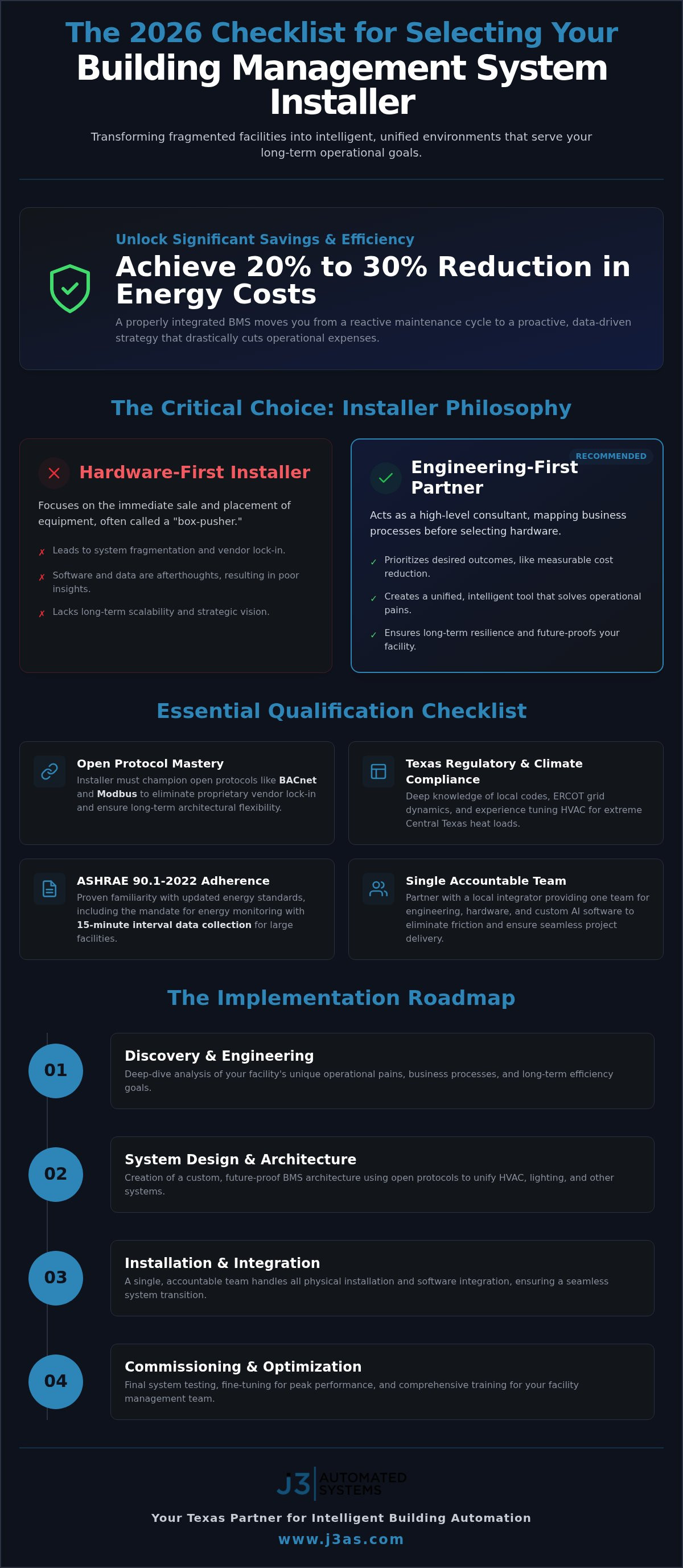
A hardware-first installer, often referred to as a "box-pusher," focuses on the immediate sale and physical placement of equipment. This approach frequently leads to system fragmentation and a lack of long-term scalability. These installers often lack the vision to see how a cooling sequence in a San Antonio office tower interacts with lighting schedules or occupancy data. When hardware is the priority, the software often becomes an afterthought, resulting in a clunky interface that provides little actionable insight.
In contrast, an engineering-first partner acts as a high-level consultant. They enter the design phase early to map your specific business processes before a single device is unboxed. They ask how your facility actually operates and how data should flow between departments. This meticulous planning ensures the final installation isn't just a collection of parts, but a unified tool that solves your unique operational pains. They prioritize your desired outcomes, such as a measurable reduction in operational expenses, over simple equipment quotas.
Texas Regulatory and Climate Compliance
Operating in Central Texas presents environmental challenges that national installers often overlook. A qualified building management system installer must possess a deep understanding of local building codes in San Antonio, Austin, and Boerne. Beyond basic licensing, they must be intimately familiar with the demands of the Texas power grid and the specific dynamics of ERCOT. This knowledge is vital for implementing demand-response strategies that protect your bottom line during peak usage periods.
Texas facilities face extreme cooling loads during summer peak cycles. Your installer should demonstrate a proven track record of tuning HVAC automation to handle these high-load scenarios without sacrificing comfort or incurring massive demand charges. Verify their familiarity with ASHRAE 90.1-2022 standards, which mandate energy monitoring with 15-minute interval data collection for larger buildings. A partner with a local footprint understands these environmental pressures and designs with them in mind, ensuring your system remains resilient when the temperature climbs.
Finally, evaluate past performance in facilities of a similar scale. Seek out a single accountable team for both engineering and installation to eliminate the friction that occurs when designers hand off a project to a separate crew. Local presence in the San Antonio and Austin corridor is non-negotiable for emergency support. When a critical system fails during a July heatwave, you need a partner who can provide rapid, on-site expertise rather than a remote technician in a different time zone.
The Technical Integration Checklist: Beyond Basic HVAC Control
A building management system installer must do more than connect sensors. They must act as an architect of interoperability. The goal is to move away from the fragmented silos of the past and toward a single, intelligent dashboard. This transformation relies on a technical foundation that supports growth, security, and measurable ROI. Modern facility management is no longer just about keeping the air moving; it is about sophisticated data orchestration.
Interoperability Requirements
Proprietary systems are a significant liability for modern facilities. They create a closed environment that limits your ability to upgrade or integrate new technologies without returning to the same vendor. Instead, look for an installer who champions open protocols like BACnet and Modbus. These standards allow different devices to speak the same language, regardless of the manufacturer.
A high-tier integrator will often utilize open-source frameworks such as Niagara to unify these protocols. This flexibility is essential for facilities that need to integrate legacy HVAC equipment with cutting-edge digital controls. By utilizing sophisticated energy management control systems, you can ensure that your current infrastructure remains relevant as you scale toward AI-driven optimization. Demand a comprehensive protocol map from your installer during the design phase. This document serves as the blueprint for your building's communication layer, ensuring no device is left in the dark.
The Role of Low-Voltage Wiring
The reliability of your BMS depends on the invisible backbone of its low-voltage wiring. High-performance commercial systems benefit from the same meticulous attention to detail found in high-end residential networking. Structured cabling provides the necessary bandwidth and stability to handle the constant data flow from thousands of sensors and controllers without signal degradation.
Your building management system installer should prioritize redundant paths for critical safety and security systems. This ensures that a single cable failure doesn't blind your entire operational dashboard. Professional engineering-led HVAC automation focuses on this physical layer to prevent the signal interference and latency issues that plague amateur installations.
Finally, consider cybersecurity protocols as a non-negotiable checklist item. As buildings become more connected, they also become more vulnerable to external threats. Your installer must implement encrypted communication channels and secure remote access points to protect your data and your occupants. This holistic approach to technical integration ensures your infrastructure is not just functional today, but resilient for the next decade of innovation.
Operational Efficiency & ROI: Evaluating Long-Term System Performance
A high-performance building is more than a collection of synchronized parts; it is a financial asset that requires precise calibration to yield maximum returns. When you partner with a sophisticated building management system installer, you aren't just purchasing a tool for climate control. You are implementing a comprehensive strategy for capital preservation. True efficiency is found at the intersection of architectural intelligence and digital oversight, where every watt of energy is accounted for and every operational friction point is smoothed away.
Slashing Operational Costs in the Texas Heat
Texas facilities face a unique set of environmental pressures that can quickly erode a maintenance budget. Peak demand charges during the sweltering summer months often represent a massive portion of utility expenses. Implementing commercial HVAC automation systems allows for granular control over cooling cycles, enabling load-shedding strategies that protect the bottom line without compromising occupant comfort. This proactive approach ensures that your facility responds dynamically to the ERCOT grid's fluctuations rather than reacting to a high bill after the fact.
Beyond HVAC, the integration of automated lighting and motorized shades provides a critical defense against thermal gain. By syncing shade positions with the sun's path, you can significantly reduce the cooling load required to maintain setpoints. These integrated strategies are central to how modern integrators reduce commercial operating costs with automation. To ensure these savings are realized from day one, a rigorous commissioning process is essential to verify that every sensor and actuator performs according to the original engineering intent.
AI-Ready Infrastructure and Defensible ROI
The landscape of facility management is shifting toward predictive rather than reactive maintenance. A forward-thinking building management system installer ensures your infrastructure is prepared for future AI business process integration by providing a clean, accessible data API. This allows for the collection of high-resolution operational data that machine learning algorithms can later use to predict equipment failure before it occurs. Without this "data-first" mindset during installation, your building remains trapped in a legacy loop of manual inspections and surprise repairs.
Quantifying these benefits requires a structured approach to financial modeling. Utilizing a smart building ROI analysis helps facility managers justify the initial capital expenditure by looking at the total cost of ownership over a ten-year horizon. This framework accounts for reduced administrative labor, lower maintenance call-outs, and extended equipment lifecycles. When you treat your BMS as a master of complexity that simplifies your world, the return on investment moves from a theoretical projection to a measurable, monthly reality.
The Implementation Roadmap: From Engineering to Commissioning
A successful deployment is not a singular event but a methodical progression that mirrors a well-planned project lifecycle. It begins long before the first sensor is mounted. A professional building management system installer treats the project as a transformation of the physical environment into a digital asset. This roadmap moves from broad conceptualization to specific, grounded applications, ensuring that every layer of the system serves the final objective of effortless operation.
Discovery and Engineering
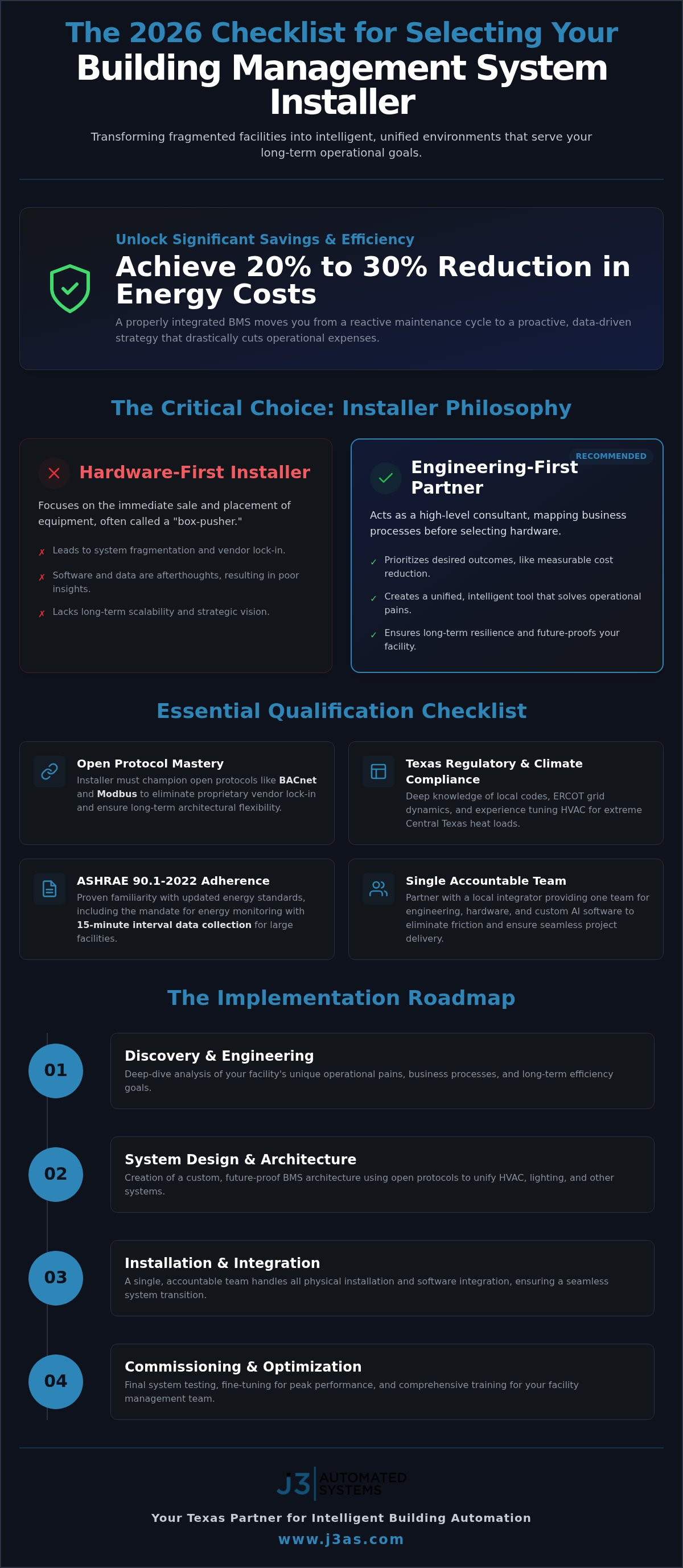
The process initiates with Phase 1: Discovery and Process Mapping. During this stage, we identify the friction points in your current operations and map the unique workflows of your facility. We ask how your team interacts with the space and where manual efforts can be replaced by intelligent automation. This leads directly into Phase 2: System Engineering and Documentation.
At J3, we focus on engineering before procurement. This design-first philosophy ensures that the hardware selected is the best fit for the intended sequence of operations. Unlike installers who prioritize equipment sales, we create a unified automation roadmap that defines how data will flow across your infrastructure. This documentation serves as the single source of truth for the entire project, reducing the risk of integration errors during the physical build. This phase eliminates the burden of fragmented systems by ensuring compatibility at the architectural level.
Commissioning: The Critical Final Step
Once Phase 3: Physical Installation and Low-Voltage Integration is complete, the project enters the most vital stage. Phase 4: Commissioning and Performance Tuning is where the theoretical design meets the reality of the physical environment. This isn't a simple power-on test. It is a rigorous verification process where we ensure every sensor, actuator, and controller performs exactly as intended.
In the San Antonio and Austin corridor, commissioning must include stress-testing the system under simulated peak Texas heat. We verify that the HVAC automation sequences handle high-load transitions smoothly and that the energy-saving logic holds up under pressure. This meticulous tuning prevents the day-two failures that often plague less disciplined installations. We look for harmony between the mechanical equipment and the digital commands that drive them.
The roadmap concludes with Phase 5: Staff Training and Handover. A sophisticated system is only effective if the facility manager knows how to use it. We provide a white-glove transition, ensuring your team understands the unified dashboard and can leverage the predictive analytics provided by the new infrastructure. To begin your facility's transformation, consult with a building management system installer who manages the entire lifecycle from engineering to final commissioning.
J3 Automated Systems: Your Texas Partner for Intelligent Building Automation
Choosing a building management system installer often feels like managing a high-stakes puzzle where the pieces don't quite fit. Traditional models force you to coordinate between separate engineering firms, hardware vendors, and software developers. J3 Automated Systems eliminates this friction by providing a single accountable team for the entire lifecycle of your project. We serve the San Antonio, Austin, New Braunfels, and Boerne corridor with a focus on high-end commercial facilities that demand precision. By owning both the engineering and the installation, we ensure that the architectural vision remains intact from the first wire to the final dashboard.
Integrated Solutions for Modern Facilities
Our approach extends beyond simple equipment placement. We unify lighting, security, and complex HVAC automation into a singular, intelligent ecosystem. For many Texas commercial estates, the standard manufacturer interface isn't enough to handle unique operational requirements. This is where our expertise in custom web app development in San Antonio becomes a strategic advantage. We don't just install a system; we engineer the digital backbone that allows your BMS to communicate with your broader business processes. This integration reduces the burden on your staff and creates a white-glove experience that traditional providers simply cannot match.
Getting Started with J3
The journey toward a more intelligent facility begins with a deep-thinking partnership. We don't offer off-the-shelf solutions because no two buildings share the same DNA. Our process starts with a discovery session designed to map your specific automation roadmap and identify hidden efficiencies. During your initial facility evaluation, we examine your existing infrastructure and listen to your operational goals. This methodical approach ensures that the final solution is both future-proofed and scalable. It is time to move past the state of fragmentation and embrace a state of effortless operation.
Your building deserves a steward who values long-term functionality over quick fixes. As a visionary integrator, we see the connections that others miss, ensuring your infrastructure scales with the coming wave of AI-driven optimization. Schedule your building automation consultation with J3 Automated Systems to define the next era of your facility's performance and secure a partner dedicated to your long-term ROI.
Securing the Future of Your Texas Facility
Navigating the transition from fragmented, manual building operations to a state of intelligent, effortless control requires more than just an equipment purchase. It demands a partnership with a building management system installer who understands the intricate relationship between physical hardware and digital AI workflows. By prioritizing open protocols and rigorous commissioning, you ensure that your infrastructure is prepared for the energy demands of 2026 and beyond. A unified dashboard isn't just a convenience; it's a measurable driver of long-term ROI and operational resilience.
J3 Automated Systems offers a single point of accountability for both hardware and custom software, eliminating the friction of vendor lock-in. Our engineering-first approach ensures that your complex building ecosystems are tuned specifically for the unique climate demands of San Antonio and Austin. We simplify the complexity of modern automation, allowing you to focus on high-level strategy while your facility manages itself. It's time to transform your property into a model of architectural harmony and technical precision. Schedule a Discovery Session for Your Texas Facility today to begin mapping your path toward a smarter, more efficient future.
Frequently Asked Questions
What is the difference between a BMS and a BAS (Building Automation System)?
A Building Management System (BMS) and a Building Automation System (BAS) are terms often used interchangeably in the modern industry. Technically, a BAS focuses on the automated control of mechanical systems like HVAC and lighting. A BMS serves as the broader management layer that integrates these controls with security, data analytics, and high-level reporting. In 2026, the distinction has blurred as both evolve into unified, intelligent building platforms.
How long does a typical building management system installation take?
The duration of a typical installation varies significantly based on facility scale and project complexity. For a standard 50,000 square foot commercial property, the process generally spans three to six months from initial engineering to final commissioning. This timeline accounts for discovery, low-voltage infrastructure deployment, and performance tuning. Larger, multi-use estates or complex industrial sites may require nine months or more to ensure every integrated system reaches peak operational harmony.
Can a new BMS be installed in an older commercial building in San Antonio?
Retrofitting older commercial buildings in San Antonio with modern automation is not only possible but highly recommended for operational efficiency. A skilled building management system installer can integrate legacy mechanical equipment with contemporary digital controls using open-source frameworks. This bridge allows historic or aging structures to benefit from AI-driven optimization and real-time monitoring without requiring a total replacement of existing HVAC hardware.
What are the main benefits of hiring a local BMS installer over a national firm?
Hiring a local firm provides the essential advantage of rapid on-site support and deep knowledge of the Texas climate. National firms often lack the specialized understanding of ERCOT grid dynamics and the extreme cooling loads specific to the San Antonio and Austin corridor. A local partner offers a single point of accountability and can arrive quickly for emergency tuning during high-heat cycles, ensuring your facility remains resilient when regional pressures peak.
How much can a BMS realistically reduce my commercial energy bills in Texas?
Optimized systems can realistically reduce commercial energy bills by 20 to 30 percent through intelligent automation and continuous monitoring. In the Texas heat, much of this savings comes from slashing peak demand charges and fine-tuning HVAC cycles to match real-time occupancy patterns. By integrating automated shades and lighting with thermal sensors, facility managers can effectively manage solar gain and prevent the utility spikes that frequently occur during sweltering summer afternoons.
What maintenance is required after the BMS installation is complete?
Post-installation maintenance involves regular software updates, sensor calibration, and periodic performance audits to prevent system drift. While automation reduces manual labor, the digital layer requires stewardship to ensure cybersecurity protocols remain current. A structured maintenance plan typically includes reviewing data analytics to identify emerging inefficiencies and performing preventative adjustments on mechanical actuators to maintain the precision established during the initial building management system installer commissioning phase.
Does a BMS installer also handle the low-voltage wiring and networking?
A comprehensive integrator manages the entire physical and digital backbone, including low-voltage wiring and resilient networking infrastructure. This ensures that the communication paths between sensors and controllers are optimized for speed and reliability. By handling the structured cabling in-house, the team eliminates the friction that occurs when multiple contractors attempt to layer digital processes over physical environments without a unified engineering roadmap.
What is commissioning in the context of building management systems?
Commissioning is the rigorous process of verifying that every component of the system operates exactly according to its engineering design. It moves beyond simple functionality tests to include stress-testing the building's response to various environmental scenarios. This final stage ensures that all integration points, from HVAC sequences to security triggers, are perfectly synchronized. It is the essential step that guarantees long-term reliability and confirms the system is ready for handover.