Video Wall Installation in San Antonio: Compare Project Costs
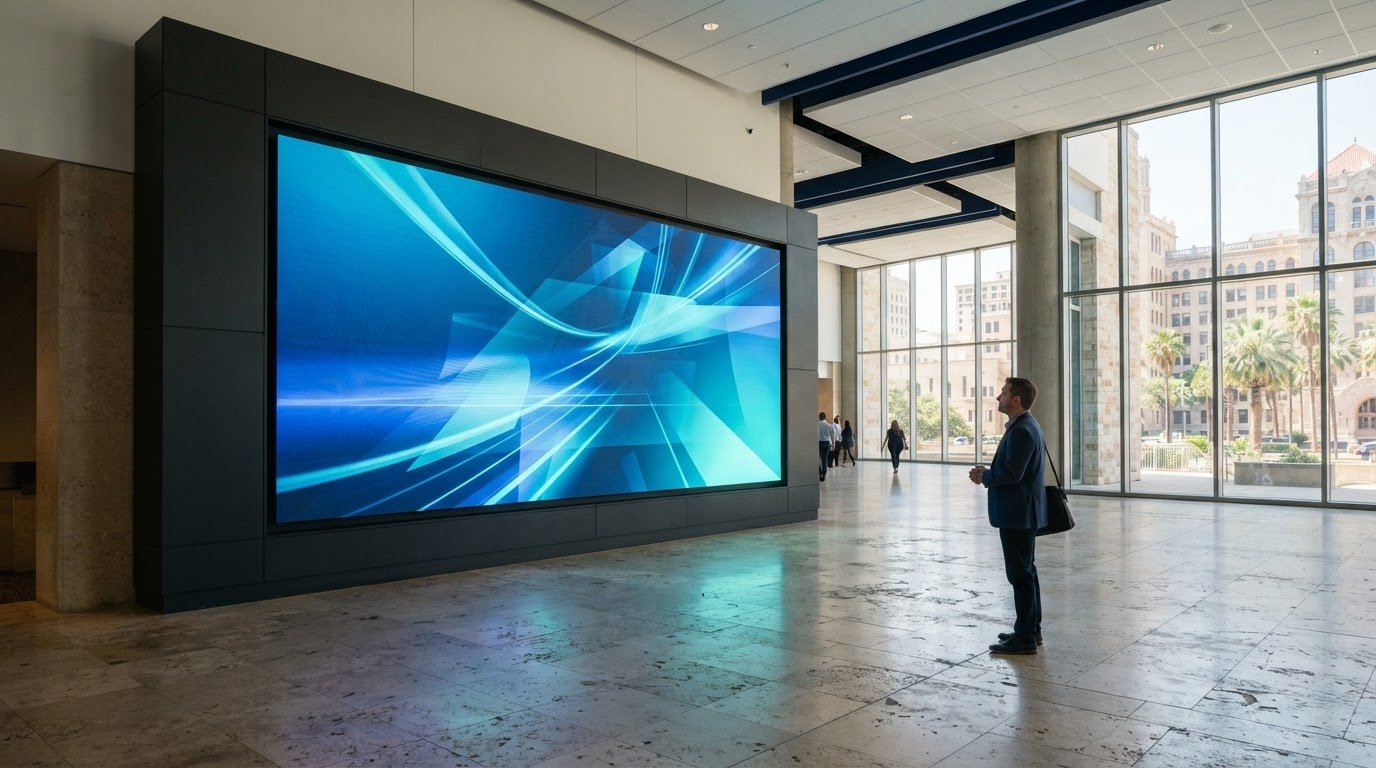
The largest LED wall isn’t automatically the right one. A large-scale project should be designed around the room, viewing distance, ambient light, and the content it needs to display. For video wall installation in San Antonio, these decisions determine whether the finished wall looks clear and integrated, rather than simply oversized.
Choosing a display is only one part of planning. Brightness, pixel pitch, mounting structure, and content management all affect performance and project scope. Compare the complete system, not just the display panels.
This guide explains how to select a display, plan viewing distance and brightness, and configure content management for the space. It also covers the main factors that shape project costs and how a custom video wall can serve a conference space, public venue, or commercial environment.
Key Takeaways
- Match pixel pitch to the audience’s viewing distance so images and text remain clear from the intended vantage points.
- Plan brightness around ambient light and the display’s location, especially where sunlight or strong indoor lighting affects visibility.
- Map content sources and screen layouts before installation to create a system that’s straightforward to operate.
- Compare the complete project scope, including displays, mounting structure, cabling, installation, and calibration, rather than hardware alone.
- Shape the wall around the space and its purpose, from screen dimensions and configuration to the experience the content should create.
Questions to ask before choosing a display
What types of video walls are available for businesses and venues? Common options include tiled indoor LCD walls, direct-view LED walls, and large-format single displays. Each suits different viewing distances, room conditions, and content needs.
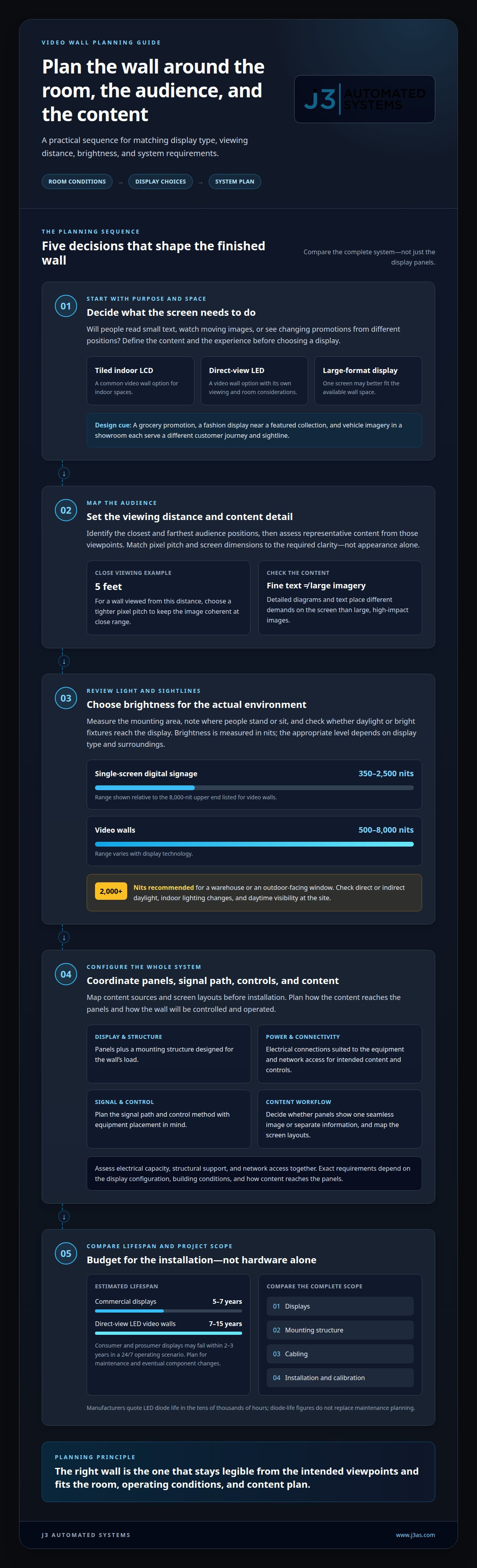
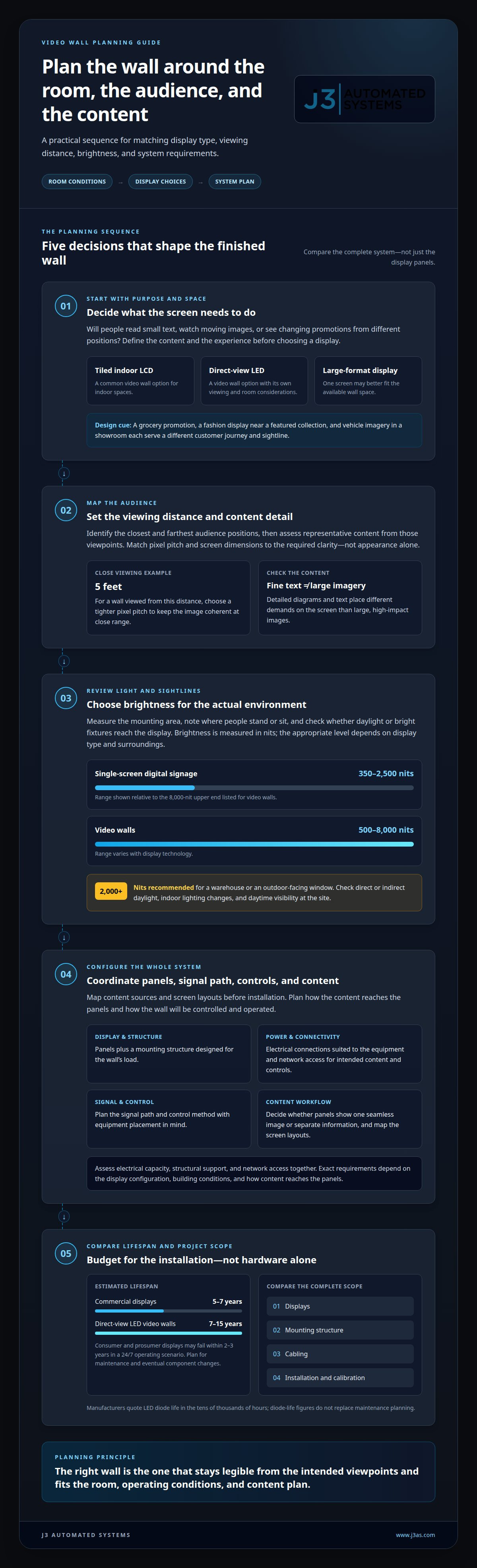
Start with the display’s purpose. Will viewers need to read small text, watch moving images, or see changing promotions from different positions? Map the farthest viewing point and the closest audience position. For a wall viewed from five feet away, choose a tighter pixel pitch to keep the image coherent at close range.
- Will the screen run continuously? Consumer and prosumer displays aren’t rated for continuous operation and may fail within 2-3 years in a 24/7 operating scenario.
- Will sunlight or bright warehouse lighting affect visibility? Displays rated for 2,000 or more nits are recommended for a warehouse or outdoor-facing window.
- Does the content need to span a seamless image, or will separate panels show distinct information?
- Will the location accommodate a tiled wall, or would one large-format display better suit the available wall space?
Match the display to the retail business and its customer journey. A grocery retailer might prioritize clear promotional messaging across aisles, while a fashion boutique may use a display near a featured collection. An automotive showroom can organize vehicle imagery and campaign content around visitor sightlines. For indoor large-format displays that aren’t video walls, the usual range is 110 to 165 inches. Choose based on viewing distance and the role of the screen, not size alone.
Include lifespan in long-term budgeting. Commercial displays are estimated to last 5-7 years, while direct-view LED video walls are estimated at 7-15 years. Manufacturers quote LED diode life in the tens of thousands of hours, but diode-life figures don’t replace planning for maintenance and eventual component changes. A consumer screen used in a 24/7 setting presents a different replacement risk from a display designed for commercial use.
Custom LED banners and shaped displays can extend content beyond a standard rectangle. Before choosing a form, define the architectural boundaries, viewing angles, and how messages will fit the shape. A banner above a retail entrance, for example, has different sightlines from a wall facing seated visitors. The design should keep content legible throughout the intended viewing area.
For advertising and marketing, decide whether the wall will show one campaign image or several messages at once. A retail promotion may need changing creative, while a venue may use the display for branded announcements and event content. That purpose informs the display format and makes video wall installation in San Antonio a planning decision, not simply a screen purchase.
Brightness, viewing distance, and ambient light
Video wall size, resolution, and viewing distance depend on audience positions, content detail, room dimensions, and ambient light. Map these conditions before selecting the technical configuration.
Screen Size and Viewing Distance
The screen should make important content legible from the farthest intended viewing position. A larger screen can improve visibility across a broad room, but resolution and content design also shape the result. Consider whether viewers need to read detailed graphics or recognize larger images. A lobby display showing headlines, for example, has different detail requirements from one playing high-impact brand imagery.
Wall Sizing and Ambient Light
Wall sizing connects sightlines with the available mounting area and lighting conditions. Measure the intended wall, identify where viewers stand or sit, and note windows or bright fixtures that may affect the screen. A wall facing a sunlit entrance has different ambient light from one in an interior meeting space. These observations inform display dimensions and brightness selection.
Brightness is measured in nits, and the appropriate level depends on the display type and environment. Single-screen digital signage displays range from 350-2,500 nits. Video walls range from 500-8,000 nits, depending on technology. These ranges describe different display categories, so compare the intended use and surrounding light rather than treating one figure as suitable for every installation.
Use a practical site review to match brightness to viewing conditions:
- Record whether daylight reaches the display directly or indirectly.
- Note how indoor lighting changes across the intended viewing area.
- Consider whether content must remain visible during bright daytime conditions.
Resolution also needs to match the content and viewing distance. Fine text and detailed diagrams place different demands on a screen than large images. Review representative content at its intended display size, then assess it from the audience’s actual positions. This helps align pixel structure, screen dimensions, and viewing comfort without sizing the wall by appearance alone.
When a room also needs coordinated sound, consider how whole-property audio fits alongside the visual plan.
System configuration and content management
Plan the display panels, signal path, control method, and content workflow as one system. Assess electrical capacity, structural support, and network access together before installation, because each affects equipment placement and how the wall operates.
Video wall installation requires electrical connections suited to the equipment, a mounting structure designed for the wall’s load, and network connectivity for the intended content and controls. Exact requirements depend on the display configuration, building conditions, and how content reaches the panels. Treat these as coordinated design decisions, not separate finishing details.
Begin configuration by defining what each screen area should show. A 98-inch display can be configured as four 49-inch quadrants for separate content. That layout could place a menu, promotion, schedule, and branded message in distinct zones. If one image should span all panels, configure the system to treat the combined surface as a single canvas.
Content management software determines how staff schedule, update, and distribute digital material. Match the workflow to the number of content sources and the people who will maintain it. One operator updating a campaign has different needs from a venue coordinating announcements, event graphics, and live inputs. Decide who approves content, how updates are delivered, and what appears when scheduled material changes.
Prepare creative files for the wall’s actual layout rather than stretching a standard image across it. Confirm the overall canvas dimensions, panel arrangement, and any separate content zones before production. For LED wall content, keep text and logos inside 5-7% safe margins so important elements don’t sit too close to the edge. Preview each asset at the intended scale to catch cropped lettering or misplaced graphics.
Build a simple signal and infrastructure plan before mounting. Identify source devices, processors, the control location, cable routes, power access, and network connection. A conference room, for example, may need a path for presentation content and a separate control point for staff. The support surface must suit the installation’s weight and layout, and cable access should remain serviceable after the panels are in place.
- Map each input to its intended display area.
- Document the content owner and update process.
- Test representative images, text, and video across the configured panels.
- Confirm power, mounting, cabling, and network routes before installation begins.
For a retail promotion, this plan connects campaign files to the right zones and update schedule. For a venue, it clarifies how event material moves from source to screen. A well-defined system makes the physical display and digital workflow work together as one installation.
Hardware, installation, and project cost comparisons
LED and LCD video walls suit different room layouts, viewing conditions, and visual goals. Compare the format, panel configuration, installation scope, and content requirements together, rather than judging the hardware in isolation.
How do LED video walls compare with LCD video walls? LCD walls use separate display panels, commonly available in 55-inch and 65-inch sizes, while direct-view LED forms an image from closely spaced diodes. LED pixel-pitch options include 0.9, 1.9, 2.9, and 3.9 mm, with tighter pitches suited to closer viewing.
LED can support custom shapes and expansive surfaces, while LCD panels create a tiled display from standard screen formats. The visible joins between LCD panels matter when content uses fine lines or text. For close viewing, direct-view LED may call for a fine pitch of 0.7 to 0.9 mm. Select according to the room, viewing distance, and intended image, not technology labels alone.
What companies install video walls in San Antonio, TX? Commercial audiovisual integrators and video-wall installation firms plan the display, mounting structure, signal path, and calibration as a coordinated project. Their work may include hardware integration and configuring the finished wall for digital signage, presentations, or immersive venue content.
Project cost depends on display technology, wall dimensions, pixel pitch, mounting conditions, cabling, content processing, and calibration. Installation, cabling, structural work, and calibration all contribute to the overall scope. Price depends on the case and is given after a quote request; the display format, site conditions, system configuration, and installation work determine the estimate.
Compare proposals by separating their components. Check whether each scope includes panels, the supporting structure, cabling, system setup, and calibration. A hardware-only comparison can leave out work needed for a functioning wall. A tiled LCD design and a custom LED surface, for example, may require different mounting and processing arrangements.
What is the process and typical timeline for installing a video wall? The sequence is site assessment, display and layout design, infrastructure planning, installation, system configuration, and final testing. The schedule depends on the chosen format, site readiness, structural work, and equipment coordination, so the project stages matter more than a generic duration.
- Define the display’s purpose and intended audience.
- Compare LCD panels with LED pitch and layout requirements.
- Review installation scope alongside the hardware specification.
- Test representative content across the completed display before use.
These comparisons help match the project to the room’s needs, whether the goal is practical digital signage or an immersive focal point.
Custom video wall design
Custom design starts with the room’s purpose, not a standard screen shape. For corporate spaces, event venues, and outdoor environments, align wall dimensions, content, mounting, and viewing positions before selecting a layout.
Do video wall installations in San Antonio require permits or inspections? The need depends on project scope and site conditions, especially structural changes or electrical work. Account for these considerations when planning the mounting and installation approach.
Set the design brief around the experience the wall should deliver. A conference room may call for a broad presentation surface, while a lobby may need a distinctive visual feature. Conference LED walls are typically 16′-24′ wide. That range offers a starting point for room planning, not a fixed template: viewing positions, architecture, and content determine the final dimensions.
Custom shapes can make a display part of the architecture, rather than a rectangle attached to it. An LED banner above an entrance, for example, can carry a continuous message across a wide area. Curved or angled layouts can follow a feature wall’s geometry. For each concept, map the mounting surface, content boundaries, and sightlines before settling on a form.
Indoor LCD video walls suit modular arrangements, but their scale has practical limits. Indoor LCD walls cap out at around a ten by ten grid. If the design calls for a larger or more integrated canvas, compare the desired dimensions and image continuity with direct-view LED. The right format depends on the visual brief and room constraints.
Outdoor video walls in Texas need planning for heat and humidity. Rather than relying on laboratory diode-life figures alone, plan spare parts for the operating environment. Include maintenance access in the mounting design so components remain serviceable after installation. This matters especially for walls exposed to outdoor conditions during extended operation.
Make content part of the design. A corporate wall showing presentations needs a different layout from a venue display built around event imagery. Define the intended image area, source content, and audience sightlines together. Then check how the design handles transitions between full-wall visuals and smaller information zones. For organizations planning conferences or business events in other regions, experienced corporate AV services North Carolina can ensure that presentation technology and overall production align seamlessly with such custom visual displays.
Complete the design with an operational plan. Schedule annual calibration and pixel checks to keep the display aligned over time. Define who manages content and how the wall will be used in daily operation. These decisions connect the visual concept to a maintainable system, rather than leaving mounting and content workflow as separate tasks.
Bring your room, viewing needs, and custom display concept together with a tailored video wall design plan.
J3 Automated Systems: Cinema-grade home theater
J3 Automated Systems is a natural next step when a residential display project needs to work as part of a complete entertainment environment. Its cinema-grade home theater offering brings the viewing experience into focus, while whole-property audio can extend sound beyond the theater room.
In a home where lighting and privacy affect viewing, automated lighting and shades can coordinate the room’s environment. Commercial projects may benefit from building automation that integrates HVAC and building management systems. These services suit projects where the goal extends beyond choosing a screen to shaping how the space functions.
To discuss how your display project fits with a broader residential or commercial system, contact J3 Automated Systems.
Shape the next stage of your space
The most useful next step is to define what the display should make possible after installation. In a home, that may mean creating a more considered entertainment environment. In a commercial space, it may mean coordinating the display with how people use the room. This broader purpose can guide video wall installation in San Antonio beyond the screen itself.
J3 Automated Systems offers cinema-grade home theater, whole-property audio, and automated lighting and shades. These offerings can support a connected experience where viewing, sound, and room ambience work together. The right direction depends on the space and the role each system should play.
Bring your goals and the space’s intended use into the conversation before settling on a final design. That creates a clear starting point for aligning the display with the wider environment. Contact J3 Automated Systems to discuss your project and explore a considered next step.
Frequently Asked Questions
Can you handle large-scale LED wall projects?
Yes. J3 Automated Systems handles integrated audiovisual projects, including planning and installation for large-scale LED walls. The design should account for the venue’s use, sightlines, structural conditions, and how content will be delivered. J3 serves projects in San Antonio, New Braunfels, Seguin, Bandera, Boerne, Austin, and San Marcos, connecting display decisions with the needs of each physical space.
Can you help with LED wall design and consulting?
Yes. J3 can guide LED wall design as part of an engineered audiovisual project. A useful design brief identifies the room’s purpose, audience positions, content sources, and the desired visual form. For example, a corporate presentation wall needs a different layout from an event backdrop. Bringing floor plans, reference images, and representative content helps translate the concept into a practical design.
Do you manage both design and installation?
Yes. J3’s project work can span engineering, installation, and system commissioning, bringing the design and implementation into one coordinated process. For an LED wall, that means aligning the display layout with the physical space and planning how its components function together. Share the project’s intended use and site constraints early, so those decisions inform the overall system rather than being treated separately.
Do you provide on-site consultation?
J3’s project planning is grounded in the physical space and the systems the installation must work with. Useful consultation materials include room plans, photos of proposed wall locations, access information, and examples of the content the display will show. A site-specific review can help clarify mounting context, sightlines, and how the wall fits the surrounding environment.
How far in advance should I book?
Begin planning once you know the intended location, project scope, and preferred installation window. Scheduling depends on design decisions, site readiness, equipment coordination, and the work required to prepare the space. A custom LED wall with structural adjustments involves different planning from a straightforward display project. Early coordination helps align these dependencies before installation begins.
Is a video wall worth it for a small San Antonio retail store?
A video wall can be worthwhile if a continuous visual surface supports the store’s goals, such as presenting a campaign across a feature wall or changing promotions throughout the day. A smaller shop may find a single digital signage screen better suited to limited wall space or simpler messaging. Consider customer sightlines, content frequency, and whether a tiled or LED format adds value to the store experience.
How much does video wall installation cost in San Antonio?
Pricing depends on the project and is provided after a quote request. The main cost factors include wall dimensions, display technology, pixel pitch, mounting conditions, cabling, system configuration, and calibration. A custom LED surface and an LCD panel arrangement involve different hardware and installation requirements. Compare the complete project scope, not just the display hardware, to understand what the proposed work includes.
What warranties and maintenance services do San Antonio video wall installers offer?
Warranty coverage and maintenance scope vary with the equipment and project terms. A useful comparison separates display hardware coverage from installation labor and identifies the maintenance work included. For a commercial venue, plan how the team will report faults, document repairs, and keep replacement components accessible. Clear records make it easier to manage the wall over its operating life without assuming every installer provides identical coverage.