Designing an Outdoor Home Theater: Engineering the Ultimate Texas Open-Air Cinema
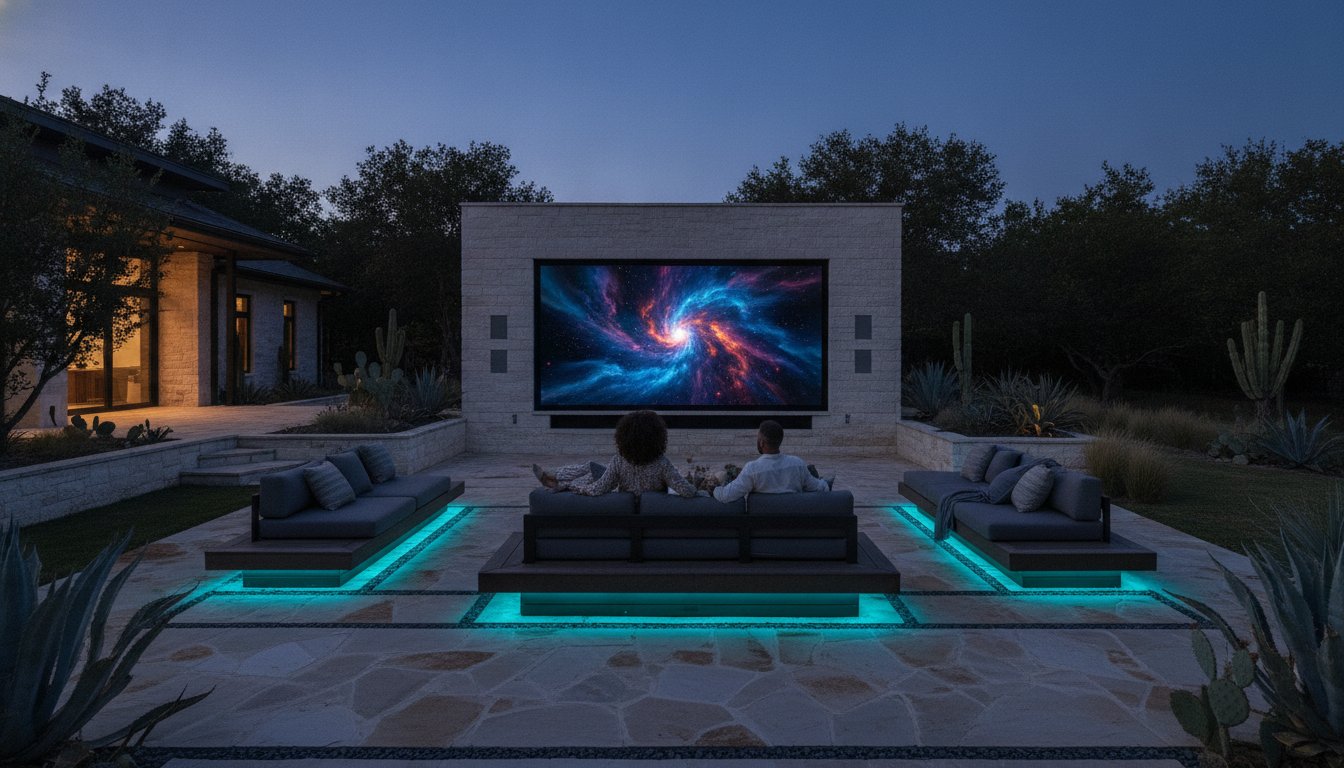
What if the most immersive cinema experience in San Antonio wasn't found in a commercial theater, but in the precise calibration of your own backyard? Achieving this level of performance is rarely as simple as mounting a screen and hoping for the best. When designing an outdoor home theater, you're not just selecting equipment; you're engineering a controlled environment against the variables of the Texas landscape. You likely understand the frustration of screen glare that renders daytime viewing impossible or audio systems that either disturb the neighbors or lose their depth to a passing breeze.
We'll demonstrate how to master these complexities by integrating high-luminance display technology and immersive landscape audio into a singular, resilient system. You'll learn the technical requirements for equipment that survives intense heat and humidity without sacrificing aesthetic elegance. This guide provides the blueprint for a seamless entertainment hub that offers effortless, one-touch control, ensuring your open-air cinema remains a reliable sanctuary of high-fidelity performance for years to come.
Key Takeaways
- Learn why designing an outdoor home theater requires a shift from simple hardware selection to comprehensive environmental engineering tailored for the Texas climate.
- Understand the technical metrics of high-luminance displays and how specialized optical coatings maintain visual clarity even under intense solar glare.
- Discover the engineering behind landscape audio systems, which utilize distributed components to provide consistent, immersive sound in unbounded open-air environments.
- Identify the importance of a resilient networking backbone to support high-bandwidth 4K streaming and unified control across your entire estate.
- Gain insight into a structured design process that prioritizes single-point accountability to ensure a sophisticated and frictionless user experience.
What is a Professional Outdoor Home Theater Design?
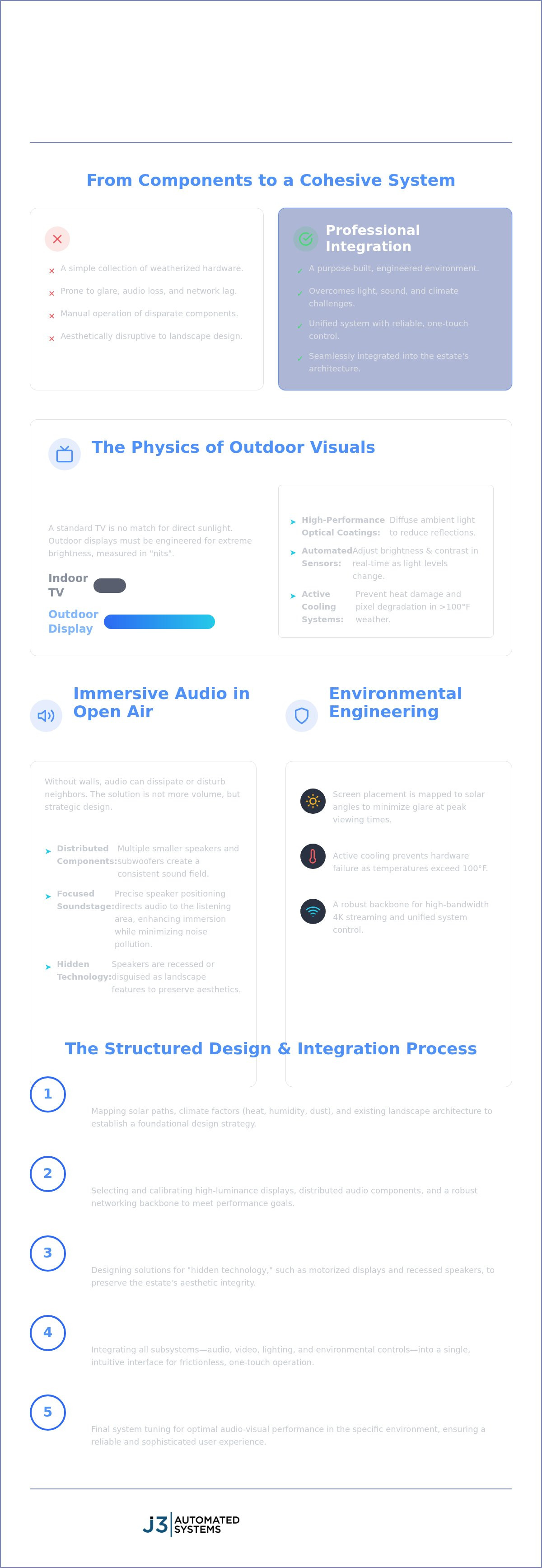
A professional outdoor theater is far more than a collection of weatherized components. It's a purpose-built environment engineered to overcome the inherent challenges of natural light and sound interference. While many homeowners start by looking at "outdoor-rated" retail hardware, there's a vast distinction between a standalone television and an integrated cinema-grade system. Designing an outdoor home theater at this level requires a shift from consumer-grade thinking to industrial-grade engineering.
The role of the integrator is to serve as the master of complexity. We unify high-performance audio, specialized visuals, and automated lighting into a single, intuitive interface. This process ensures that the technology doesn't just sit in the space but lives within it, supported by a resilient networking backbone that prevents the buffering and lag common in outdoor environments. By treating the installation as a unified system, we remove the friction of manual operation and replace it with reliable, one-touch control.
Environmental Control: The Foundation of Design
Effective design begins with an analysis of the sun's path. We determine screen placement not by convenience, but by mapping solar angles to minimize glare and maximize contrast during peak viewing hours. This technical precision extends to the hardware itself. We prioritize high Ingress Protection (IP) ratings to safeguard electronics against the relentless humidity and dust characteristic of the corridor from San Antonio to Austin. Thermal management is equally vital; when Texas temperatures climb past 100°F, we implement active cooling strategies within equipment housings to ensure long-term functionality and prevent hardware failure.
The Architecture of Outdoor Entertainment
A world-class theater should enhance the estate's architecture, not detract from it. We integrate technology into existing pergolas, cabanas, or poolside structures using "hidden technology" principles. This involves recessed speakers and motorized displays that disappear when not in use, maintaining the aesthetic integrity of your landscape. Acoustic performance in an unbounded space is another critical hurdle. Without walls to reflect sound, audio can easily dissipate or disturb neighbors. We balance these architectural needs with precise speaker positioning to create a focused, immersive soundstage. Environmental cinema design is the harmony of hardware and habitat.
The Physics of Outdoor Visuals: Overcoming the Texas Sun
Indoor televisions rely on controlled environments. Designing an outdoor home theater requires battling the raw output of the sun, which easily overpowers standard consumer displays. The primary metric in this conflict is the "nit," a unit of luminance. While a high-end indoor TV might output 300 to 500 nits, an outdoor display in the Texas heat must produce 2,000 nits or more to remain visible. Without this engineering, images appear washed out, losing the depth and color accuracy essential for a world-class experience.
We solve this by prioritizing high-performance optical coatings and anti-glare technology. These layers work to diffuse ambient light rather than reflecting it back at the viewer. Calibration is the final piece of the puzzle. Light levels shift dramatically between a San Antonio sunset and midnight. We implement automated sensors that adjust brightness and contrast in real-time, ensuring the image remains perfectly balanced as the environment transitions. If you're unsure which technology fits your landscape, consulting with a professional integrator can clarify the technical trade-offs before you break ground.
Display Technology: Direct Sun vs. Full Shade
"Partial Sun" and "Full Sun" ratings represent fundamental engineering differences, not just price points. Full-sun displays utilize active cooling systems to dissipate the immense heat generated by both the sun and the high-output LEDs. High temperatures are the enemy of electronics; they can cause pixel degradation and permanent color shifting. For 4K HDR content, the challenge is even greater. High dynamic range demands extreme peak brightness to maintain contrast against the sky's natural brilliance. We select hardware that maintains its color gamut even under the stress of 100°F afternoons.
Projection Systems for the Modern Estate
Projectors offer a grand, cinematic scale that flat panels can't match, yet they require specific environmental engineering. We often deploy short-throw laser projectors for their ability to deliver high-intensity light from a short distance. The screen, however, is where the science happens. Ambient Light Rejecting (ALR) screens use microscopic optical structures to reflect projector light toward the audience while absorbing light from the sun or nearby pool lights. To preserve these high-performance surfaces, we integrate motorized enclosures that protect the fabric from wind and debris when the system is dormant.
Engineering Immersive Audio in an Unbounded Space
Sound waves require boundaries to resonate. In a traditional indoor cinema, walls reflect and contain acoustic energy, creating a pressurized environment where bass feels impactful and dialogue remains crisp. When designing an outdoor home theater, these physical boundaries disappear. Without surfaces to reflect sound, audio energy dissipates rapidly into the open air, often resulting in a thin, disconnected experience that fails to match the scale of the visuals. Overcoming this requires a transition from traditional high-volume point sources to a sophisticated landscape audio model.
This distributed approach utilizes multiple small, high-fidelity satellite speakers hidden within the foliage or architectural elements. By placing speakers closer to the listeners, we achieve consistent coverage at lower volumes, ensuring every seat remains in the "sweet spot." This strategy is a core component of a broader luxury home audio solution, where the theater functions as a high-performance zone within a unified property-wide system. This integration allows for a seamless transition between ambient background music and the high-impact requirements of a cinematic feature.
Directional Sound and Neighbor Etiquette
Precision is the antidote to noise complaints. We utilize directional satellite speakers that allow us to aim audio energy specifically at the seating area, preventing sound from "bleeding" into neighboring properties. Digital Signal Processing (DSP) serves as the brain of this system, automatically compensating for wind interference and environmental noise to maintain clarity. Across large Texas estates, we prioritize low-voltage wiring and robust signal amplification to ensure that audio quality remains consistent regardless of the distance from the central equipment rack.
High-Fidelity Outdoor Components
Achieving deep, cinematic bass in an open field involves moving earth. In-ground subwoofers are engineered to be buried, using the soil's density to enhance low-frequency resonance while keeping the hardware invisible. For architectural integration, we deploy all-weather surface mount speakers that match the estate's aesthetic, from stone finishes to bronze patinas. DSP tuning effectively replaces the natural acoustics of an indoor room by digitally shaping the audio signal to compensate for the lack of reflective surfaces. This meticulous calibration ensures that the foundation of your sound remains firm, providing the visceral impact required for modern cinema without visual clutter.
The 5-Step Process for Designing an Outdoor Cinema
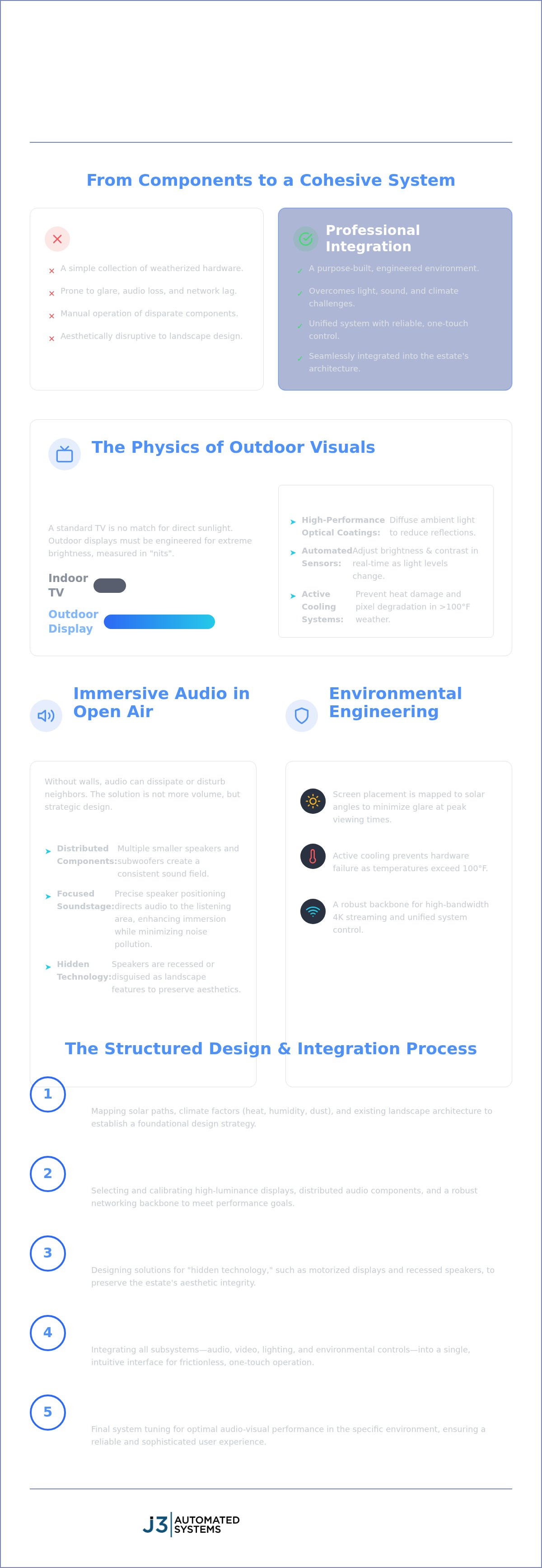
Designing an outdoor home theater is a methodical exercise in systems integration. We move beyond the guesswork of consumer-grade setups by following a structured, five-step engineering lifecycle that ensures every component performs at its peak. This process transforms a fragmented collection of hardware into a unified, high-performance environment.
- Site Audit: We begin by assessing the environmental variables, including light levels, Wi-Fi saturation, and power availability. This phase identifies the specific challenges of your landscape, such as reflective pool surfaces or acoustic dead zones that require specialized attention.
- System Mapping: We engineer the high performance residential networking backbone to support high-bandwidth streaming. This step ensures that the digital infrastructure is as resilient as the physical hardware.
- Hardware Selection: We curate industrial-grade components that match the IP ratings required for the San Antonio climate. We prioritize displays with high-nit output and speakers with UV-resistant finishes to prevent long-term degradation.
- Integration: We program the control interface to unify AV, lighting, and shades into a single, intuitive user experience. This removes the friction of managing multiple remotes or disparate apps.
- Commissioning: We perform final acoustic and visual calibration to account for the specific landscape geometry. This ensures the system sounds as good at the edge of the property as it does in the center of the seating area.
The Connectivity Backbone
Streaming 4K HDR content in an open-air setting demands a robust digital foundation. We deploy enterprise-grade Wireless Access Points (WAPs) to facilitate seamless roaming as you move from the patio to the pool. While Wi-Fi is essential for mobile control, we hardwire all critical theater components. This prevents the latency and signal dropouts that often plague less sophisticated installations. By treating the network as the invisible backbone of the estate, we ensure that your cinema remains a reliable sanctuary of entertainment.
Unified Control and Automation
The true value of a professional design lies in its intelligence. We integrate motorized shades that automatically descend to block late-afternoon glare, preserving the visual integrity of the screen. Smart lighting scenes are programmed to dim the landscape lights the moment the "Movie" button is pressed on your remote or smartphone. For long-term reliability, we implement weather-sensing automation. These systems detect high winds or moisture, automatically retracting screens and powering down sensitive hardware during unpredictable Texas storms. To start the engineering phase of your project, contact our design team for a professional consultation.
Why Bespoke Engineering Trumps Off-the-Shelf Solutions
Designing an outdoor home theater is an investment in your property's long-term utility and aesthetic value. While off-the-shelf components might seem convenient, they often lead to a fragmented experience characterized by technical friction. DIY attempts frequently struggle with inconsistent Wi-Fi, audio dropouts, or hardware that fails after a single season of Central Texas humidity. Bespoke engineering eliminates these burdens by treating every element as a unified system rather than a collection of disparate gadgets.
Choosing a professional integrator provides a single point of accountability. Instead of managing multiple vendors or troubleshooting hardware incompatibilities, you partner with a team that owns the entire lifecycle from mapping to maintenance. This high-level consultancy ensures that your cinema grade home theater design adheres to the same rigorous standards as a world-class indoor screening room. The result is a system that doesn't just work; it performs with the reliability of an industrial-grade installation.
Local expertise is particularly critical in regions like Boerne, New Braunfels, and Austin. Understanding the interplay between specific building codes and the harsh local climate allows us to select materials that offer true longevity. This precision adds tangible ROI to your estate, transforming an underutilized backyard into a high-performance entertainment destination that withstands the elements year-round.
The J3 Automated Systems Advantage
Our approach is defined by a white-glove service model that prioritizes your experience above all else. We provide more than just installation; we deliver tailored automation roadmaps that can evolve alongside your property. By integrating physical environments with digital processes, we ensure your theater remains at the cutting edge of technology. We possess the technical authority to simplify complex systems, allowing you to enjoy the result without the burden of manual troubleshooting or configuration.
Transforming Your Texas Estate
The ultimate goal of professional engineering is to move from manual intervention to intelligent, effortless operation. Imagine a system where the audio, visuals, and lighting respond instantly to your needs, creating a year-round destination for your family and guests. This transformation turns your outdoor space into a sanctuary of high-fidelity performance that feels like a natural extension of your home. To begin this journey, Contact J3 Automated Systems to engineer your outdoor cinema masterpiece.
Elevate Your Estate with Professional Open-Air Cinema
Mastering the Texas environment requires more than just high-end hardware; it demands a holistic engineering approach that accounts for solar angles, acoustic dissipation, and thermal stress. By prioritizing high-luminance displays and distributed landscape audio, you ensure that your backyard remains a sanctuary of high-fidelity performance regardless of the time of day. Designing an outdoor home theater is ultimately about removing the technical friction that often accompanies DIY attempts, replacing it with a seamless, one-touch environment.
Our Texas-based engineering team provides the white-glove installation and long-term support necessary to protect your investment. We develop custom automation roadmaps that allow your technology to evolve alongside your property, ensuring that your estate remains at the forefront of modern entertainment. Don't settle for off-the-shelf compromises when you can achieve cinematic perfection under the stars.
Schedule a Design Consultation for Your Outdoor Cinema and begin the transformation of your property today.
Frequently Asked Questions
Can I use a regular indoor projector for an outdoor home theater?
No, you shouldn't use an indoor projector for an outdoor setting because it lacks the necessary luminance and environmental sealing. Indoor units typically output lower ANSI lumens that wash out in open air. Professional systems utilize high-output laser engines and weatherized chassis to ensure the image remains crisp while protecting internal components from the dust and insects common in Central Texas landscapes.
How do I protect my outdoor theater equipment from Texas humidity and heat?
Equipment protection relies on a combination of high IP ratings and active thermal management. When designing an outdoor home theater in the San Antonio heat, we specify hardware with internal cooling fans and sealed enclosures. These systems are engineered to operate in temperatures exceeding 100°F, preventing the thermal shutdowns and moisture-driven corrosion that typically destroy standard retail electronics over a single season.
What is the best way to get Wi-Fi to my outdoor theater in San Antonio?
The most reliable method involves deploying enterprise-grade outdoor Wireless Access Points (WAPs) connected to a hardwired fiber or Cat6 backbone. Standard mesh extenders often fail to penetrate stone exteriors or cover large acreages. By installing dedicated outdoor WAPs, we provide the high-bandwidth connectivity required for 4K streaming without the latency issues caused by traditional residential networking solutions.
Do I need a special screen for an outdoor projector?
Yes, a specialized Ambient Light Rejecting (ALR) screen is essential for maintaining contrast in an open-air environment. These surfaces use microscopic triangular structures to reflect projector light toward viewers while absorbing light from the sky or nearby pool fixtures. Without an ALR screen, your visuals will lose depth and appear faded, regardless of how powerful your projector's output might be.
How do I prevent my outdoor theater audio from bothering the neighbors?
We prevent sound bleed by utilizing directional satellite speakers that focus audio energy exclusively on your seating area. Unlike traditional speakers that radiate sound in all directions, these components allow us to "aim" the audio. We also use in-ground subwoofers that utilize the earth's density to contain low-frequency energy, providing a visceral bass experience for you without disturbing the surrounding estate.
Can an outdoor home theater be used during the day in full sun?
You can certainly use an outdoor theater during the day if the system is designed with high-luminance display technology. Designing an outdoor home theater for full-sun exposure requires screens or panels capable of producing at least 2,000 nits of brightness. This extreme output, combined with anti-reflective optical coatings, allows the display to remain visible even under the direct intensity of the Texas afternoon sun.
How much maintenance does an outdoor cinema system require?
A professionally engineered cinema requires minimal maintenance beyond periodic cleaning of optical surfaces and checking for debris around ventilation ports. High-end outdoor hardware is built to be resilient, but we recommend a seasonal "white-glove" inspection. This ensures that seals remain intact and that the automated cooling systems are functioning optimally before the peak heat of the summer months arrives.
What is the difference between IP65, IP66, and IP67 for outdoor electronics?
These ratings define the enclosure's ability to resist environmental ingress, with the first digit representing dust and the second representing water. IP65 protects against low-pressure water jets, while IP66 handles high-pressure sprays. IP67 is the most robust, allowing for temporary submersion. For most Texas installations, we prioritize IP66 or higher to ensure the hardware survives both heavy thunderstorms and high-pressure cleaning around the patio.