Home theater acoustical treatment: What to fix and why
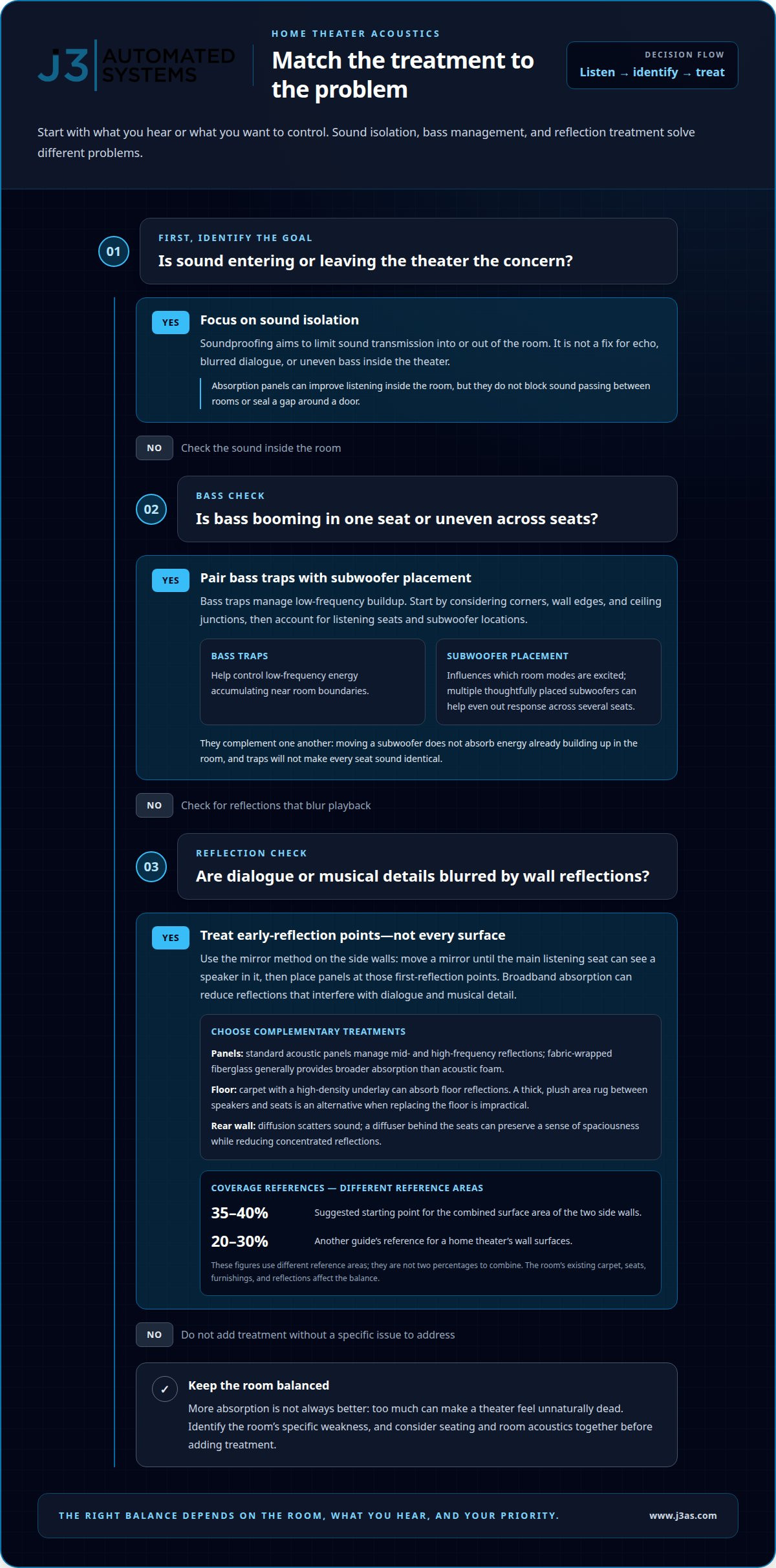
More acoustic treatment isn’t always better, and soundproofing won’t solve every listening problem. Home theater acoustical treatment is worthwhile when it addresses the room’s actual weaknesses: absorption can reduce reflections that blur dialogue, while sound isolation helps limit sound traveling in or out. If the main concern is echo or uneven bass inside the room, isolation work alone won’t fix it.
It’s understandable to expect a quieter, more controlled room to sound better. But too much absorption can make a theater feel unnaturally dead, and bass traps, panels, and sound-isolation measures each serve a different purpose. The right balance depends on the room, what you hear, and whether your priority is clearer playback or less sound transmission.
This guide explains how reflections affect dialogue and soundstage, where bass traps and absorption fit, and when soundproofing may help. It also covers common treatment mistakes, so you can distinguish a targeted acoustic solution from changes that add complexity without addressing the problem.
Key Takeaways
- Match bass traps to low-frequency buildup, and use them alongside, not instead of, treatment for mid- and high-frequency reflections.
- Use absorption strategically to improve dialogue clarity and soundstage without making the room feel unnaturally dull.
- Separate sound control inside the theater from sound isolation: they address different problems and call for different solutions.
- Plan seating and room acoustics together, since listening position affects how bass and reflections are experienced.
- Avoid treating every surface the same way; identify the room’s specific issues before adding panels or isolation measures.
Bass traps and low-frequency control
Bass traps manage low-frequency energy that can build up in a home theater. Their placement and coordination with acoustic panels matter because bass problems can vary from seat to seat.
Bass Trapping
Bass trapping uses absorptive materials to reduce excess low-frequency energy in a room. Bass can collect near corners, along walls, and at ceiling junctions, so traps are often placed in those areas. A seat with booming bass, for example, may be near a buildup zone. Targeted trapping can make low-frequency playback more controlled without relying on broad, indiscriminate absorption.
Room-Mode Management
Room modes are patterns of low-frequency buildup and cancellation shaped by a room’s boundaries. Bass traps can help manage buildup, but they won’t make every seat sound identical. A listener may hear strong bass in one position and less in another. The goal is to address uneven response across the listening area, not simply cover every available corner.
Included Panels and Bass Traps
Acoustic panels and bass traps perform related but distinct roles in a treatment plan. Standard panels help manage mid- and high-frequency reflections, while bass traps address lower frequencies. “Included” shouldn’t imply a fixed set or quantity for every room; the treatment needed depends on the room and its acoustic behavior. Coordinating the two types helps avoid treating bass buildup as if ordinary wall panels alone could resolve it.
Subwoofer placement is another part of bass integration. Multiple subwoofers, placed thoughtfully, can help even out bass response across several seats. This complements bass traps rather than replacing them: placement influences how the system excites room modes, while traps help control low-frequency energy accumulating near boundaries.
Consider a theater where one seat sounds boomy and another seems bass-light. Moving a subwoofer can change which room modes it excites, potentially improving consistency across seats. But changing its position won’t absorb energy already building up in the room. Bass traps and subwoofer positioning work together, each addressing a different part of the response.
When choosing trap locations, start where bass energy tends to gather: corners, wall edges, and ceiling junctions. Then consider the listening seats and subwoofer locations together. This room-focused approach is more useful than spacing panels evenly for appearance alone, because low-frequency control depends on how boundaries, speakers, and listeners interact.
Broadband absorption for early-reflection control
Broadband absorption reduces reflections across a range of frequencies, helping preserve clear dialogue and a balanced soundstage. In a cinema room, panel placement matters as much as panel quantity.
Start with the first-reflection points from the main speakers. Use the mirror method, moving a mirror along each side wall until the listening seat can see a speaker in it. Place acoustic panels at those points to reduce early reflections reaching the listener. Untreated wall reflections can overlap with direct sound and make dialogue or musical detail less distinct. Targeted absorption addresses that path without covering every surface.
Acoustic Panels for Sound Absorption
Acoustic panels absorb sound waves rather than block sound from passing between rooms. Fabric-wrapped fiberglass panels generally provide broader absorption than acoustic foam, making material choice relevant to the reflections being controlled. Panels can mount on existing walls beneath fabric finishes, integrating treatment with the room while addressing specific reflection points instead of relying on foam across large areas.
Carpet and Underlay Absorption
Wall-to-wall cut-pile wool carpet with a high-density rubber or foam underlay can absorb sound at the floor. This combination helps manage reflections from hard flooring, especially between the speakers and listening seats. If replacing the floor isn’t practical, a thick, plush area rug along that path is an alternative. Carpet complements wall panels, but doesn’t replace treatment at speaker reflection points.
Absorption and diffusion shape reflections in different ways. Absorptive panels reduce reflected energy, while diffusers scatter sound waves across a wider area. A diffuser on the rear wall behind the seats can preserve a sense of spaciousness while reducing concentrated reflections. Use absorption where early reflections interfere with clarity, and consider diffusion when a more natural sense of room ambience is desirable.
Coverage figures need context. A suggested starting point is about 35-40% of the combined surface area of the two side walls. Another guide places acoustic panels over 20% to 30% of a home theater’s wall surfaces. These figures describe different reference areas, not a requirement to cover both percentages independently. For example, a reflective room may need a different balance from one already softened by carpet, seats, and furnishings.
Sound absorption isn’t soundproofing. Absorption reduces echo and reverberation inside the theater; soundproofing aims to limit sound entering or leaving it. A panel on an interior wall may improve listening, but it won’t seal a gap around a door. Match the treatment to the problem: reflections call for absorption or diffusion, while sound transmission calls for isolation measures.
Is soundproofing worth it in a home theater?
Soundproofing is worthwhile when the goal is to limit sound entering or leaving the theater, not to correct bass or reflections inside it. Room size, construction, and listening position shape the acoustic plan.
Room Dimensions and Acoustic Challenges
Room dimensions shape low-frequency behavior because sound waves interact with the boundaries differently at different frequencies. A suggested dimension ratio is 1:1.6:2.6, representing height, length, and width in that order. A more rectangular room can help avoid coinciding acoustic problems when dimensions can be chosen. In an existing room, the same principle helps explain why one seat may experience stronger bass than another.
Seating position matters as much as room shape. The 38% rule places the listening position 38% of the room’s length from either the front or back wall. Treat this as a starting point, not a perfect placement for every room. Fix the main seats early in planning, then account for how people, furniture, and the screen affect sound quality and available treatment locations.
Professional Treatment Costs
Professional treatment pricing depends on room size, construction, and scope, and is provided after a quote request. DIY treatment may cost less in materials, while professional planning coordinates room conditions, panel placement, and sound-system correction. A simple room with clear reflection problems differs from a small theater requiring isolation, bass management, and diffusion. The work involved shapes both cost and performance.
Room Acoustic Targets
There isn’t one RT60 target for every home theater; the appropriate reverberation time varies with room size. RT60 describes how long sound takes to drop by 60 dB after the speakers stop. Frequency response also depends on the room and listening positions, so a useful objective is consistent playback across the seats rather than a single perfect reading. Equalization can refine system response, but it can’t correct every physical room problem.
Soundproofing and room correction address different issues. Resilient channels, floating floors or walls, soundproof doors, and specialized drywall can help isolate a theater from adjoining spaces. These structural measures don’t replace absorption, bass control, or diffusion within the room. For example, a gap around a door may let sound escape even when the listening area has been treated.
A small home theater should be planned around its actual constraints, not just its screen size. Limited wall area can affect panel placement, while a compact seating layout makes each position more consequential. Room equalization can refine the system after placement and treatment, but it won’t change an unsuitable room shape. A coordinated design considers the room, seats, furnishings, and system together.
How room reflections affect dialogue clarity and soundstage
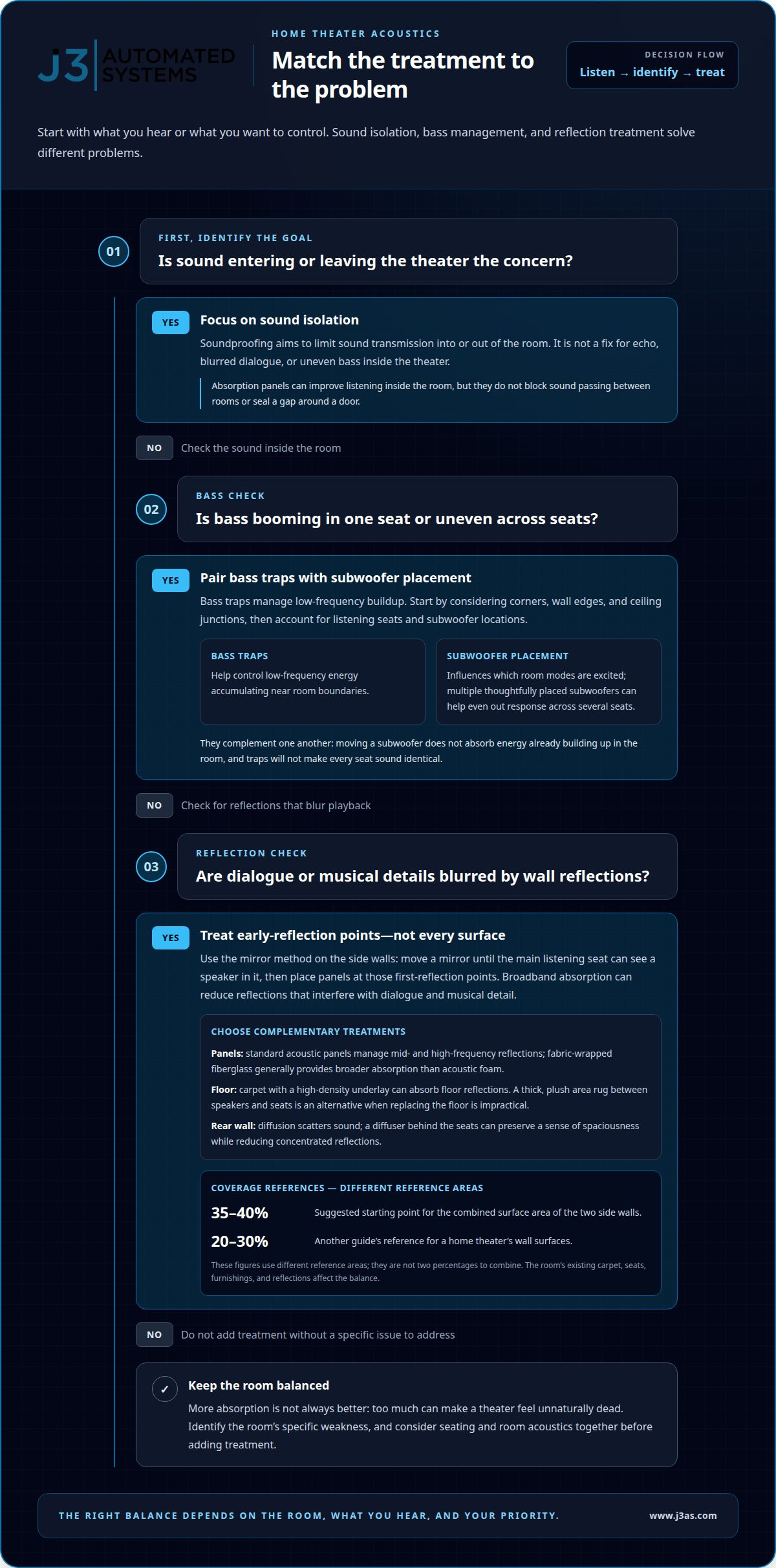
Untreated walls and ceilings reflect sound toward the listening area, which can blur dialogue and music. Their interaction with speakers also shapes how precisely the sound system places effects around the room.
Treatment and Soundproofing
Acoustic treatment shapes sound inside the theater; soundproofing limits sound traveling through its structure. This distinction matters when a room sounds unclear and neighboring spaces also hear the movie. Panels can manage reflections inside the room, while isolation measures address transmission through walls, floors, or ceilings. Treating one problem doesn’t automatically resolve the other.
Seating and Sound Consistency
Seating placement defines where the sound system needs to perform well, so establish listening positions early. A seat close to a wall may receive a different mix of direct sound and reflections than one farther away. Planning a row before setting speaker positions, for example, helps align the speakers with actual listeners rather than an empty room.
Yes, acoustic treatment can improve surround sound and Dolby Atmos performance by controlling reflections that interfere with clarity and spatial cues. It helps the system create a coherent soundstage, but doesn’t replace appropriate speaker placement or system calibration. A rear-wall diffuser, for instance, can scatter reflections instead of allowing them to return as a strong, concentrated echo.
Dialogue depends on the relationship between sound arriving directly from a speaker and sound bouncing off nearby surfaces. When a side wall or ceiling sends a reflection back shortly after the direct signal, speech can seem less distinct. The same effect can flatten musical depth, making separate elements harder to locate. Treatment should address reflection paths that affect the listening seats, not simply add material wherever wall space remains.
Sound isolation requires a different architectural approach. Resilient channels or isolation clips can decouple walls, while floating floors and walls can reduce vibration paths. Specialized drywall and soundproof doors may also be part of an isolation design. These measures address the building assembly, rather than the acoustic behavior of a panel inside the theater.
Floors, walls, and ceilings can all provide routes for sound transmission. A floating floor addresses the floor assembly; decoupled walls address vibration passing through wall structures. A soundproof door can help limit transmission at an opening. These measures matter when keeping movie sound inside is a priority, while absorption and diffusion manage reflections around the audience.
For a room with both soundstage problems and noise escaping into adjoining spaces, separate the objectives before selecting materials. First locate the reflections that compromise dialogue or surround cues. Then identify transmission paths through the construction. This distinction helps preserve depth and clarity without confusing sound control inside the room with isolation from the rest of the home.
Common home theater treatment mistakes
A common mistake is treating every surface as if it creates the same problem. A bare side wall may produce distracting echoes, while a rear wall may benefit from diffusion. Covering both with identical panels ignores their different roles. In a room with fabric seating and carpet, adding absorption across every remaining surface can also reduce useful liveliness.
Too much absorption can make a theater sound unnaturally dead. Dialogue may become less engaging, and music can lose a sense of space. A room covered in thick panels, for example, might suppress reflections so aggressively that playback feels flat. The answer isn’t to remove all treatment, but to balance absorption with reflective and diffusive elements according to the room’s needs.
Another mistake is choosing panels for appearance before considering their function. A decorative fabric finish can fit into a room, but appearance alone doesn’t show how a panel will absorb sound. Heavy fabric shades, for example, can reduce high-frequency reflections from glass. A decorative panel placed elsewhere may not address that reflection path.
Evenly spacing panels across walls may look orderly, yet miss the locations that matter most for listening. First identify where speakers reflect sound toward the seats, then place absorption at those points. Consider the ceiling, too: a reflective ceiling above the listening area can contribute to distracting reflections, even when the side walls are treated.
Confusing soundproofing with acoustic treatment can lead to a costly mismatch. Panels manage reflections inside the room; they don’t seal a door gap or isolate a shared wall. Adding wall panels, for example, won’t stop movie sound passing through an unsealed doorway. Identify whether the problem is echoes within the theater or sound transmission beyond it before choosing materials.
Ignoring seating is another planning mistake. A treatment layout designed before listening positions are set may leave a key seat exposed to strong reflections or uneven sound. Map the seats and speaker positions together, then assess how each surface interacts with them. A room that sounds balanced from one chair may not sound the same across a row.
Finally, don’t expect room equalization to correct every physical issue. Calibration can refine a sound system, but it can’t substitute for managing excessive reflections or inappropriate treatment. A more reliable sequence is to define the listening positions, address the room’s acoustic problems, and then refine system settings. Plan a more cohesive home theater experience by aligning the room, treatment, and sound system as one design.
J3 Automated Systems: Cinema-grade home theater
J3 Automated Systems designs cinema-grade home theaters that bring the room, sound system, and listening experience into one considered design. If you’re planning a theater or refining a room where dialogue, bass, or reflections remain difficult to balance, this is the point to connect acoustic decisions with the wider system.
A coordinated design considers how seating, speakers, room surfaces, and system performance work together, rather than treating each as a separate upgrade. Automated lighting and shades can also be integrated into the theater where they support the room’s intended use.
Contact J3 Automated Systems to discuss your home theater plans and the acoustic priorities that matter most to your space.
Shape the theater around how you want to experience it
Treat the room as part of the system, not as a backdrop for equipment. Before making further changes, define how you want the space to feel during a film, music listening, and everyday use. That intention can guide decisions about the room, its acoustic design, and how the technology should work together. Thoughtful home theater acoustical treatment starts with a clear view of the experience you want to create.
J3 Automated Systems brings together cinema-grade home theater, whole-property audio, and automated lighting and shades. This gives the design a wider context, connecting the theater to the way sound and lighting function throughout your home. The right starting point is a conversation about your space, your priorities, and the experience you’re aiming for. Contact J3 Automated Systems to discuss the possibilities for your home. A well-planned room can make each viewing feel more considered and immersive.
Frequently Asked Questions
What is acoustic treatment for a home theater, and how does it differ from soundproofing?
Acoustic treatment shapes how sound behaves inside the room, while soundproofing aims to reduce sound traveling through its boundaries. If dialogue sounds unclear but the movie can’t be heard in adjoining spaces, focus on the listening environment first. If sound carries into a nearby bedroom, the issue involves isolation. Home theater acoustical treatment is most useful when the goal is better listening, not less sound traveling between rooms.
How do you identify first reflection points in a home theater?
Use a mirror to locate where each main speaker first reflects toward a listening seat. Sit in the primary seat while someone moves a mirror along the side wall, and mark each place where you can see a speaker in it. Repeat on the opposite wall, then consider the ceiling if it reflects sound toward that seat. These are candidate treatment locations, not a requirement to cover every marked surface.
What acoustic panels and bass traps work best for home theater treatment?
Choose treatment according to the frequency problem: fabric-wrapped fiberglass panels generally offer broader absorption than acoustic foam, while bass traps target low-frequency issues. In a room with sharp dialogue reflections and uneven bass, for example, panels and traps address different parts of the problem. No single panel type resolves every issue, so match the material and placement to the room rather than choosing by appearance alone.
How many acoustic panels does a home theater need, and where should they go?
There’s no universal panel count because room dimensions, surfaces, furnishings, and listening positions change the treatment plan. Start by identifying the seats that matter, then locate speaker reflections and other clearly problematic areas. A small room with carpet and upholstered seating may need a different layout from a larger room with hard surfaces. Panel placement should support the listening area without covering walls just to create symmetry.
How do you treat bass buildup and standing waves in a home theater?
Address bass variation by considering room boundaries, listening positions, and subwoofer placement together. If one seat has excessive bass while another sounds thin, compare those positions before changing system settings. A subwoofer moved to another location may interact differently with the room, while bass traps address energy accumulating near boundaries. Multiple subwoofers can help even out bass across seats, but they don’t replace room treatment.
What materials are safe and effective for DIY acoustic panels?
Fabric-wrapped fiberglass panels are a common option for broadband absorption, and acoustic foam is another material, though it generally absorbs less broadly. For a DIY build, use a fabric covering intended to enclose the absorber and follow the material manufacturer’s handling and installation instructions. Keep the panel securely assembled and mounted. Don’t assume soft decorative fabric or household foam will perform like a purpose-made acoustic absorber.
What are common home theater acoustic treatment mistakes and risks?
A frequent mistake is adding absorption across too many surfaces, which can leave the room unnaturally dull. Another is expecting wall panels to stop sound traveling into adjoining rooms; that requires isolation measures. Before installing treatment, consider how it affects access to doors, speakers, and other room elements. Whether your theater is in San Antonio, New Braunfels, Seguin, Bandera, Beorne, Austin, or San Marcos, let the room itself guide the design.