Enterprise Wi-Fi Solutions in Austin: An Engineering-Led Guide

Your internet connection can be working while business Wi-Fi still disrupts daily operations. That distinction matters when evaluating enterprise wifi solutions Austin businesses can rely on. Internet service connects a property to external online services. The internal network connects people, devices, and systems within the property. A problem with one layer does not automatically point to a problem with the other, so identifying where the issue occurs is a useful first step.
Reliable enterprise Wi-Fi planning starts with how the property operates, not just with equipment selection. This guide explains the difference between internet service and internal Wi-Fi, what to assess across a building and its workflows, and how to plan networking alongside systems such as building automation, audio, and software. Use it to define your requirements and understand how coordinated design, installation, and support can bring the pieces together for your Austin operation.
Key Takeaways
- Separate internet service from internal Wi-Fi to narrow down where connectivity problems may originate.
- Evaluate enterprise wifi solutions Austin businesses need by considering property layout, workflows, users, and connected systems together.
- Compare internet service, internal Wi-Fi design, and integrated networking by their purpose. They address different parts of a network.
- Document business requirements before deciding how a network should be designed.
- J3 Automated Systems brings design, installation, and support together through one accountable team, with 15+ years integrating intelligent systems.
What Enterprise Wi-Fi Solutions in Austin Actually Include
A business can have internet service and still need to address how people, devices, and systems connect inside its property. Enterprise Wi-Fi is the wireless access layer of the internal network. Its design considers how wireless access supports the business’s spaces and daily activity, while internet service provides the connection between the property and external online services.
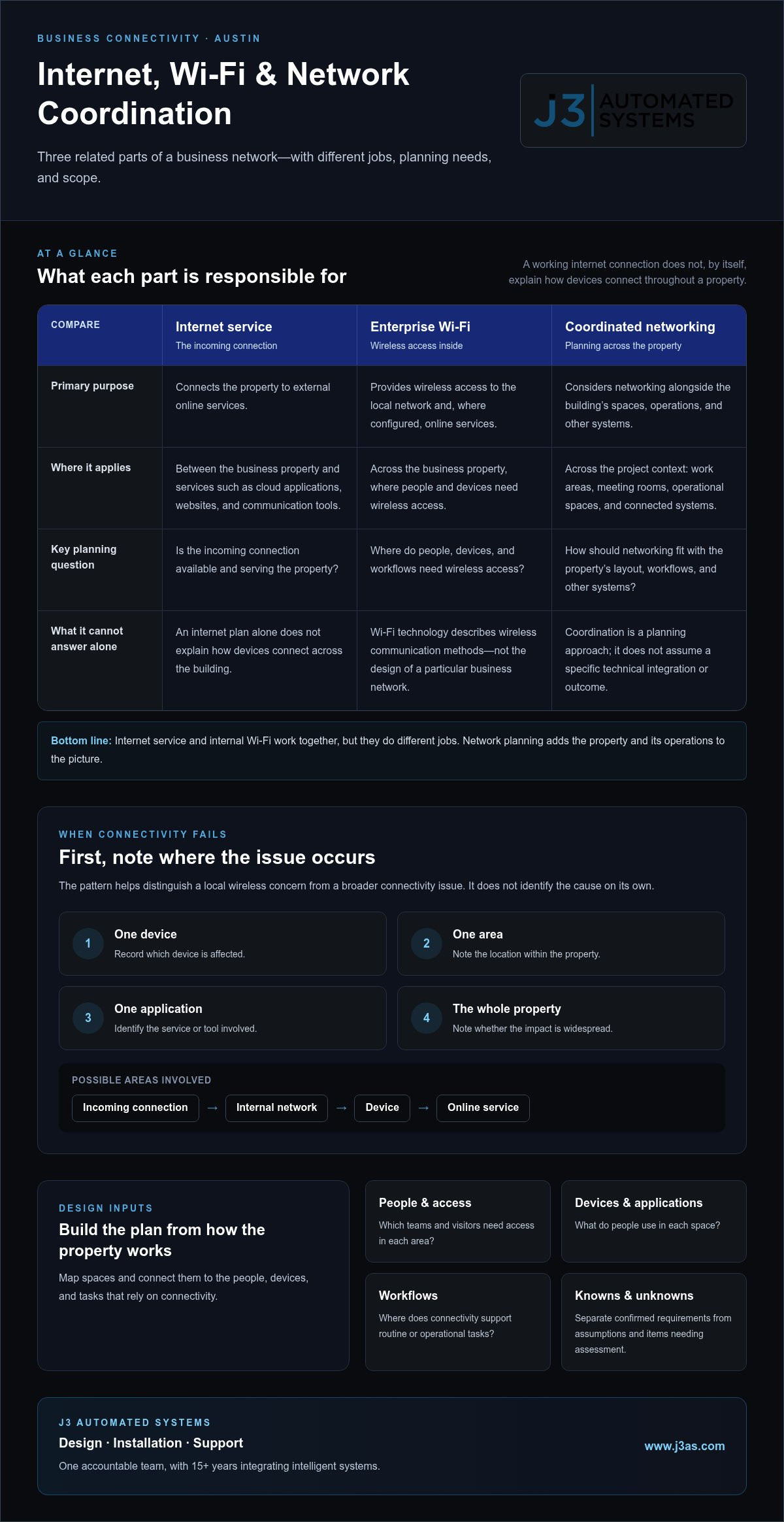
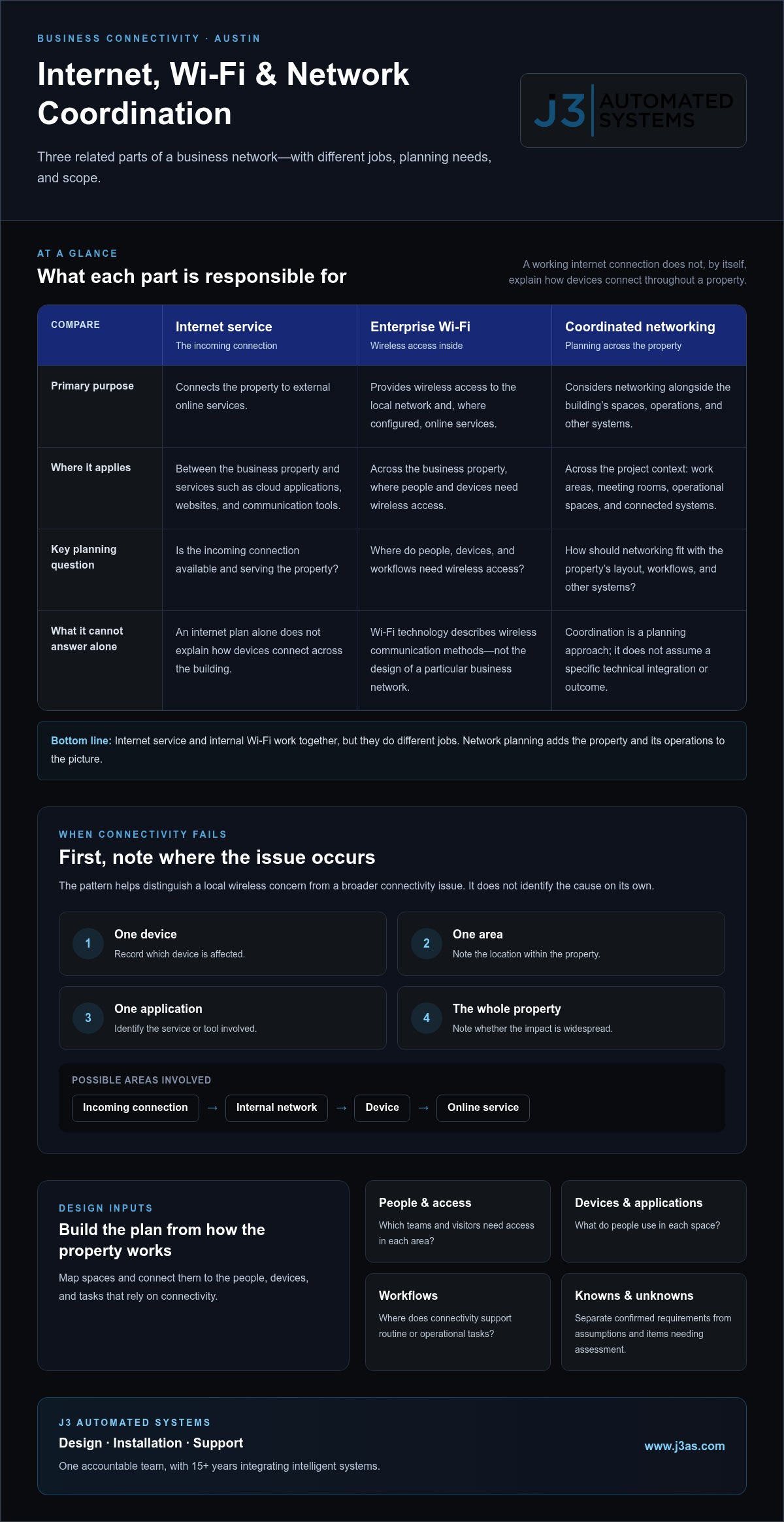
Enterprise Wi-Fi is the wireless access layer within a business network; business internet service connects that network to the online world. The distinction matters because an internet plan alone does not explain how devices connect across an office, showroom, or other commercial property. Wi-Fi technology and standards describe the wireless methods devices use to communicate, not the design of a particular business network.
How business internet and enterprise Wi-Fi work together
Think of internet service as the route between your business and external services, such as cloud applications, websites, and communication tools. Wi-Fi gives devices inside the property wireless access to the local network and, where configured, those online services. The layers work together, but they do different jobs.
When a service is slow or unavailable, the cause could involve the incoming connection, the internal network, a particular device, or the online service being accessed. Start by noting where the issue occurs: does it affect one device, one area, one application, or the whole property? Those observations help distinguish a local wireless concern from a broader connectivity issue before decisions are made about the network.
When a business needs more than a basic connection
A basic connectivity decision may suit a simple use case. A commercial property needs a broader assessment of its layout, teams, devices, and operations. Open work areas, enclosed offices, meeting rooms, and operational spaces may have different patterns of use. Documenting those differences helps create a network plan based on how the building functions instead of treating it as one uniform space.
For example, staff might use cloud tools at desks while connected systems support lighting or building operations elsewhere in the property. Planning then involves more than getting devices online. It means identifying which workflows rely on connectivity, where people and devices need access, and how networking fits with other systems in the building. Specific performance expectations depend on the project design and site conditions, so define the business requirements before drawing conclusions about the solution.
For organizations evaluating enterprise wifi solutions Austin, a practical first step is to distinguish the incoming internet service from the internal wireless environment, then document how the property is used. This creates a stronger basis for planning resilient networking as part of an engineered commercial environment, rather than treating Wi-Fi as an isolated equipment purchase.
How Enterprise Wi-Fi Design Fits an Austin Business Property
Enterprise Wi-Fi design starts with the property and its operation, because the network plan depends on where people work, what they do, and which systems support that work. A floor plan can help show how teams move between spaces, where business activities take place, and which areas have distinct connectivity needs. For an Austin commercial property, that context helps shape a plan around the actual environment rather than assumptions about a typical office.
Start with the spaces, people, and work taking place
Map the spaces employees, visitors, and daily operations rely on. Include work areas, meeting rooms, reception areas, and operational spaces where connected devices are used. Then connect each space to the tasks that happen there. Staff may use business applications at desks, rely on mobile devices while moving through the property, or use connected systems in designated areas.
Turn those observations into clear planning inputs. A useful inventory can include:
- Which teams and visitors need access in each area.
- Which devices and business applications people use there.
- Where connectivity supports a routine workflow or operational task.
- What is known about current use and what still needs assessment.
Keep confirmed requirements separate from assumptions. A planned increase in staff or devices may affect future needs, but it is not a measured capacity requirement unless the project has supporting information. This distinction keeps the design discussion grounded in current operations while making room to consider anticipated changes.
Coordinate networking with other building systems
A commercial property is an environment, not just a collection of unrelated devices. Networking belongs in the wider project plan alongside systems such as commercial building automation, which can include HVAC and building management. Coordination means considering how the systems fit within the property’s overall design and operation. It does not assume a particular technical integration or outcome.
For example, a business planning changes to its building systems can include networking in the same project discussion. That gives the team a chance to consider physical spaces, operational priorities, and system requirements together instead of making each decision in isolation. A broader view of commercial building management systems in Texas can help frame that coordination.
When comparing enterprise wifi solutions Austin, describe how the property is used before setting performance requirements. J3 Automated Systems brings networking into an engineered property environment, coordinating design and installation as part of its work on intelligent spaces. Businesses planning connected commercial environments can explore J3’s networking and automation approach while defining project requirements.
How to Compare Enterprise Wi-Fi Solutions for an Austin Business
Compare networking options by purpose, scope, and fit with the property, not only by equipment or advertised performance. Internet service, internal Wi-Fi design, and integrated networking address different parts of a commercial operation. They are not always substitutes. A business may need an internet connection as well as a carefully designed internal network, with broader coordination when other building systems are part of the project.
Use this framework to compare scope, property fit, coordination, and accountability:
| Approach | Primary purpose | Property fit and coordination | Project accountability |
|---|---|---|---|
| Internet service | Connect the business property to external online services. | Addresses the incoming connection, not by itself how wireless access is arranged throughout the property. | Focused on the connectivity service being supplied. |
| Internal Wi-Fi design | Plan wireless access for devices and business activity inside the property. | Considers how spaces are used and where teams rely on connected devices. | Focused on the internal wireless network’s design and installation. |
| Integrated networking | Position resilient networking within a broader commercial project. | Considers networking alongside relevant property systems and operational needs. | Can bring related design and installation work under one accountable team. |
This is a comparison of project scope, not a ranking. An internet service provider supplies the external connection, while an internal network project addresses how devices connect within the building. A broader project can coordinate networking with other property technologies. The key question is which scope matches the work your business needs and how responsibilities are defined across the project.
Internet provider versus property-network integrator
An internet provider supplies the connection between a business and external online services. J3 Automated Systems designs and installs resilient networking for properties as part of the commercial environment. The roles can complement each other: one provides external connectivity, while the other plans the property’s network. Neither category automatically replaces the other.
Standalone connectivity versus coordinated building systems
An internet-only decision focuses on the incoming service. A coordinated project considers networking alongside other building technologies, such as commercial building automation and security systems. The scope should identify which systems are part of the project and how they relate, without assuming a particular technical integration. For businesses planning security as part of a wider property environment, commercial security system design in Texas offers a related perspective.
For enterprise wifi solutions Austin businesses are assessing, compare the intended scope, how property use informs the design, which systems need consideration together, and who is accountable for delivery. J3 Automated Systems brings 15+ years integrating intelligent systems and provides end-to-end design, installation, and support through one team. J3’s networking and integration work can be considered as part of a coordinated approach to your property.
A Practical Austin Enterprise Wi-Fi Planning Framework
A useful network plan starts with a clear project brief, not a shopping list. For Austin businesses, this framework turns operational priorities into a coordinated scope while leaving technical specifications to the project design.
- Document the property. List the spaces people use, from work areas and meeting rooms to visitor-facing and operational spaces. Note how employees and visitors move through them, and identify areas with distinct business uses.
- Describe the work. Record the teams, connected devices, and business applications involved in daily workflows. Separate current needs from expectations about future growth, and distinguish confirmed requirements from assumptions about capacity or performance.
- Set operational priorities. Clarify what the network needs to support, such as staff access to business applications or connectivity for specific operational tasks. Define priorities before discussing equipment or implementation so design decisions have a clear business purpose.
- Map related building plans. Note whether networking needs to be considered alongside commercial building automation, security, AV, or lighting plans. Identify which systems are part of the same project and where coordination is needed, without presuming a particular technical integration.
- Define project responsibilities. Set out the expected scope for design, installation, and ongoing support. Clarify who is responsible for each stage, how related project components will be coordinated, and what documentation the business needs to understand the completed work.
This sequence gives decision-makers a shared reference point. For example, if a business is renovating office and meeting spaces while planning changes to building automation, its brief can capture the affected areas, workflows, related systems, and project responsibilities in one place. That makes it easier to discuss the full scope rather than treating each technology decision as a separate purchase.
A single accountable team can simplify coordination when networking and other project components intersect. J3 Automated Systems provides end-to-end engineering, installation, and support, with 15+ years integrating intelligent systems. Its resilient networking work is part of a broader approach to planning technology around the property and its operation.
Once your requirements are organized, plan your Austin business networking project with J3 as part of a coordinated property design.
J3’s Enterprise Wi-Fi Approach: One Accountable Texas Partner
For a commercial property, networking supports people, business processes, and connected building systems. J3 Automated Systems designs and builds intelligent automation for commercial and residential properties across Texas, including Austin. Its work brings resilient networking into a broader engineering approach, where the property’s needs guide the project instead of a standalone equipment choice.
Networking as part of intelligent spaces
Resilient networking and commercial building automation serve distinct roles, but both belong in the planning conversation when a business is shaping an intelligent space. A property may also involve security, audio-visual systems, lighting, or other technologies. Considering these elements together helps the project team understand how they relate to the building and its operations. The design should reflect the project scope rather than presume that every system will integrate in a particular way.
This approach gives business owners a clearer view of how individual decisions fit into the whole. Instead of treating networking as an isolated purchase, J3 considers it alongside the property’s intended use and relevant building systems. The focus is a coordinated design process with defined responsibilities, not a promise of a particular performance outcome.
From project vision to an engineered solution
A well-formed project begins with the business’s priorities and the property’s requirements. J3 tailors its design and build process to those needs, then provides end-to-end engineering, installation, and support through one accountable team. Carrying context from design into installation and support can help keep work aligned with the agreed scope and make coordination across project components more straightforward.
J3 brings 15+ years integrating intelligent systems to projects that connect networking with broader property needs. For an Austin business, one partner can provide a clear line of accountability across related work, from resilient networking to commercial building automation. The aim is an engineered solution shaped around the operation, rather than a collection of disconnected decisions.
Businesses evaluating enterprise wifi solutions Austin can bring property plans, workflows, and networking priorities into one project discussion. J3 Automated Systems supports that process with coordinated design, installation, and ongoing support, tailoring the solution to the business and its environment.
Discuss your Austin networking project with J3 and begin shaping an engineered approach for your property.
Shape the Next Stage of Your Austin Network
Use your network plan as a working brief for the decisions ahead. Capture the business activities connectivity needs to support, the spaces involved, and any planned changes to building systems. This gives your team a grounded starting point for discussing scope and priorities instead of defaulting to equipment choices before defining the project.
For businesses considering enterprise wifi solutions Austin, the next step is to bring those requirements into a focused project discussion. J3 Automated Systems translates property needs into coordinated networking projects, with design, installation, and support handled by one accountable team serving commercial properties across Texas. With 15+ years integrating intelligent systems, J3 brings experience to the work while keeping the solution aligned with your operation.
Discuss your Austin networking project with J3 and take a clear, considered step toward a network plan built for your business.
Frequently Asked Questions
What is the difference between enterprise Wi-Fi and business internet?
Business internet provides a connection from the property to online services, while enterprise Wi-Fi is part of how devices access a network inside the property. A business may have internet service available but still need to assess how staff devices connect in separate work areas. Keeping the scopes distinct helps clarify whether a concern relates to the incoming service, internal access, or another part of the workflow.
Does an Austin business need enterprise Wi-Fi or a faster internet plan?
It depends on where the connectivity problem occurs, so a faster plan is not automatically the answer. Consider whether the issue affects a particular room, device, application, or the entire property. If only one area or type of device is affected, review the internal network and the conditions around that use. If access to external services is broadly affected, consider the incoming connection as a separate part of the picture.
How should a business evaluate enterprise Wi-Fi solutions?
Evaluate the proposed scope against the work taking place in the property. For enterprise wifi solutions Austin businesses are considering, compare how each approach addresses the intended spaces, users, workflows, coordination needs, and project responsibilities. Record assumptions separately from established requirements. For example, identify whether a planned change in staff or operations is a firm project requirement or a possibility that may shape future planning.
Can enterprise Wi-Fi be planned alongside commercial building automation?
Yes. A business can include networking and commercial building automation in the same planning process, particularly when both are part of a property project. Document what each system is expected to support and where project responsibilities overlap. This creates a clearer basis for coordinated design without assuming that a specific technical integration is appropriate. For an HVAC or building management project, include the operational stakeholders who understand how the spaces are used.
What should an Austin business include in an enterprise Wi-Fi project brief?
Include the property’s relevant spaces, teams, business applications, connected devices, and the workflows the network should support. Note planned changes, existing building technology, and known connectivity concerns, while identifying what is confirmed and what is assumed. State the desired project scope, including design, installation, and support, and identify the people responsible for decisions. This gives the project team a practical starting point for defining requirements.
Can one technology partner coordinate networking with other building systems?
Yes. A single technology partner can coordinate project planning across networking and related systems, such as building automation, security, AV, or lighting. The practical value is a shared view of project priorities and responsibilities, rather than separate conversations that may overlook dependencies. Coordination does not mean every system will connect technically; the project scope should define how each component is designed, installed, and supported.
How does J3 approach commercial networking projects in Texas?
J3 Automated Systems designs networking as part of tailored solutions for properties and business processes, with end-to-end engineering, installation, and support. The team brings 15+ years integrating intelligent systems. Its Texas work includes commercial projects in Austin, San Antonio, New Braunfels, Seguin, Bandera, Boerne, and San Marcos. Businesses can shape a project around their property, operational priorities, and the systems involved.