Commercial Audio Visual Companies in Texas: How to Choose the Right Partner
The most impressive equipment list can still result in a fragmented AV system. When comparing “commercial audio visual companies texas,” ask which partner will stay accountable from engineering through commissioning, not just which equipment it sells.
Displays, microphones, and meeting-room features matter, but they also need to work with the facility’s network, lighting, and controls. A smooth result depends on how those systems are planned and coordinated. An equipment supplier and a full-service integrator may offer very different levels of project ownership.
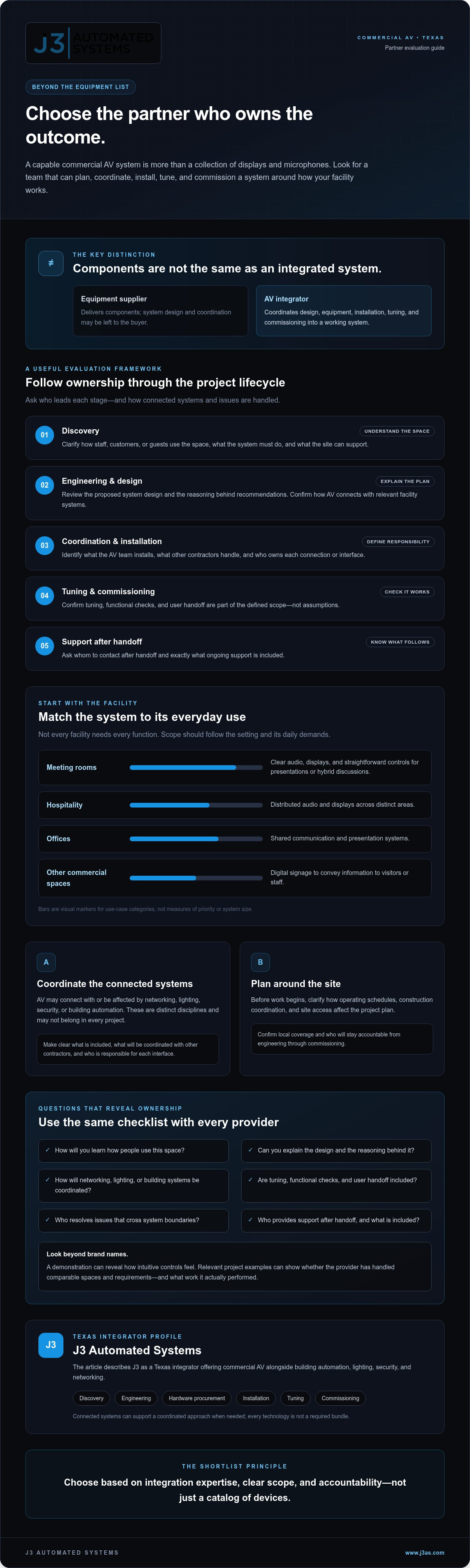
This guide will help you compare providers against your facility’s needs, check local coverage, and understand what a well-managed project should include. We’ll cover discovery, system design, installation, and commissioning, along with questions that reveal whether a team can coordinate the technologies your project requires. The goal is a shortlist based on integration expertise and accountability, not just a catalog of devices.
Key Takeaways
- Compare commercial audio visual companies texas by who leads design and coordinates the project, not simply by the equipment each provider lists.
- Use a consistent checklist to assess discovery, engineering, installation, commissioning, and support after handoff.
- Match the AV system to how your facility is used, then ask how each recommendation addresses those needs.
- Clarify how operating schedules, construction coordination, and site access affect the project plan before work begins.
- Look for a partner with a defined project lifecycle and the ability to coordinate AV with relevant building systems.
What Commercial Audio Visual Companies in Texas Actually Deliver
A commercial AV integrator does more than supply screens and speakers. It coordinates system design, equipment, installation, tuning, and commissioning so the components work together for the way a business uses its space. An AV integrator delivers a working system; an equipment supplier delivers components.
The distinction matters when you compare commercial audio visual companies texas. Permanent workplace and venue systems are planned for regular use, with equipment and controls suited to the space. Event production and rentals support temporary occasions, while standalone hardware sales typically leave system design and coordination to the buyer. For a neutral overview of the broader technology category, see Audiovisual (AV).
Which commercial spaces benefit from integrated AV?
The right scope depends on the setting and its daily demands. Meeting rooms may need clear audio, displays, and straightforward controls for presentations or hybrid discussions. Hospitality venues may use distributed audio and displays across distinct areas. Offices can benefit from shared communication and presentation systems, while other commercial spaces may use digital signage to convey information to visitors or staff. Not every facility needs every function.
What belongs in a commercial AV project scope?
A well-defined project begins with discovery: understanding how people use the space, what the system needs to do, and what the site can support. The integrator then develops the system design, coordinates appropriate hardware, and plans installation. Tuning and commissioning check that the system operates as intended and that users can work with it. Ask which team owns each stage and how issues between connected components will be resolved.
Related systems should be clearly scoped, not assumed. Lighting, security, networking, and building automation can affect or connect with AV, but they are distinct disciplines and may not belong in every project. Confirm what is included, what will be coordinated with other contractors, and who is responsible for each interface.
J3 Automated Systems is a Texas integrator offering commercial AV alongside building automation, lighting, security, and networking. Its project-based work can include discovery, engineering, hardware procurement, installation, tuning, and commissioning. That range can support a coordinated approach when a facility needs connected systems, without making every technology a required bundle.
How to Evaluate Commercial AV Companies in Texas Beyond the Equipment List
Comparing commercial audio visual companies texas is more useful when you look beyond model numbers and product brands. A strong proposal shows how the provider will turn your operational requirements into a system that is installed, tested, and ready for use. Evaluate accountability across the full project lifecycle rather than inferring it from an equipment list.
Use this framework to build a shortlist:
- Discovery: Does the provider ask how staff, customers, or guests will use the space?
- Engineering: Can the provider explain the proposed system design and the reasoning behind it?
- Coordination: Does the proposal identify connections and responsibilities involving networking, lighting, or building systems?
- Commissioning: Are tuning, functional checks, and user handoff defined in the scope?
- Support: Does the proposal clarify whom to contact after handoff and what support is included?
A demonstration can show how intuitive the controls feel, while relevant project examples help you assess whether a provider has handled comparable spaces and requirements. Ask what each example involved and which work the provider performed. A list of well-known brands alone cannot show how the design addresses your room, how components interact, or who will resolve an issue that crosses system boundaries.
For another reference point, review AVIXA standards and ask providers how recognized industry guidance informs their design and delivery practices. A standards reference can make technical discussions more specific, but it does not replace a clear project scope.
Questions to ask before selecting a Texas AV integrator
Ask how the provider translates operational requirements into a documented design, and request enough detail to understand the system’s intended functions. Confirm which installation, tuning, commissioning, and handoff tasks are included. Then ask who provides support after handoff, how that support is defined, and who takes ownership when connected equipment does not work together as expected.
How to compare proposals without comparing equipment alone
Compare each proposal against the same requirements. Review the system architecture, included labor, commissioning activities, and stated exclusions. Check whether the provider explains how AV will connect with relevant networking, lighting, or building systems, and which party owns each interface. A familiar brand or shorter equipment list is not automatically a better fit. The proposal should explain how its choices serve your facility’s needs.
For a closer look at how one Texas provider approaches connected commercial systems, explore commercial systems integration and compare its project scope with your requirements.
Match a Texas Commercial AV Company to Your Facility and Use Case
A system that suits a conference room may not suit a customer-facing venue. Before comparing commercial audio visual companies texas, describe how people use each space, who operates its technology, and what the system needs to support. Evaluate providers against those needs rather than assuming one standard configuration fits every facility.
| Facility use | AV functions to consider | Questions for the provider |
|---|---|---|
| Meeting-focused spaces | Room audio, displays, video conferencing, and room controls | How will the design account for room layout, meeting workflows, and network dependencies? |
| Customer-facing venues | Distributed audio, video displays, digital signage, and centralized control | Who operates the system, and how will its functions fit venue operations? |
| Multi-use environments | Flexible display and audio functions, with controls suited to different uses | Which capabilities need to adapt between uses, and what coordination does that require? |
Commercial AV priorities for meeting and collaboration spaces
Start with the meetings themselves. A room used for presentations may prioritize display visibility and clear speech. A space for video conferences may need audio and camera coverage suited to its layout. For facilities planning internal broadcast or high-end recording suites, resources from United Broadcast & Media Solutions (UBMS) offer guidance on professional camera hardware and optics. Ask how users will start and control a session, and whether the proposed workflow matches how staff work. Confirm what network infrastructure the system depends on and who coordinates that connection.
Commercial AV priorities for venues and customer-facing spaces
For a venue, assess how audio, displays, and signage fit the guest experience and staff routines. WorldSprings offers an example of venue technology combining AV, lighting, and digital signage, but its approach is not a template for every property. For broader inspiration on how specialized video walls and large-format screens are engineered, teams can look to international integrators like etavisual.com to benchmark modern commercial LED display applications. Ask providers to explain how their design responds to your spaces, operating patterns, and control needs.
Related systems may be relevant, but only where the facility’s requirements call for them. Lighting may need to coordinate with room use, resilient networking can support connected AV, and building automation may be appropriate where HVAC or other building controls intersect with operations. Define each discipline and its owner in the project scope. If protection systems enter the discussion, clarify who is responsible for that work and how it connects with AV rather than assuming it belongs in the AV package.
For multi-use environments, identify which functions must change between activities and who will manage those changes. A provider should explain the proposed configuration and its dependencies without adding systems the facility does not need.
What to Expect from Commercial AV Design and Installation in Texas
A well-managed AV project follows a sequence, with decisions made early enough to coordinate the system with the facility and its operations. Before selecting among commercial audio visual companies texas, confirm that the provider can explain each stage, identify who owns it, and account for your location, schedule, and site conditions.
From discovery to a coordinated AV design
Discovery should establish what the facility needs the system to do, who will use it, how each room functions, and what infrastructure or operating constraints may shape the design. A site review helps identify practical conditions that affect equipment placement and installation planning. If AV needs to connect with networking, lighting, security, or building automation, ask how those dependencies will be mapped and which project partners are responsible for each connection.
A clear scope distinguishes the integrator’s design work from information or work other partners must provide. It should also reflect operating schedules, construction sequencing, and facility access. Installation in an occupied space, for example, may need to be coordinated around room use. A project underway during construction may depend on decisions and site access being available at the right stage.
Commissioning, handoff, and support after installation
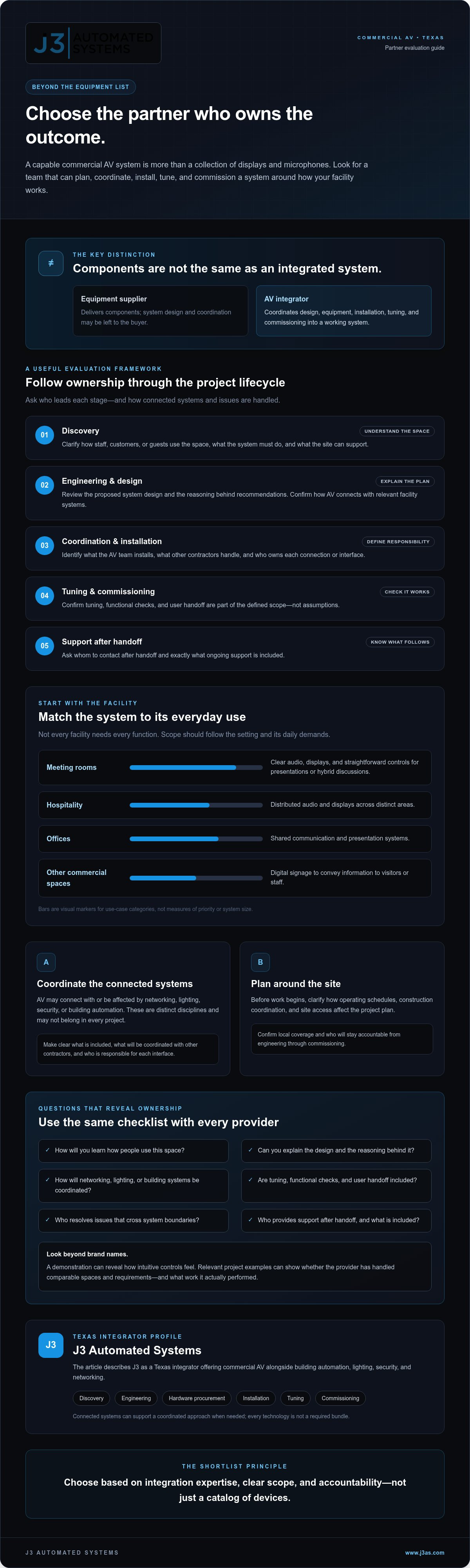
Expect the project to move through defined steps:
- Discovery and site review: Document goals, users, room functions, existing infrastructure, and site constraints.
- Design and coordination: Set out the system, confirm responsibilities, and coordinate relevant connections with other project partners.
- Installation and tuning: Install the approved system and adjust it for the intended space and use.
- Commissioning and handoff: Check that the installed system operates as intended, then provide agreed documentation and staff orientation.
Before approving a proposal, document what commissioning includes, who will orient staff, what system documentation will be provided, and which support contact handles questions after handoff. Clarify responsibility boundaries as well. If an issue involves AV and another connected system, the agreement should explain how ownership is determined rather than leaving staff to coordinate vendors without guidance.
Texas buyers should confirm that a provider covers their specific project location and clarify any travel, site access, or local coordination responsibilities before work begins. Do not infer statewide availability from a general Texas presence. J3 Automated Systems serves commercial clients across Texas and handles project-based engineering, installation, tuning, and commissioning. Verify current coverage for your location directly.
To discuss your facility’s requirements and project scope, contact J3 Automated Systems about your project.
Why Consider J3 Automated Systems for Commercial AV in Texas
For commercial clients comparing commercial audio visual companies texas, J3 Automated Systems is a Texas integrator to consider when a project calls for AV coordinated with other building systems. Its work spans AV, lighting, security, networking, and building automation, with a team that can plan and deliver tailored projects across connected disciplines.
A single accountable team across connected systems
When technologies intersect, clear ownership can help keep a project coherent. J3’s project lifecycle can include discovery, engineering, hardware procurement, installation, tuning, and commissioning. The scope is shaped around the facility’s requirements rather than assuming every client needs every available system. One project may focus on AV, while another may also need coordination with relevant lighting, networking, security, or building automation systems.
If HVAC or building management system requirements are part of your project, define those needs separately and confirm how they relate to the AV scope. Review a Texas commercial building management systems guide as you prepare to discuss control requirements, interfaces, and responsibility boundaries with your project team.
J3’s stated commercial service communities include San Antonio, New Braunfels, Seguin, Bandera, Boerne, Austin, and San Marcos. Confirm current availability for your location and clarify which project stages and connected systems J3 would own before proceeding.
Prepare for a useful first project conversation
A focused initial discussion starts with the facility and its use, not a predetermined equipment list. Outline the type of space, who will use it, the AV functions you are considering, and the project stage, such as early planning, design, or construction. Note existing infrastructure, operating constraints, and any other teams or contractors involved. These details help establish what needs to be assessed before a solution is proposed.
Bring questions about how the project will move from discovery and engineering to installation and commissioning, what information the team needs from you, and how responsibilities will be documented. A useful discussion should clarify requirements and scope before technologies are selected, giving both sides a grounded basis for next steps.
Discuss your commercial AV project with J3, including your facility, requirements, location, and project scope.
Choose a Partner Built Around Your Facility
The strongest AV proposal is not necessarily the one with the longest equipment list. Choose a partner who can connect your facility’s requirements to a clear design, defined responsibilities, and a coordinated path through installation and commissioning. As you compare commercial audio visual companies texas, prioritize system fit and project accountability, then confirm what handoff and ongoing support include.
J3 Automated Systems works with commercial clients on integrated AV, lighting, security, networking, and building automation. Its project-based services include engineering, installation, tuning, and commissioning. Stated Texas service communities include San Antonio, New Braunfels, Seguin, Bandera, Boerne, Austin, and San Marcos. Confirm current project availability for your location and discuss which systems belong in your scope.
Share your facility type, user needs, project stage, and any connected systems you are considering to begin a focused conversation. Discuss your commercial AV project with J3. A clear scope and accountable partner can help you move forward with a better understanding of the work involved.
Frequently Asked Questions
What do commercial audio visual companies in Texas do?
Commercial AV companies plan and deliver systems that support communication, content, and control in workplaces and venues. Projects may include meeting-room audio and displays, video conferencing, distributed audio, digital signage, or centralized controls. Full-service integrators can also handle engineering, equipment coordination, installation, tuning, and commissioning. The scope depends on how the facility operates, so clarify whether a provider is responsible for the complete system or only selected equipment or services.
How do I choose a commercial AV integrator in Texas?
Choose a provider that can translate your facility’s needs into a documented design and explain who owns each project stage. Ask about discovery, engineering, installation, tuning, commissioning, and post-handoff support. Request relevant project examples and a clear scope listing inclusions, exclusions, and coordination responsibilities. For a Texas project, confirm the provider’s current coverage for your location rather than assuming a general state presence means service is available everywhere.
What is the difference between an AV company and an AV integrator?
An AV company is a broad description that may include equipment suppliers, event production providers, rental companies, or permanent-system integrators. An integrator coordinates the design and components of a lasting system, then manages agreed installation and commissioning work. Ask who creates the system design, who connects the equipment, and who resolves problems across components. Those responsibilities, rather than a company label, show whether the provider is delivering an integrated project.
Can commercial AV work with lighting and building automation?
Yes, AV can be coordinated with lighting, networking, security, or building automation when the facility’s requirements call for it. For example, a business may want room controls to work alongside presentation equipment or need AV planned in coordination with its network. These are distinct disciplines, so establish what belongs in the AV scope, who is responsible for each connected system, and how interfaces will be documented. Not every project needs every technology.
What happens during commercial AV installation?
Installation typically follows discovery and design, with the team coordinating equipment, site conditions, facility access, and other project work before installing the approved system. After installation, tuning and commissioning check that it operates as intended for the planned use. Before work begins, agree on the installation scope and schedule. At handoff, confirm what documentation and staff orientation are included, whom to contact with questions, and how post-installation support is defined.
Do commercial AV companies serve businesses outside major Texas cities?
Some providers work beyond major city centers, but coverage varies by company and project. J3 Automated Systems’ stated Texas service communities include San Antonio, New Braunfels, Seguin, Bandera, Boerne, Austin, and San Marcos. If your facility is elsewhere, confirm current availability directly and ask about site visits, travel, access, and project coordination. Do not assume that a company serving Texas cities automatically covers every town or location statewide.
How can I compare commercial AV proposals fairly?
Give each provider the same facility requirements and compare proposals against a shared checklist. Review the system design, included equipment and labor, installation, tuning, commissioning, handoff, support terms, and stated exclusions. Check whether each proposal explains dependencies on networking, lighting, or building systems and identifies who owns the coordination. A familiar brand or shorter equipment list does not automatically mean a stronger fit. Assess how clearly the proposed scope serves your actual use case.